
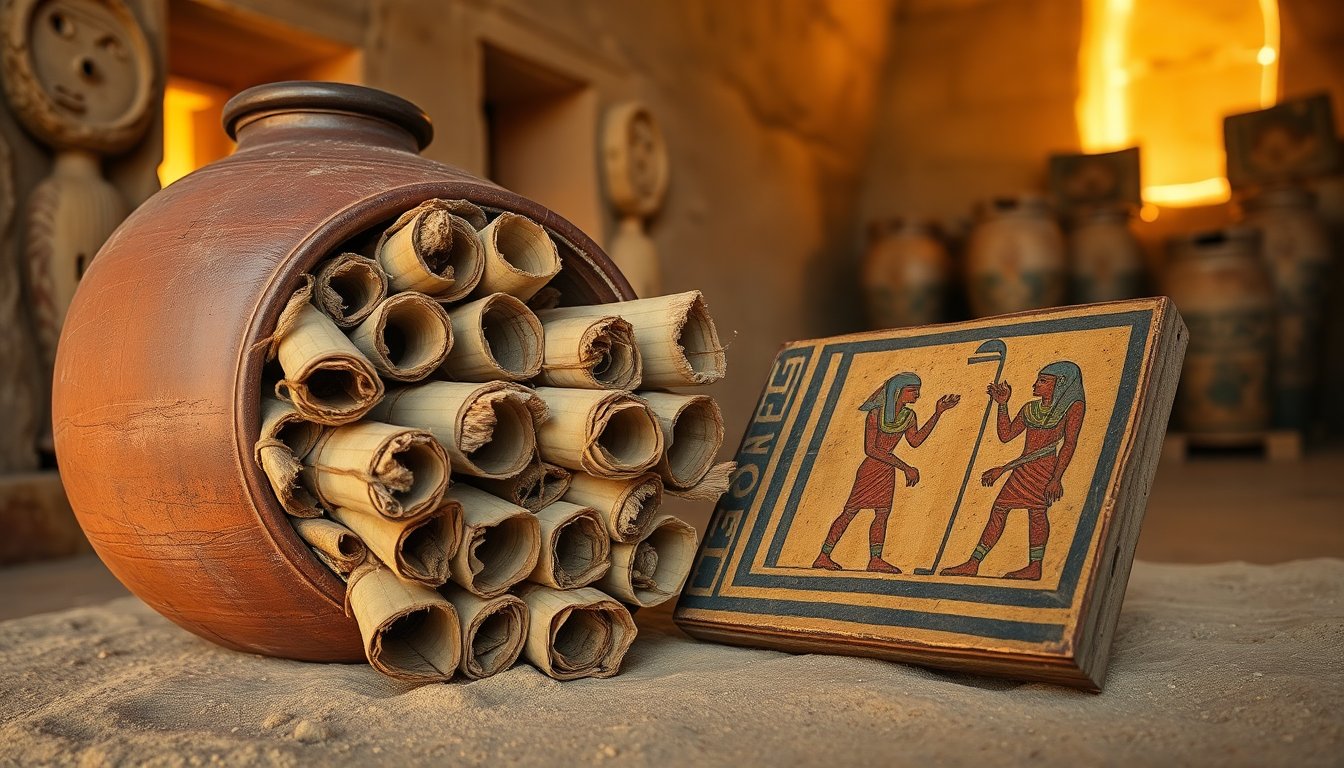
The archaeological mission working on Luxor’s West Bank recently exposed a remarkable assemblage: multiple papyrus scrolls protected inside a large pottery vessel and a nearby rock-cut funerary space crammed with painted coffins. The documents have been dated to the Third Intermediate Period (1070 B.C. to 664 B.C.), a span of Egyptian history that scholars treat as a complex and transformative era. Some of the scrolls still display their original clay seals, which functioned as the ancient equivalent of a do not open notice. For now these seals remain intact while conservators plan the careful work needed before any translation can begin.
The burial chamber and its occupants
The funerary chamber, carved into the living rock near Qurna and close to the tomb of Seneb, contained rows of vibrantly painted coffins stacked in a tight, space-efficient layout. Excavators report the burial assemblage primarily lists professional titles rather than personal names, with the label “Chanter(s) of Amun” recurring frequently. In this context, chanters refers to temple singers and ritual specialists attached to the cult of the god Amun, an institutional class whose practices are only partially documented in surviving records. The arrangement of the coffins — lids separated from boxes and organized in ten horizontal rows — demonstrates ancient planners prioritized capacity and preservation even within confined chambers.
Condition and immediate measures
Although the painted surfaces preserve lively pigments, much of the wood used for the coffins shows signs of deterioration, prompting an urgent conservation response. The mission’s restoration team began targeted interventions to stabilize fragile wood fibers and to consolidate weakened layers of painted plaster. Mechanical cleaning methods have been used with extreme care to remove deposits without stripping the original polychromy. These emergency treatments are intended to buy time: conservators must arrest ongoing decay before more invasive conservation or documentation proceeds, and every action is being logged so subsequent analyses will have a clear record of treatment history.
The sealed papyrus cache and what it might hold
The pottery jar that yielded the scrolls appears to have functioned as a private archive or ritual deposit. Archaeologists report the cache includes eight rare papyri of varying sizes, some encased with their original clay seals. Until conservators complete the delicate processes of cleaning, humidification, and repair the texts will remain unread. Once prepared, the manuscripts will undergo philological examination and translation, a stage that may reveal administrative records, liturgical texts, or personal notations associated with the temple personnel interred nearby. Because the titles on the coffins emphasize institutional roles, researchers expect the documents to shed light on the social and religious life of temple staff during the Third Intermediate Period.
Scholarly expectations and challenges
Experts are cautiously optimistic that the scrolls could illuminate the repertoire, duties, and organization of the chanters, but several challenges lie ahead. Fragmentation, ink fading, and the presence of carbonized or brittle fibers will complicate transcription. The conservators’ work must therefore proceed in parallel with imaging campaigns, such as multispectral photography, to enhance legibility. If the texts contain musical notations, ritual instructions, or payroll-like entries, they would open new avenues for understanding the economic and devotional networks that sustained temple personnel. Even evidence limited to titles and formulaic phrases would refine our picture of how religious labor was categorized during this period.
Broader context and recent discoveries in Egypt
Officials, including Tourism and Antiquities Minister Sherif Fathy, have described the find as a significant addition to the country’s archaeological record and a demonstration of continued state support for systematic research. The mission’s announcement arrives amid a string of other notable discoveries: teams have recently revealed early Christian monastic complexes in Wadi El-Natrun and a multiroom monastic guesthouse dating to the fifth century. Separately, hypotheses about subsurface features under the Giza Plateau continue to provoke debate, with radar-based claims of additional buried structures meeting healthy scientific skepticism. Together, these investigations underscore how ongoing fieldwork across Egypt is expanding understanding of ancient religious communities of different eras.
For now the most tantalizing elements of the Luxor cache — the sealed scrolls and the vividly painted coffins of the Amun chanters — remain under conservation and cataloguing. When experts complete the painstaking processes of stabilization, imaging, and linguistic analysis, the texts and material culture recovered from the site will likely provide both specific data about temple personnel and broader insights into the practices and priorities of a long-neglected historical period.


