
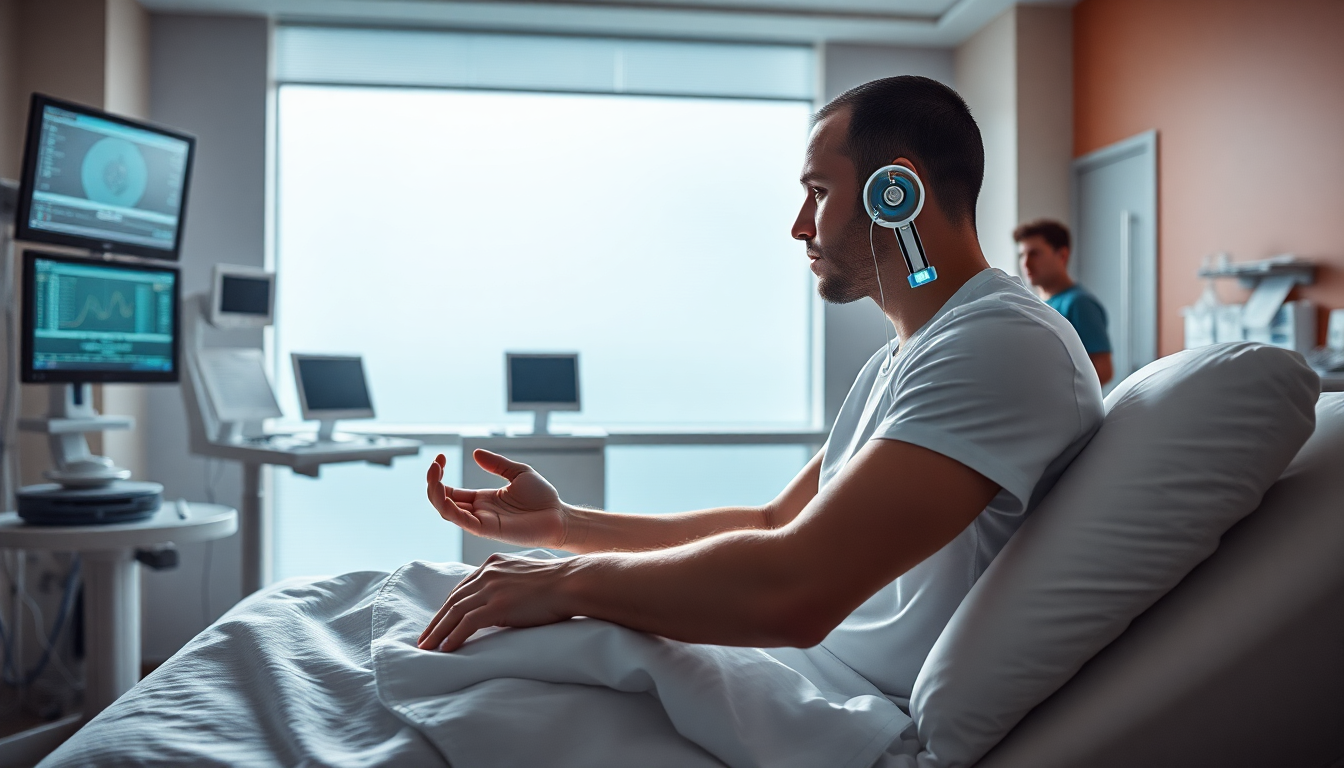
Imagine being utterly trapped in your own body, a prisoner of circumstance after a catastrophic accident. This isn’t a scene from a dystopian novel but a harsh reality for one man who lost all of his limbs due to a high-voltage electrical mishap over a decade ago. Now, after years of darkness, he finds a flicker of hope, thanks to a revolutionary brain implant that allows him to control a cursor on a screen. How did we get here? And what does it mean for the future of technology and humanity?
The groundbreaking trial
In March, researchers embarked on what can only be described as a Herculean task. They implanted a device the size of a coin into the man’s brain, alongside a series of electrodes that would serve as the bridge between his thoughts and the digital realm. A few weeks later, the impossible became possible: he could manipulate a cursor, play chess, and even dive into video games with a near-normal level of proficiency. Isn’t it astonishing? Or is it just another peek into the abyss of our technological obsession?
What’s next for the tech?
This isn’t just a one-off miracle. The researchers, with their sights set high, plan to expand their trials to patients suffering from paralysis or ALS, with small-scale tests scheduled for this year. Bigger plans are afoot, too—up to 40 patients will be involved in trials by 2026. But here’s a kicker: while this technology holds immense promise, it also raises eyebrows about where we’re headed. Are we opening doors to a future where technology becomes a crutch rather than a tool? Or perhaps, we’re edging closer to becoming mere extensions of our devices?
The players involved
This ambitious endeavor is spearheaded by the Chinese Academy of Sciences’ Centre for Excellence in Brain Science and Intelligence Technology, in collaboration with Huashan Hospital, affiliated with Fudan University in Shanghai. Industry partners are also in the mix, suggesting that the stakes—and the money—are incredibly high. But let’s be real: who wouldn’t want to invest in technology that could redefine the limits of human capability? It’s a thrilling prospect, but also a slippery slope. Are we ready to grapple with the moral implications of such advancements?
As the trials progress, one can’t help but wonder about the psychological toll on participants. Will they emerge as champions of resilience, or will they find themselves lost in a maze of expectations? And what about society? Are we prepared to embrace these changes, or will we cling to our outdated perceptions of disability and capability?
With each advancement, we’re invited to reflect on our humanity, our ethics, and how we define what it means to be ‘normal.’ But let’s face it: in a world increasingly dominated by technology, are we becoming the very machines we’re trying to control? Perhaps this is just the beginning of a long, complicated relationship between human beings and the devices we create. So, as we stand on the brink of this new era, the questions linger. Will this be a triumph of human ingenuity or a descent into techno-chaos? Only time will tell.


