
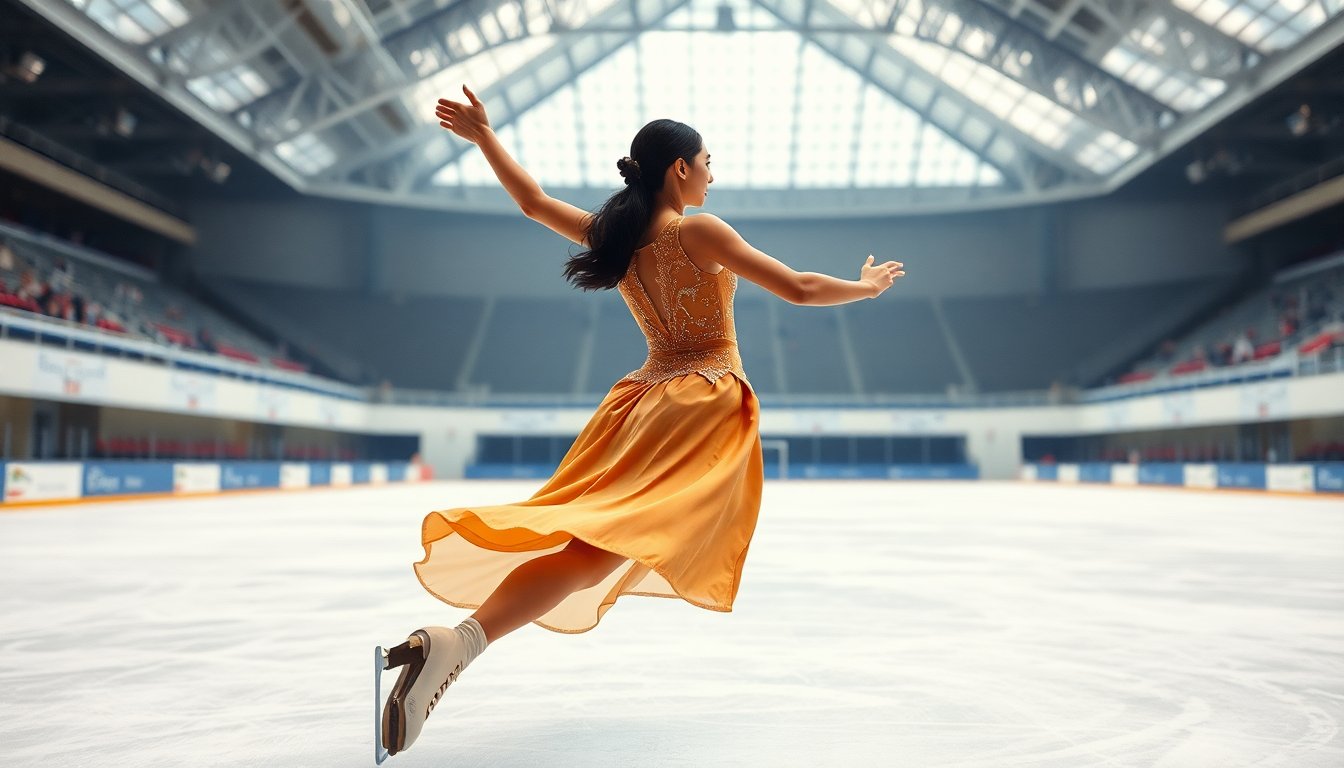
Alysa Liu ended a long drought for U.S. women’s Olympic figure skating with a commanding free skate at the Milan-Cortina Games, skimming the ice in a golden dress and leaving little room for doubt. The 20-year-old from the San Francisco Bay Area combined daring jumps with composed presentation to post a career‑best 226.79 points on Feb. 19, — a performance that felt both inevitable and electric.
The program itself was a study in balance. Liu opened with clean triples and quads, kept her speed through the latter half, and landed the kinds of rotations that judges favor under the current scoring system. Her costume complemented the skating — eye-catching enough to frame the performance but never stealing focus from her lines or timing. Technical panels verified the content and grades of execution that produced her highest total to date, and the scoreboard reflected both the difficulty she attempted and the quality with which she executed it.
The podium race tightened in the final moments. Two challengers skated after Liu, each attempting high-value elements that could have swung the outcome. Small execution slips, however — an under-rotation here, a wobble there — changed the math. Japanese veteran Kaori Sakamoto finished a hair behind with 224.90 points for silver, while Ami Nakai took bronze at 219.16. Those margins were wafer-thin, a reminder that in modern judging the difference between a medal and fourth place often comes down to fractions and flawless transitions.
More than just a personal triumph, Liu’s victory carried broader significance. She returned to elite competition after a break following Beijing and did so with composure, resilience and a program that married technical ambition to musicality. That narrative — the comeback, the high-stakes execution, the calm under pressure — resonated across the sport and beyond, amplifying her win into a cultural moment for American skating.
Coaches, judges and sports scientists all noticed two recurring strengths: Liu’s jump difficulty and her ability to deliver under pressure. Analysts praised how she managed risk across the program, inserting her highest-value elements where they would count most while preserving component scores through steady transitions and clean edges. Sports medicine experts also pointed to her staged return to competition as a model of cautious load management and progressive training: a path that allowed her to expand technical content without sacrificing consistency.
Expect other national teams to respond. Federations and coaches are already eyeing their programs’ risk profiles, debating when to chase base value and when to bank secure points. The prevailing trend seems to be staged risk — pushing for technical advances but within controlled windows so athletes can rely on consistent elements elsewhere in the program. That approach rewards reliability, especially in multi-segment events where one mistake can erase the benefit of a quad or other high-difficulty jump.
American teammates provided complementary storylines that night. Amber Glenn rebounded from a shaky short program to deliver a season-best free skate and finished fifth 91 points. Her emotional reaction in the kiss-and-cry and that fleeting celebration while sitting in the leader’s chair were among the evening’s most human moments. Isabeau Levito skated with characteristic grace but fell on an opening triple flip — a reminder that even the smallest errors can be decisive.
The technical drama extended beyond the podium. Eighteen-year-old Adeliia Petrosian, competing as a neutral athlete, attempted the only quad in the women’s free skate — a quad toe loop — but fell. She completed the rest of her routine cleanly and finished close behind the leaders. Her run highlighted the trade-off every coach and skater faces: a successful quad can trump minor GOE deductions, but a fall or severe under-rotation often cancels that advantage entirely.
From a training perspective, teams are likely to increase simulations of competition pressure: leader‑chair moments, televised run-throughs, and scoring-aware practice sessions designed to recreate the stress of a championship. Mental skills training is becoming as integral as jump technique — the ability to reset emotionally after a mistake, or to deliver under intense scrutiny, is now a clear competitive edge.
Strategically, choreographers and technical specialists will work more closely to design programs that protect consistency without dulling artistic impact. Expect more contingency planning: programs with built-in margins that allow skaters to chase technical peaks in specific segments while relying on clean, lower-risk content elsewhere. National federations may refine selection criteria to favor head-to-head results under pressure, rather than isolated demos of technical prowess.
The program itself was a study in balance. Liu opened with clean triples and quads, kept her speed through the latter half, and landed the kinds of rotations that judges favor under the current scoring system. Her costume complemented the skating — eye-catching enough to frame the performance but never stealing focus from her lines or timing. Technical panels verified the content and grades of execution that produced her highest total to date, and the scoreboard reflected both the difficulty she attempted and the quality with which she executed it.0
The program itself was a study in balance. Liu opened with clean triples and quads, kept her speed through the latter half, and landed the kinds of rotations that judges favor under the current scoring system. Her costume complemented the skating — eye-catching enough to frame the performance but never stealing focus from her lines or timing. Technical panels verified the content and grades of execution that produced her highest total to date, and the scoreboard reflected both the difficulty she attempted and the quality with which she executed it.1
The program itself was a study in balance. Liu opened with clean triples and quads, kept her speed through the latter half, and landed the kinds of rotations that judges favor under the current scoring system. Her costume complemented the skating — eye-catching enough to frame the performance but never stealing focus from her lines or timing. Technical panels verified the content and grades of execution that produced her highest total to date, and the scoreboard reflected both the difficulty she attempted and the quality with which she executed it.2