
Table of Contents
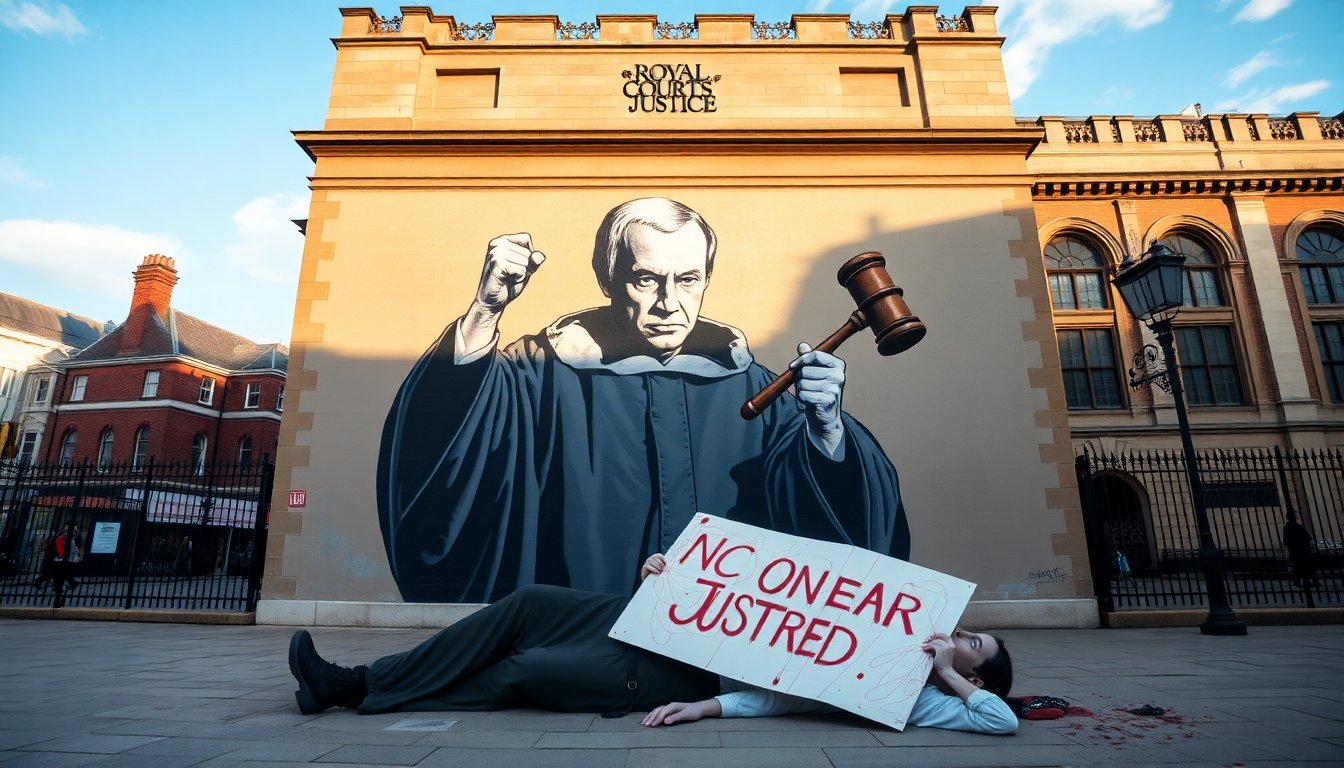
On Monday, a striking new mural by the elusive street artist Banksy appeared outside the Royal Courts of Justice in London, stirring both admiration and controversy. This artwork depicts a judge wielding a gavel against an unarmed protester, a powerful image that speaks volumes about the current state of justice and authority. The mural shows a protester on the ground, holding a blood-spattered placard, while the judge, adorned in traditional attire, delivers a brutal blow. This piece is characteristic of Banksy’s style, which often critiques societal issues through stark visual commentary.
Banksy took to Instagram to announce the mural, captioning it simply, “Royal Courts Of Justice. London.” This method of claiming authenticity is typical for the artist, who has built his reputation around anonymity and provocative statements. However, the immediate response to the mural was one of containment; security officials quickly covered it with black plastic and installed barriers to prevent public interaction. This response underscores the delicate balance between art and the legal implications of its location.
The Legal Implications of Art in Historical Spaces
The removal of Banksy’s mural was swift, driven by the building’s historical significance. The Royal Courts of Justice, a landmark with a 143-year history, is classified as a listed building, meaning it is protected by law due to its architectural and historical value. A spokesperson from HM Courts and Tribunals explained that the removal aligns with regulations designed to preserve the integrity of such sites. “The Royal Courts of Justice is a listed building, and HMCTS are obliged to maintain its original character,” they stated, emphasizing the legal framework surrounding the preservation of historical structures.
This incident raises critical questions about the relationship between public art and legal frameworks. On one hand, the mural is a testament to artistic freedom and the role of art in political discourse. On the other, it highlights the constraints imposed by laws designed to protect heritage. As the public and authorities grapple with this complex dynamic, Banksy’s work continues to challenge perceptions of justice, authority, and the power of art to provoke thought and dialogue.
Public Reception and the Political Commentary of Banksy
Banksy has long been known for his politically charged pieces, often addressing issues like migration and government policies. His work resonates with many, not only as art but as a form of social commentary that reflects the frustrations and challenges faced by society. In a recent example, Banksy’s inflatable raft display at the Glastonbury Festival drew attention to the plight of migrants, further cementing his role as a provocative voice in contemporary art.
The reaction from authorities, such as the U.K. Home Secretary, who labeled Banksy’s inflatable boat display “vile and unacceptable,” illustrates the contentious nature of his work. While critics may view his art as inflammatory, supporters argue it serves as a necessary critique of current policies and societal values. Banksy himself has stated that he feels the backlash against his work is excessive, further igniting discussions about the boundaries of artistic expression and its societal implications.
Conclusion: The Enduring Significance of Banksy’s Art
Banksy’s latest mural not only adds to his extensive portfolio but also reinforces the ongoing dialogue surrounding the role of art in society. As debates about justice, authority, and the value of public art continue to unfold, the artist’s work remains a focal point for discussions about the intersection of creativity and legal frameworks. Whether one views the mural as a mere provocation or a meaningful commentary on the state of justice, it undeniably sparks conversation and reflection, reaffirming art’s power to influence public perception and inspire change.