
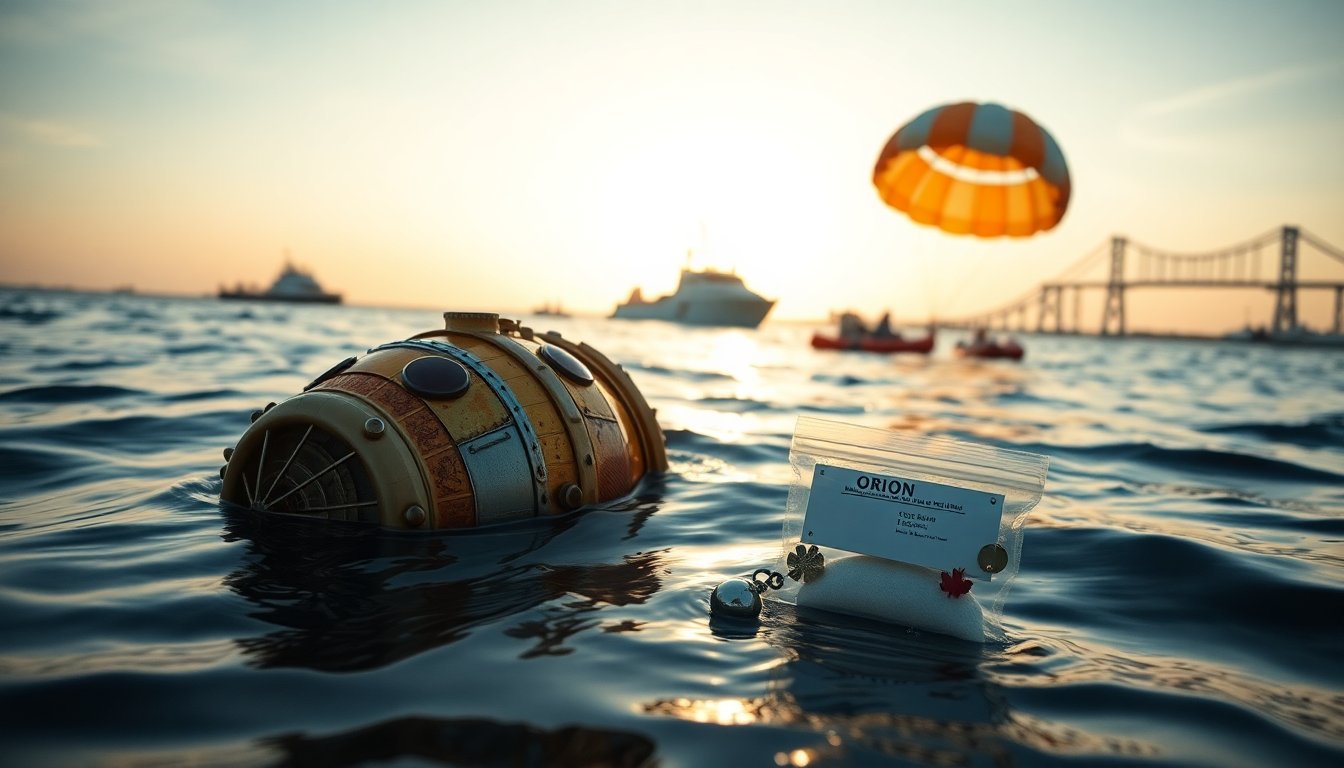
The Artemis II mission marked NASA’s first crewed trip around the Moon in decades, with four astronauts riding the Orion spacecraft back toward Earth after a successful lunar flyby. Launched at 6:35 p.m. EDT on April 1 from Launch Pad 39B at Kennedy Space Center, the crew—Reid Wiseman, Victor Glover, Christina Koch, and Canadian Space Agency astronaut Jeremy Hansen—spent the flight period validating spacecraft systems and performing observations of the lunar surface. Coverage and multimedia from the mission were available in real time on NASA‘s channels and updated daily via briefings from Johnson Space Center, with editorial notes reflecting schedule adjustments published on April 4, 2026 and updated on April 5, 2026 and April 6, 2026.
The crew’s trajectory took them both near and far: the mission was planned as an approximately 10-day journey that would test deep-space operations and culminate in a Pacific splashdown off the coast of San Diego. Over the course of the flight the vehicle was expected to travel roughly 695,081 miles from launch to splashdown and to approach within about 4,070 miles of the lunar surface at closest pass. During the lunar encounter the spacecraft reached a maximum distance from Earth of 252,760 miles, surpassing the human distance record set by Apollo 13 by roughly 4,105 miles.
Mission timeline and re-entry choreography
The final hours of Artemis II followed a tightly choreographed sequence to ensure a safe return. Before atmospheric entry, the Orion service module separated to expose the heat shield, and the crew module executed a brief burn to set the craft on the correct entry angle. As the capsule met Earth’s atmosphere it endured extreme heating—temperatures near 3,000 degrees Fahrenheit—and the planned trajectory produced peak deceleration forces up to about 3.9 Gs. Mission planners forecasted a short communications blackout as plasma enveloped the vehicle while the craft descended at hypersonic speeds, a standard risk during high-speed Earth entries from lunar distance.
Critical times for descent and splashdown
The timeline published by NASA outlined the sequence in detail: at 7:33 p.m. the crew module separates from the service module; at 7:37 p.m. an 18-second raise burn aligns the heat shield; by 7:53 p.m. Orion typically encounters the upper atmosphere and the comms blackout begins; at around 8:03 p.m. drogue parachutes are expected to deploy near 22,000 feet; shortly after at 8:04 p.m. the main parachutes take over; and the planned splashdown time was approximately 8:07 p.m. EDT (5:07 p.m. PDT) on Friday, April 10. Recovery forces stood ready to retrieve the crew and transport them to the USS John P. Murtha for medical checks.
Onboard operations, observations, and scientific aims
While in lunar space, the astronauts exercised both automated and manual controls to evaluate the spacecraft’s life-support, propulsion, power, thermal, and navigation systems—core objectives for future crewed lunar operations. Crew activities included an extended period of lunar observation during which the team planned to split into shifts to photograph and visually inspect both near and far sides of the Moon. These human observations complement robotic data because trained eyes can perceive subtle color and texture differences that automated sensors may not synthesize in context, helping refine landing site science and future mission planning.
Payloads, crew comfort, and outreach elements
Orion carried a range of equipment for engineering, science, and public engagement: 32 cameras (fifteen vehicle-mounted and seventeen handheld) supported imaging needs, and flight hardware plus data returns were priorities for assessment. For crew wellbeing the flight menu included 189 unique items and a selection of beverages to support nutrition and morale. The crew also brought a symbolic mascot: the plush named Rise served as the mission’s zero-gravity indicator to visually mark transitions into weightlessness; the item was chosen through a global design challenge and fabricated for flight.
After splashdown, recovery procedures called for rapid extraction by naval teams and helicopter transport to the USS John P. Murtha, where the astronauts would undergo post-mission medical evaluations before returning to NASA’s Johnson Space Center. Throughout the mission, NASA provided frequent status briefings, live downlinks with the crew, and continuously refreshed imagery for scientists and the public, ensuring transparency as Orion demonstrated capabilities that will underpin future Artemis lunar surface operations.


