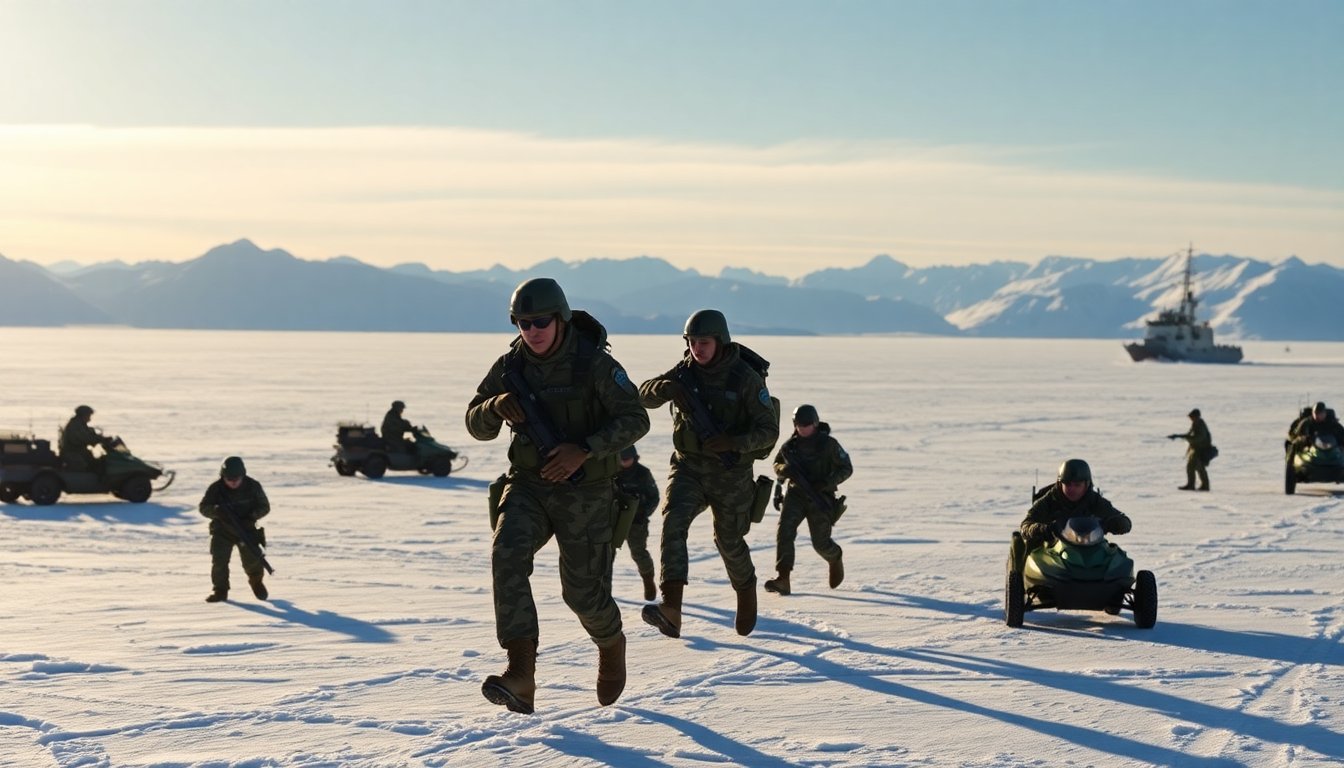
In one of the most isolated parts of Canada, over 3,000 kilometers from the capital, a large assembly of the Canadian Armed Forces convened to address a pressing question: how can they effectively board a foreign vessel determined to remain undetected? This scenario reflects real concerns for national security in the North.
The annual drill, known as Operation Nanook, has gained heightened significance due to evolving geopolitical dynamics, particularly with China’s increasing assertiveness in the Arctic. Prime Minister Mark Carney has advocated for an expansion of military capabilities, emphasizing the growing importance of northern mineral resources.
The geopolitical landscape and Arctic interests
The Arctic is becoming a focal point for nations seeking to capitalize on its rich natural resources, including minerals such as copper, nickel, lithium, graphite, and cobalt. China’s ambitions in this region are particularly noteworthy, as the country aims to establish control over crucial rare-earth elements and explore investment opportunities within the Canadian Arctic.
Stephanie Carvin, a former national security expert and current academic at Carleton University, notes that China is actively pursuing these strategic interests. The presence of Chinese vessels, such as the Xue Long 2, in Arctic waters has been closely monitored by Canadian military and coast guard operations. This summer, a Canadian CP-140 surveillance aircraft tracked the Chinese research vessel as it returned to the Arctic for the second consecutive year.
Monitoring foreign activities
Independent ship tracker Steffan Watkins reported that a Canadian icebreaker, the CCGS Sir Wilfred Laurier, was closely following the path of the Xue Long 2 as it journeyed from Japan to Alaska. This highlights the vigilance of Canada’s maritime forces in the face of foreign vessels that may have dual purposes, gathering intelligence while posing as research ships.
The potential for espionage is not limited to China; Russia also plays a significant role in Arctic affairs. Both nations employ ‘ghost’ ships that masquerade as ordinary merchant vessels while conducting surveillance and intelligence-gathering activities.
Local implications and community investments
Former Nunavut Premier P.J. Akeeagok has emphasized the need to prioritize the well-being of Northern communities, arguing that economic stability and infrastructure investment are critical for asserting sovereignty in this region. He advocates for essential developments such as hydropower and housing, emphasizing that strong communities are vital for the region’s future.
Recently, the federal government identified a significant Arctic economic and security corridor, proposing various projects that could lead to substantial funding and expedited regulatory processes. This move signals a commitment to enhancing security and improving living standards in the North.
Military exercises and response strategies
During the recent military exercise, the Canadian navy’s HMCS William Hall, one of the newest Arctic patrol vessels, successfully located a suspect ship within hours. This operation demonstrated the navy’s capability to intervene in domestic waters, but highlighted the necessity for law enforcement, such as the RCMP, to be involved in addressing potential threats.
In a simulated scenario monitored by CBC News, RCMP officers apprehended actors posing as suspicious individuals on a remote beach. The exercise included the discovery of a fictional handgun and false Russian military identification, underscoring the seriousness with which the military approaches real-world threats.
The future of Arctic defense
The annual drill, known as Operation Nanook, has gained heightened significance due to evolving geopolitical dynamics, particularly with China’s increasing assertiveness in the Arctic. Prime Minister Mark Carney has advocated for an expansion of military capabilities, emphasizing the growing importance of northern mineral resources.0
The annual drill, known as Operation Nanook, has gained heightened significance due to evolving geopolitical dynamics, particularly with China’s increasing assertiveness in the Arctic. Prime Minister Mark Carney has advocated for an expansion of military capabilities, emphasizing the growing importance of northern mineral resources.1
The annual drill, known as Operation Nanook, has gained heightened significance due to evolving geopolitical dynamics, particularly with China’s increasing assertiveness in the Arctic. Prime Minister Mark Carney has advocated for an expansion of military capabilities, emphasizing the growing importance of northern mineral resources.2