
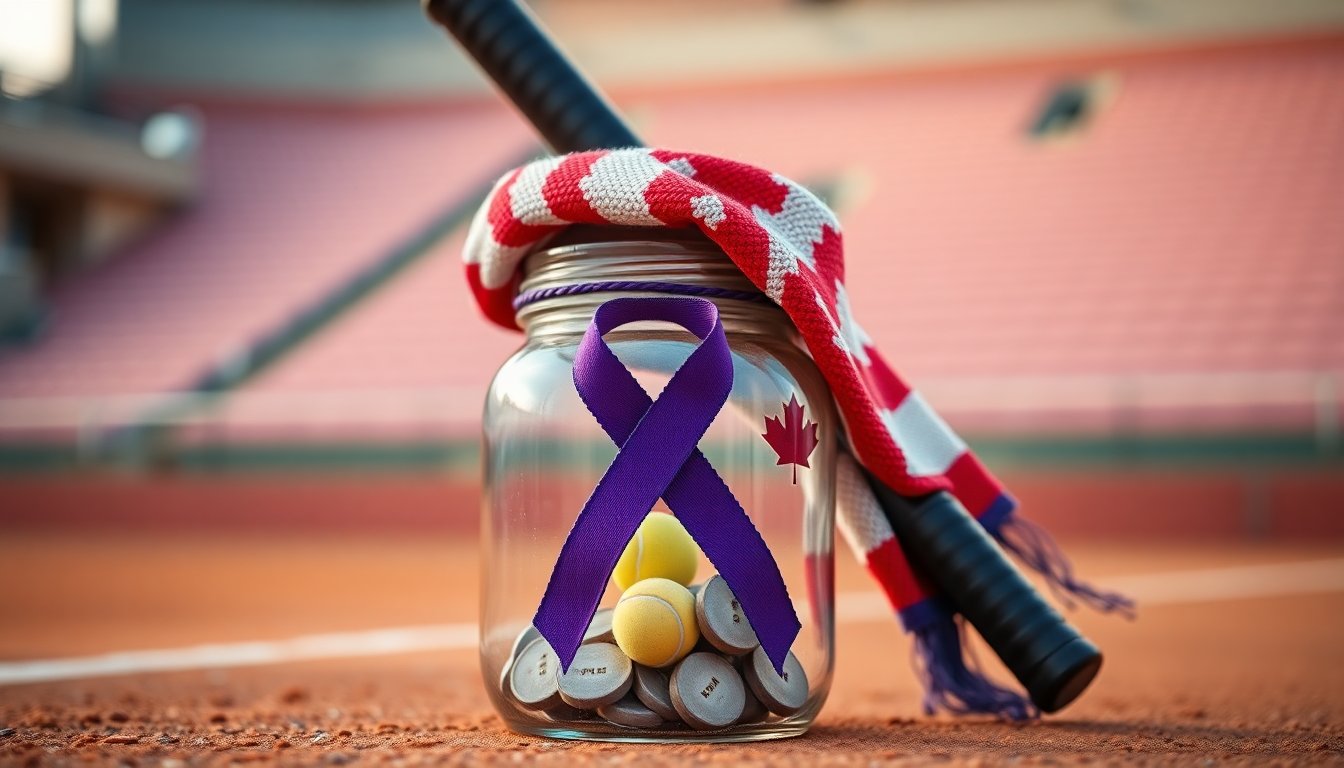
The Ottawa-born doubles specialist Gabriela Dabrowski has turned a streak of strong tournament results into a fundraising effort that ties each on-court game to charitable support. Off the scoreboard she is committing $20 US for every game she wins this season to the 1in3 Fund, a pooled initiative that channels money into groups working to eliminate gender-based violence. So far, the campaign has already generated more than $7,700 US, and Dabrowski is tracking victories with a public target: she hopes to reach 600 game wins this year, a benchmark she calls both measurable and motivating for the initiative she calls Gaby’s Games for Good.
Partnership, momentum and recent results
On the court, Dabrowski has re-established a productive pairing with Brazil’s Luisa Stefani, a team that captured a high-level crown and posted deep Grand Slam runs early in the season. The duo claimed a WTA 1000 doubles title in Dubai and advanced to the semifinals at the Miami Open, following an earlier semifinal showing at the Australian Open. Dabrowski’s broader doubles résumé also includes a U.S. Open victory in 2026 with New Zealand’s Erin Routliffe, underscoring her ability to win at the biggest events. Together with her coaching group, Dabrowski points to consistent communication and shared problem-solving as the backbone of the partnership’s on-court progress.
The relationship with Stefani is the product of several seasons of starts and stops. The pair first teamed up in 2026 and reached the U.S. Open semifinals before Stefani suffered a serious ACL injury that sidelined her. They reunited on tour in 2026 but only this season did their collaboration click again, aided by time spent strengthening their friendship off court. Dabrowski describes the current phase as built on trust and honesty: they give each other straightforward feedback in matches and lean on a support team to navigate tactical adjustments and pressure points during tight fixtures.
Gaby’s Games for Good: the pledge and its purpose
Dabrowski’s fundraising model is intentionally simple: for each game she wins, she donates $20 US to the 1in3 Fund. The name of the fund references the sobering statistic that one in three women and girls aged 15 and older experience physical or sexual violence, a figure that moved Dabrowski to act. Donations from her campaign are distributed across seven global charities supported by the fund, selected for their evidence-based, scalable approaches to preventing and responding to violence against women. Among the beneficiaries is the Kenya Land Alliance, which works on property and land rights for women — an example of how structural change factors into the fund’s strategy.
Origins and motivation
The 1in3 Fund was established following the 2026 killing of Ugandan distance runner Rebecca Cheptegei, an event that sharpened the fund’s urgency and outreach. Cheptegei’s death — a high-profile instance of gender-based violence — prompted athletes and supporters to organize resources for prevention and survivor services across affected regions. Dabrowski has said she does not want that tragedy to fade into a statistic; instead she hopes her campaign and the larger movement generate sustained awareness and concrete aid. The simple per-game pledge makes the link between athletic performance and activism immediately tangible for fans and donors.
Health, injuries and recovery
While pursuing competitive and charitable goals, Dabrowski has managed several medical challenges. A doctor at the Miami Open recommended a scan in 2026 that led to a breast cancer diagnosis and subsequent treatment plan; she now receives long-term medication and follows a schedule of mammograms and MRIs every six months, with results that have been clear so far. Dabrowski emphasizes nutrition, sleep and monitoring to reduce side effects from hormone therapy. Her openness about this journey has been part of her public narrative, pairing athletic resilience with the realities of long-term health maintenance.
Injury management and competition schedule
On top of medical follow-ups, Dabrowski has coped with physical injuries carried over from past seasons, including elbow and shoulder issues, a knee complaint and a left-foot plantar fascia tear. Those conditions forced a withdrawal from Canada’s Billie Jean King Cup roster in Kazakhstan when she recognized she needed more recovery time. She reports committing about two hours a day to rehabilitation as she prepares for an extended European swing of tournaments. The balance of preserving fitness while chasing match wins is central to both her competitive plans and her ability to continue contributing to the charitable pledge.
Looking ahead, Dabrowski remains focused on combining performance with purpose: to compete at a high level with Stefani, to reach her fundraising target, and to keep using her platform to support organizations addressing violence against women. Whether by winning titles or accumulating games, her campaign ties the rhythm of a tennis season to a real-world impact goal, offering a model for how athletes can translate victories into ongoing social investment.


