
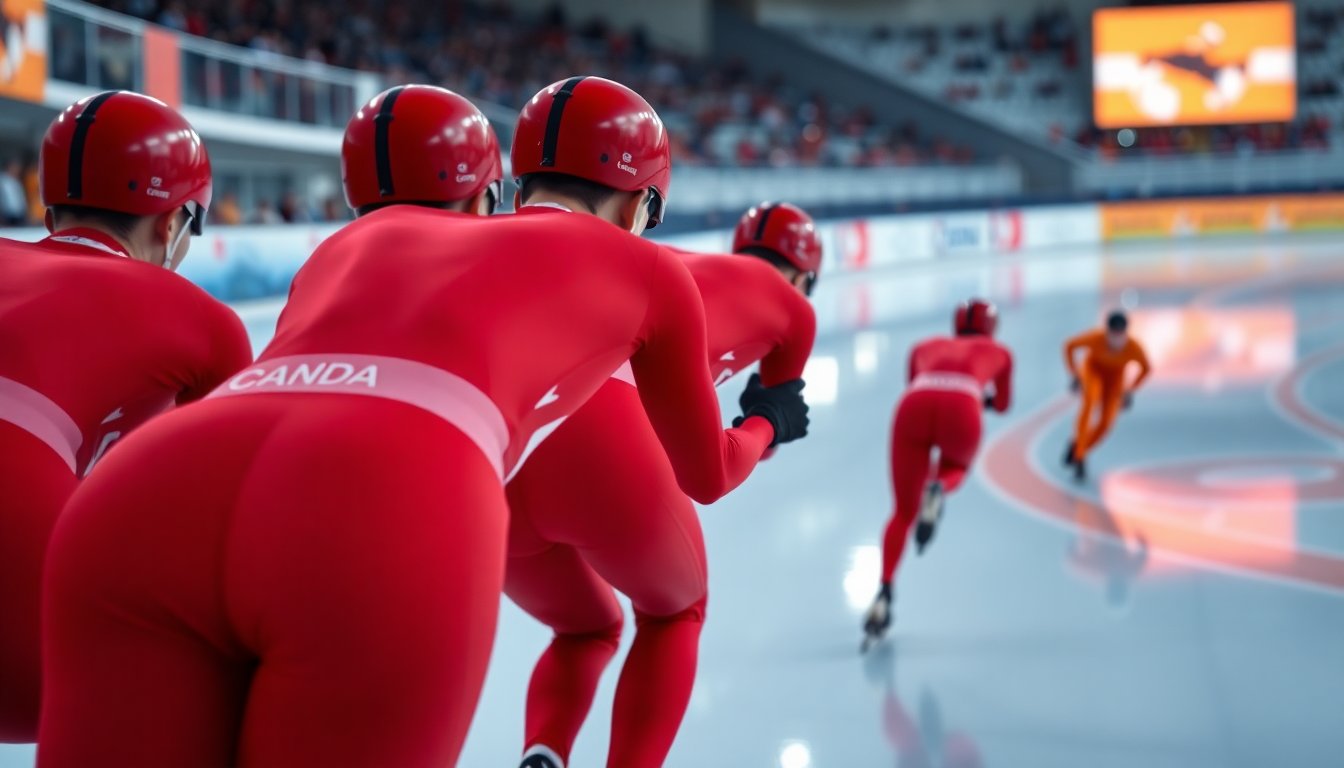
Milano Cortina — Canada’s women made the team pursuit final look almost inevitable on Feb. 17, 2026. Valérie Maltais, Ivanie Blondin and Isabelle Weidemann mixed patient pacing with crisp, economy-minded exchanges to outdistance the United States in the semifinal by a little more than four seconds, booking their place in the gold-medal race.
Waiting for them in the final were the Netherlands, who squeaked past Japan in the other semifinal by barely a tenth. Coaches pointed to the difference-makers in Canada’s performance: disciplined rotations, consistent lap management and virtually flawless handoffs. In an event decided by hundredths, those details can be the margin between gold and silver.
From the opening exchange, Canada set a steady, authoritative tempo. The trio favored long, controlled pulls and stayed tightly bunched down the back straight, neutralizing the short, sharp surges the Americans tried to use as disruptors. Clean exchanges preserved speed through the late laps and turned small efficiencies into a decisive advantage.
That microscopic margin is the sport’s constant: the Dutch-Japan duel showed how quickly the order can change, and officials were watching every transition closely — one particularly close handoff even drew a review, though no penalty followed. Legal, smooth transitions are the invisible currency of team pursuit; when they click, a team gains seconds without dramatic flurries.
Tactically, this isn’t a contest of single, spectacular moves but of relentless, measured execution. Key factors to watch in the final:
– Balanced pacing over six laps so all three skaters have something left for the finish.
– Faultless exchanges and strict lane discipline, since wasted metres or an illegal change can cost tenths.
– The order of rotates: who shelters whom, and when a fresher skater takes the lead.
– Coaching calls that decide whether to probe for a gap or consolidate the rhythm.
Canada’s trio brings an obvious edge: familiarity. Years of skating together has sharpened their timing at exchanges and helped them conserve effort across each lap. The Netherlands counter with raw velocity and technical finesse; if Canada hopes to repeat, their handoffs must be near perfect.
This pursuit sits within a larger Canadian uptick at Milano Cortina. Maltais already picked up bronze in the women’s 3,000 metres and Laurent Dubreuil claimed bronze in the men’s 500 metres, hinting at depth across the long-track squad rather than isolated successes. The coaching staff’s emphasis on regular joint training — balanced with tailored individual plans — appears to be paying dividends, a strategy Blondin and Maltais credited for their readiness.
As the Games move on, selection and load management will be crucial. Coaches will try to keep the core trio intact while protecting individual medal chances through careful recovery plans. The Dutch will test Canada relentlessly at every rotation; the Canadian answer will need to be calm, precise and unflappable. In a race decided by tenths, those qualities could be the difference between gold and silver.