
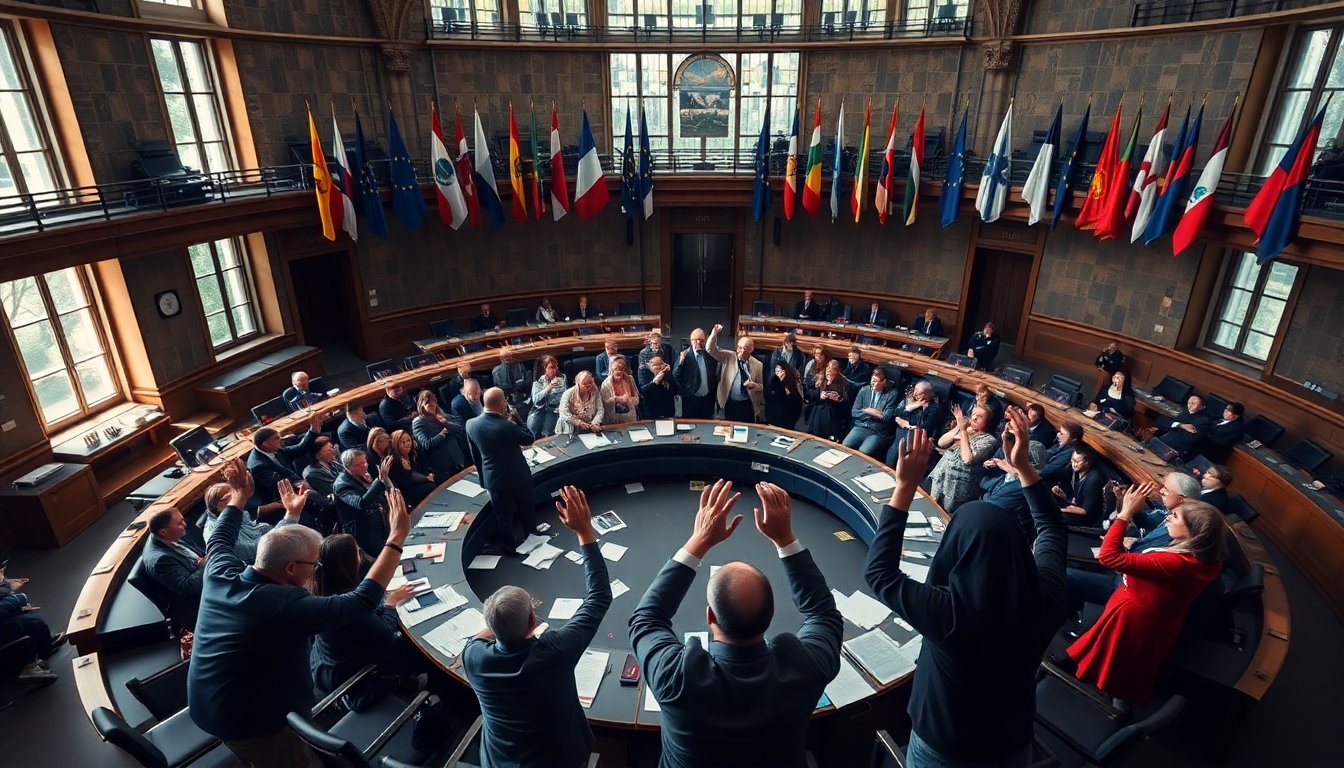
The European Parliament is currently engaged in a contentious debate over a proposal to ban the hijab and other Islamic head coverings for employees within EU institutions. This initiative, led by Charlie Weimers of the Sweden Democrats, has faced considerable backlash from various lawmakers who regard it as a discriminatory measure.
On October 3, an email disseminated among European Parliament members detailed Weimers’ petition, requesting support for a ban on wearing the hijab, niqab, and other Islamic headscarves by civil servants and contracted service providers. Weimers intends to submit the collected signatures to Roberta Metsola, the President of the European Parliament, by the week’s end.
Rationale behind the proposal
In his correspondence, Weimers contends that implementing such a ban would uphold the principles of impartiality, equality, and universality within public service across the EU. He argues that this action would empower women facing Islamic oppression and position the European Parliament as a model of neutrality for member states and global organizations.
Additionally, Weimers’ letter claims that head coverings create practical challenges, complicating security screenings and hindering effective identification of individuals. He emphasizes that smaller religious symbols worn discreetly do not present the same operational risks.
Opposition from fellow lawmakers
However, opposition to this initiative is strong among lawmakers. Martin Schirdewan, co-chair of The Left group, has denounced the proposal as an Islamophobic distraction. He asserts that rather than addressing urgent issues such as inequality, climate change, and housing insecurity, far-right politicians are using this proposal to foster fear and division within communities.
Criticism of the initiative
Another notable critic, Hana Jalloul Muro, a member of the Progressive Alliance of Socialists and Democrats, expressed her dismay at the proposal. She condemned Weimers’ letter for its negative depiction of women who wear headscarves, characterizing it as filled with hatred, sexism, and Islamophobia.
Jalloul Muro stressed that this initiative constitutes a direct attack on the freedom of religion, a fundamental human right within European institutions. She calls for the European Parliament to embody the core values of inclusivity and respect.
Broader implications and historical context
The Sweden Democrats have a history of opposing Islam, previously advocating for a ban on new mosques in Sweden and the demolition of existing ones. This proposal aligns with ongoing discussions in several EU countries, including France, the Netherlands, and Austria, where bans on face-covering garments in public buildings have been enacted.
Despite this, the hijab, which covers the head while leaving the face visible, remains a divisive issue across Europe. The cultural and religious ramifications of such a ban pose critical questions about balancing security concerns with the protection of individual rights.
Future developments
Weimers maintains that this initiative is personal, yet he expects significant support from his colleagues. When asked about the backing from the European Conservatives and Reformists (ECR) group, he expressed optimism regarding its acceptance.
On October 3, an email disseminated among European Parliament members detailed Weimers’ petition, requesting support for a ban on wearing the hijab, niqab, and other Islamic headscarves by civil servants and contracted service providers. Weimers intends to submit the collected signatures to Roberta Metsola, the President of the European Parliament, by the week’s end.0


