
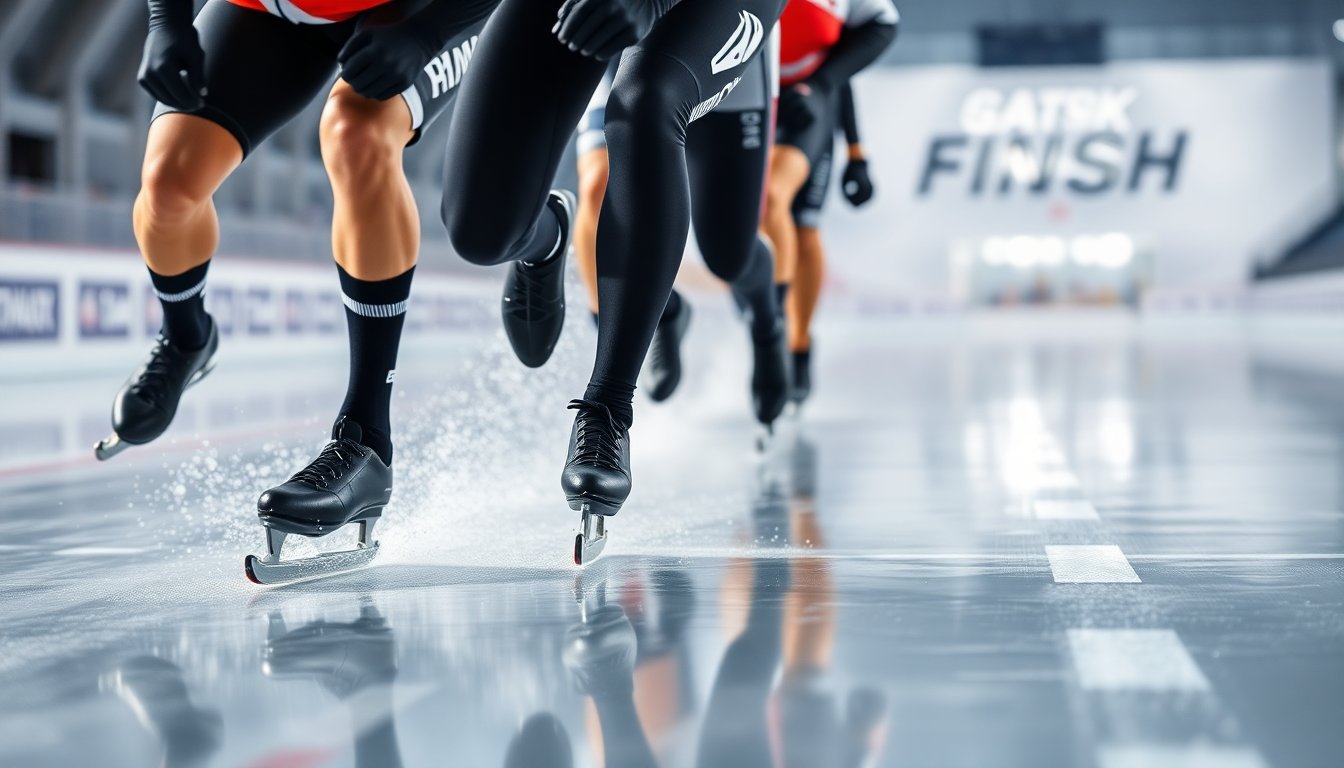
Milano Cortina, Feb. 14, 2026 — The men’s short-track program served up the kind of edge-of-your-seat drama the sport lives for: frantic sprints, chess-like tactics on ice, and medals decided by slivers of time. The 1,500 metres made clear how deep and evenly matched the field has become — outcomes now hinge on hundredths of a second and the smallest technical adjustments.
The podium was a study in margins. Netherlands’ Jens van ’t Wout skated to gold in 2:12.219, South Korea’s Hwang Dae-heon was a breath behind at 2:12.304, and Latvia’s Roberts Kruzbergs took bronze in 2:12.376. With just 0.085 seconds between first and second and 0.157 to third, races were won or lost on corner exits, tiny weight shifts and perfectly timed passes rather than pure top-end speed.
Canada’s showing blended promise with reminders of how quickly fortunes can flip. Montreal’s Auston Dandjinou was the most consistently strong Canadian over the two-day sprint festival: fourth in the 1,000 metres and fifth in the 1,500, where he rode composed pacing and smart lap management. Those consecutive results suggest he’s moving beyond contender status toward someone who can nudge the race’s favorites and stay in the mix when it matters.
But the event also highlighted short track’s volatility. Veteran Steven Dubois, the 2026 Olympic silver medallist, was taken out of contention after a crash about eight and a half laps from the finish — a collision that removed a key tactical player from the closing drama. Earlier, a semifinal review found Dubois had been impeded by Italy’s Thomas Nadalini while holding a qualifying spot; after video review he was advanced into the final alongside China’s Liu Shaoang. Those rulings reshaped the final’s tactical map.
Not every Canadian escaped unscathed: Félix Roussel of Sherbrooke received a yellow card following contact in the last semifinal. That sanction—meant for actions judged unsafe—ended his progression and reinforced how strict safety and conduct standards are at this level.
Officiating and replay technology are no longer background influences; they shape results. As finishes compress, multi-angle replays, synchronized timing and clearer protocols have become integral. Research from groups such as MIT backs this up, showing that tighter fields increase both the frequency and the impact of review decisions. Teams now have to prepare for outcomes decided as much by video rooms as by blades on ice.
Coaches are responding. Training plans now balance raw speed work with scenario drills that rehearse when to yield, when to fight for position and how to react to contact. Those who integrate replay-informed simulations and practice split-second tactical choices will be better positioned when milliseconds swing medal placements.
Penalty interpretation remains one of short track’s thorniest issues. Obstruction, improper lane changes and avoidable contact are familiar categories, but how officials weigh competitive fairness against athlete safety determines whether a skater is advanced, penalized or disqualified. Crashes still trigger medical checks, re-skates or race-ending incidents; federations are pushing for standardized review windows, improved barrier design and enhanced medical readiness to reduce risk and controversy. Early evidence suggests that better replay systems and clearer infraction criteria can cut the number of contested overturns.
What should teams and organizers do next? For teams: drill race craft under pressure, rehearse rule-scenario responses and mine replay footage to isolate the millisecond choices that cost places. Sport scientists will likely press for higher-frequency telemetry and chaotic-pack simulations to reproduce real-race stressors. For event organizers and officials: continue refining replay protocols, invest in barrier and medical upgrades, and aim for consistent, transparent decision-making so the sport’s excitement is matched by fairness.
Above all, the Milano Cortina 1,500 showed short track at its most thrilling and unforgiving — a discipline where tiny technical edges, tactical savvy and the instant judgment of officials together write the day’s headlines.