
Table of Contents
In a remarkable scientific breakthrough, researchers have successfully traced a colossal 3,000-light-year-long cosmic jet back to its origin, linked to the first-ever imaged black hole. This discovery was made possible through the enhanced capabilities of the global Event Horizon Telescope, as detailed in a recent study published in the journal Astronomy & Astrophysics.
The black hole in question, known as M87, resides in the Messier 87 Galaxy, approximately 55 million light-years away from our planet. With a mass about 6.5 billion times that of our Sun, M87 is not only supermassive but also remarkably active. The implications of this research are profound, potentially offering insights into the mechanisms behind the launch of cosmic jets that travel at nearly the speed of light.
The significance of the findings
Understanding the dynamics of black holes is crucial, as only a small fraction of them exhibit activity at any given time. Dr. Padi Boyd from NASA pointed out that the activity levels of black holes fluctuate, suggesting they might turn on and off periodically. This variability is significant as it is thought to be associated with the high magnetic fields present in the vicinity of black holes, which play a critical role in the formation of jets.
Connecting theory with observation
According to Saurabh, the lead researcher from the Max Planck Institute for Radio Astronomy, this study serves as an initial step in bridging the gap between theoretical concepts regarding jet launching and observable phenomena. He emphasized how identifying the jet’s origin point, and its relationship with the black hole’s shadow, contributes to a more comprehensive understanding of the mechanisms powering these enigmatic cosmic engines.
How cosmic jets are formed
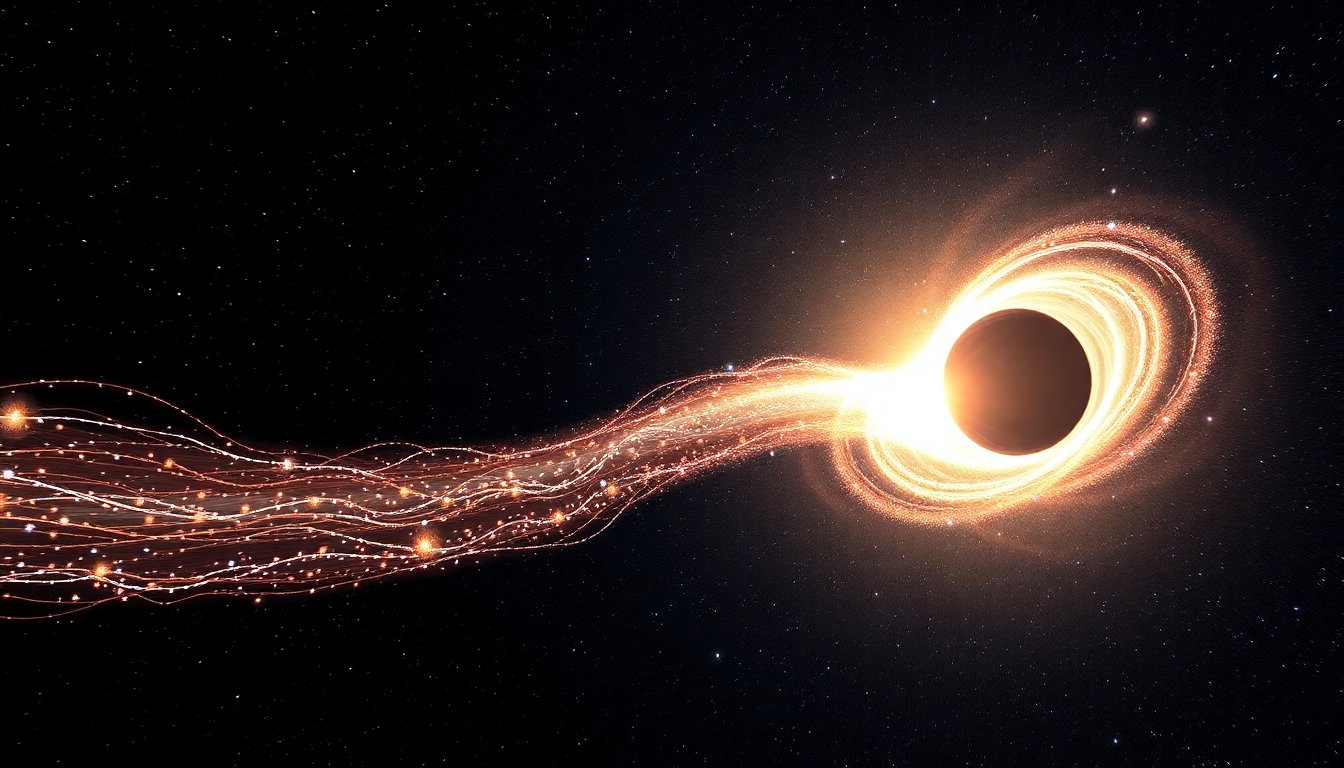
The M87 black hole operates by both absorbing surrounding gas and dust while simultaneously ejecting powerful jets of charged particles from its poles. These jets manifest as a stream of energy and matter that can extend across vast distances, shaping the space environment around them.
Data collected from the Event Horizon Telescope in has been pivotal in this study, allowing scientists to analyze the intricate details of the black hole’s activity. While the findings are promising, the authors caution that further observations with improved sensitivity and a broader frequency range are necessary to confirm these results definitively.
Future implications for black hole research
As researchers continue to unravel the mysteries of black holes, the enhanced observation capabilities of networks like the Event Horizon Telescope stand to revolutionize our understanding of these cosmic giants. They provide a unique opportunity to observe phenomena that were once thought to be beyond reach.
In conclusion, the identification of the source of M87’s jet stream not only enriches our knowledge of black holes but also sets the stage for future explorations into the complexities of the universe. As scientists delve deeper, the connections between black holes and their jets may reveal transformative insights into the nature of cosmic evolution.