
Table of Contents
The geopolitical landscape in East Asia is increasingly tense as China’s military has initiated extensive drills around Taiwan. These operations, which began on a Monday morning, are perceived by Beijing as a serious warning to both separatist factions within Taiwan and foreign entities considered to be interfering.
In response to these military activities, Taiwan has placed its armed forces on high alert, characterizing the actions of the Chinese government as the primary threat to regional peace. The drills are occurring in the waters and airspace surrounding the self-governing island, which China claims as its territory.
Details of China’s military exercises
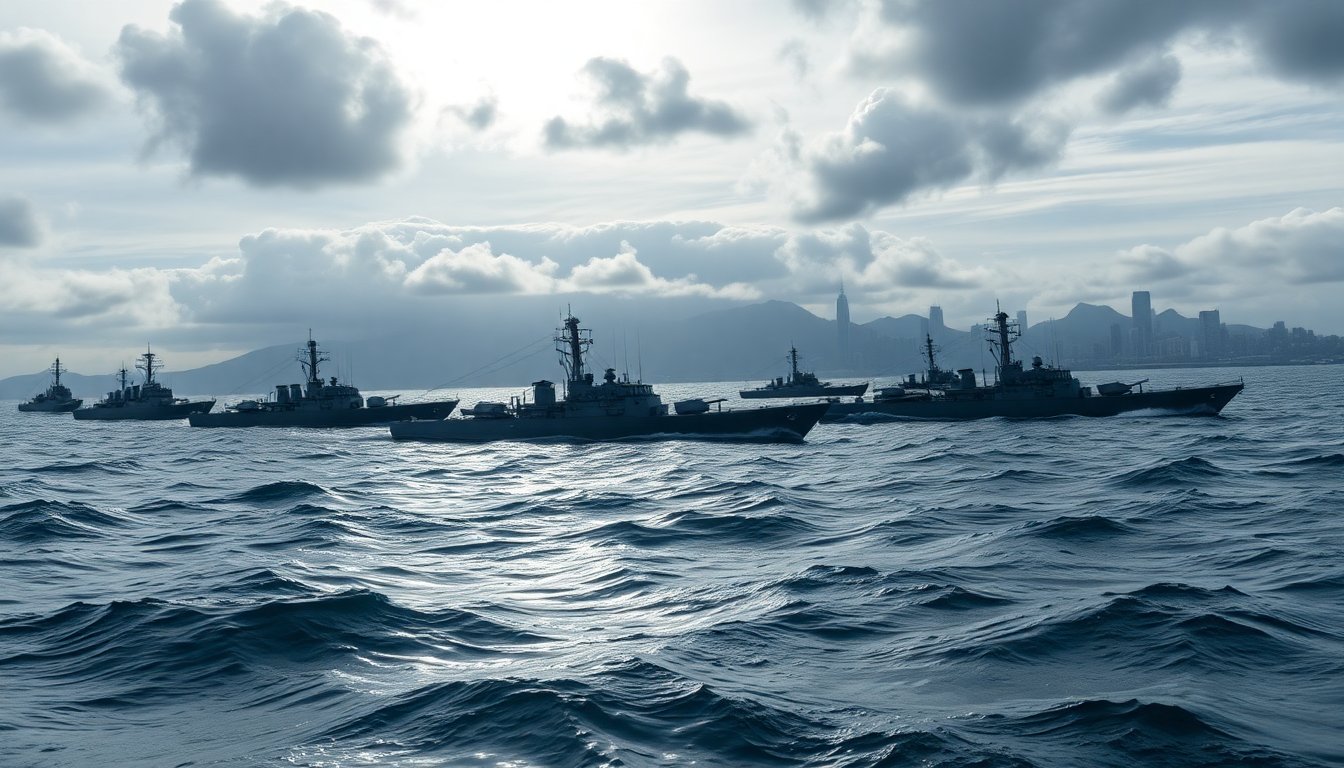
These military drills, referred to as a joint operation, involve various branches of China’s armed forces, including air, naval, and missile units. According to a statement from the spokesperson for the People’s Liberation Army’s Eastern Theatre Command, Senior Colonel Shi Yi, the drills aim to enhance combat readiness and include live-fire exercises targeting maritime objectives in areas to the north and southwest of Taiwan.
Focus on deterrence and dominance
Shi Yi noted that the exercises are designed to strengthen sea-air combat readiness and establish comprehensive superiority in the region. This training marks a significant escalation, as it explicitly states its objective of exerting all-dimensional deterrence, a strategy intended to discourage external powers from intervening in the event of a conflict.
Taiwan’s Defence Ministry has condemned these maneuvers, asserting that such exercises confirm China’s aggressive posture and its role as a principal disruptor of peace in the region. The ministry reported increased military activity in the strait, with numerous aircraft and vessels detected near Taiwanese waters.
Taiwan’s defensive measures
In light of the Chinese military’s actions, Taiwan has mobilized its forces, conducting rapid response drills to ensure readiness against potential incursions. The Taiwanese Defence Ministry reported that by the afternoon of the first day of drills, 89 aircraft and drones were sighted in the vicinity, with a significant number entering the island’s defensive response zone.
International implications and responses
These military exercises escalate tensions between China and Taiwan and pose challenges for international relations in the region. The Taiwanese government has expressed concerns regarding the impact of such military pressure on local stability and broader international norms. Karen Kuo, a spokesperson for the Taiwanese president’s office, stated that these actions openly defy international law and threaten the security of the Indo-Pacific.
These developments follow a recent announcement of substantial arms sales from the United States to Taiwan, which Beijing has vehemently opposed, leading to sanctions on American defense companies. This intertwining of military posturing and diplomatic tension illustrates the precarious nature of peace in the Taiwan Strait.
Historical context and ongoing tensions
The historical backdrop of the relationship between China and Taiwan is rooted in the aftermath of the Chinese Civil War, which culminated in 1949 when Nationalist forces retreated to Taiwan while the Communist Party established authority over mainland China. Since then, Taiwan has operated under its own government, yet China has continually sought to assert its claim over the island.
As military activities intensify, both sides remain on high alert, with Taiwan developing its own defense systems, such as the anticipated T-Dome missile shield, aimed at counterbalancing China’s military threats. The situation remains fluid, and the potential for miscalculation during these military drills poses significant risks not only to Taiwan but also to regional peace and stability.