
Table of Contents
A recent report from the Anti-Corruption Foundation (FBK) has revealed details about a lavish mansion built for Russian President Vladimir Putin along the scenic southern coastline of Crimea. Estimated to cost approximately 10 billion rubles (about $125.8 million), the residence has sparked significant controversy.
Before the annexation of Crimea in 2014, Ukrainian media highlighted construction activities at a site known as Cape Aya, previously referred to as Yanukovych’s dacha. The property, covering roughly 3.5 hectares (8.6 acres), was purchased by former Ukrainian President Viktor Yanukovych in 2007 for only $1.2 million while he was still serving as prime minister. Yanukovych later distanced himself from the property during his presidency in 2013, denying any involvement in its development.
The transition of ownership
After Russia’s takeover of Crimea, Sergey Menyaylo, the newly appointed governor of Sevastopol, announced plans for the Russian government to assert ownership of the estate. Initial reports indicated that it would become a resort, but the property ultimately came under the control of Russia’s Presidential Property Management Department. Investigations revealed that the unfinished mansion had been transferred to businesses linked to individuals close to Putin, particularly Yury and Boris Kovalchuk. The FBK noted that the original dacha has been vastly surpassed by the new construction at Cape Aya.
Ownership and construction details
The FBK reported that the palace is officially registered under a company called Bereg LLC, a subsidiary of Golden Gate. Legal representatives for this firm are also connected to Binom Joint Stock Company, which is affiliated with Complex LLC, the organization managing the title of Putin’s other luxurious residence near Gelendzhik on the Black Sea coast. Specifications for the Crimean estate require that its interior meet the standards set by Russia’s Federal Protective Service, which ensures the safety of high-ranking officials.
The FBK’s investigation also pointed out the involvement of a construction firm named Credo, responsible for designing and developing nearly all of Putin’s official and unofficial residences. While the FBK published architectural plans and images of the complex, the source of this information remains undisclosed.
Luxury on an extravagant scale
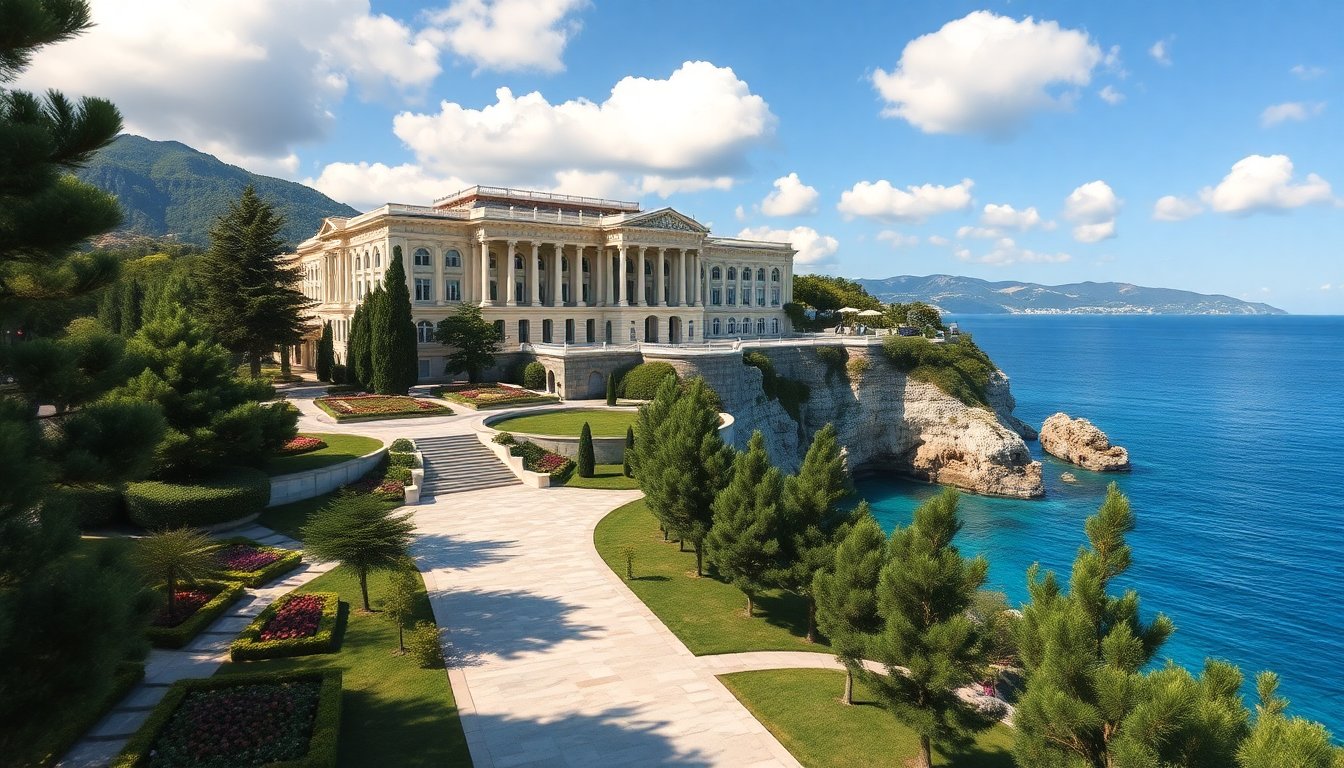
The main structure of the palace includes a grand hall measuring 233 square meters (2,508 square feet), featuring a dining table capable of seating up to 20 guests. Additionally, there is a lavish 154-square-meter (1,658-square-foot) bedroom complete with a 50-square-meter (538-square-foot) marble bathroom and jacuzzi. The estate also features another large bedroom measuring 183 square meters (1,970 square feet), a private medical clinic with several offices, a spa equipped with a swimming pool and cryotherapy chamber, a cinema, a billiards room, and a wine cellar stocked with fine vintages.
Furthermore, the entire complex includes a separate building for guest accommodations, along with a rooftop garden offering stunning views of the sea.
Funding and connections
The construction of the estate has reportedly been funded by businessman Vladimir Kolbin, along with the company Aratron, which is also believed to have invested in a winery near the Gelendzhik palace. Additionally, Forstis, another company linked to Yury Kovalchuk, has contributed to the funding of the construction.
Reports from Novaya Gazeta indicated that the estate on Cape Aya is closely associated with Putin’s inner circle, referring to it as Kovalchuk’s dacha. Journalists attempting to access the site faced obstacles, with a man in civilian clothing stopping them at a checkpoint. When questioned about the activities on the property and the presence of individuals inside, he simply responded, “Putin.” A construction worker confirmed to reporters that the residence was indeed being built for Russia’s president.