
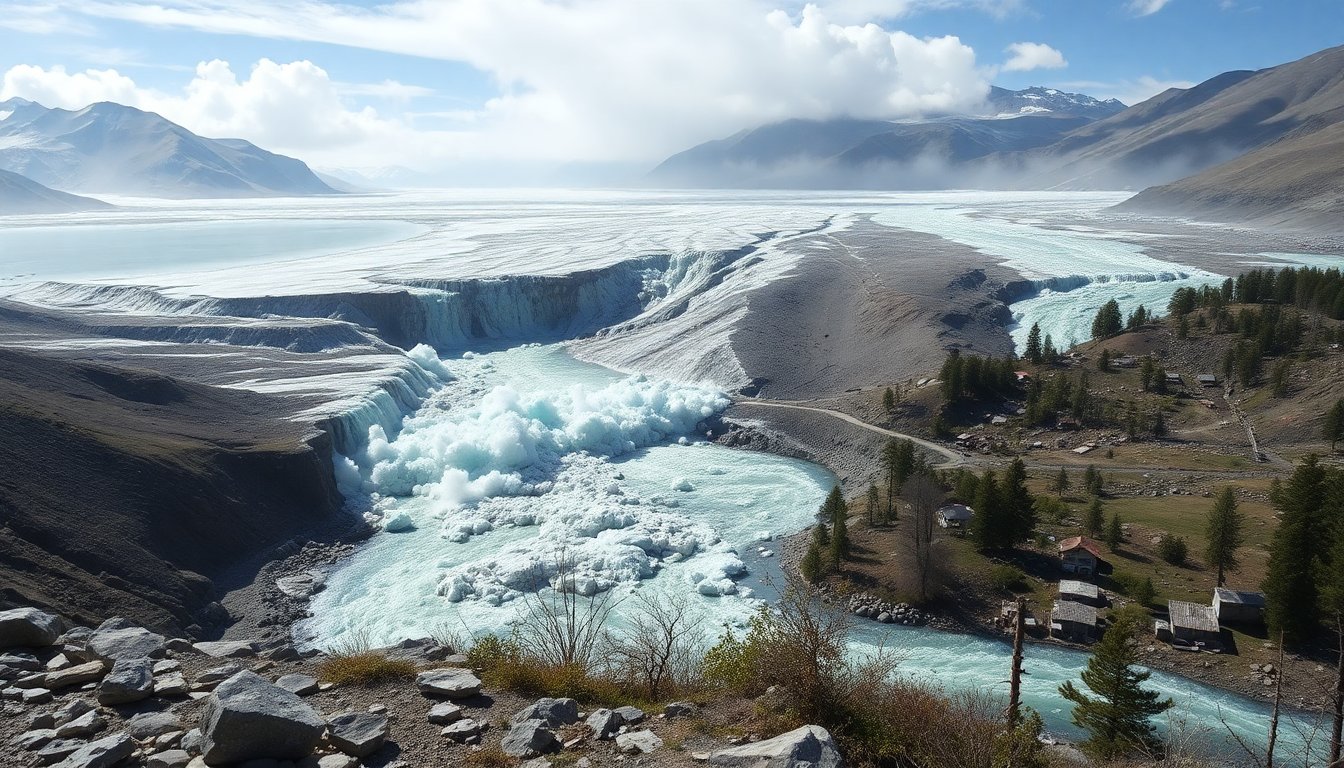
The warming climate is reshaping not only polar regions but also the high mountain landscapes that feed rivers and sustain communities. Where glaciers retreat, meltwater often pools behind unstable natural barriers, producing a proliferation of glacial lakes that did not exist decades ago. In some cases, these lakes sit at extreme elevations—above 17,000 feet—and their sudden failure can send a shock downstream in the form of a localized tsunami or a massive flood pulse. These events combine the dynamics of ice, rock and water in ways that few communities are prepared to face.
Understanding the mechanism behind such disasters requires grasping a few essential terms and processes. A sudden release of a mountain lake is commonly described as a glacial lake outburst flood (GLOF), a phenomenon driven by dam failure, slope collapse or rapid melting. The stability of a lake often depends on a moraine—a ridge of glacial debris—or frozen ground known as permafrost. When these natural barriers weaken, water that has been accumulating at altitude can discharge violently, carrying ice, boulders and sediment and creating a wave that behaves like a tsunami in a confined valley.
How high-altitude lakes become ticking time bombs
Glacial retreat leaves behind basins that readily fill with meltwater, forming proglacial lakes and supraglacial ponds. These water bodies are frequently bounded by loose moraines or ice-dammed walls that are not engineered to resist large loads. Over time, warming and increased meltwater pressure can degrade those boundaries through seepage and erosion, while thawing permafrost removes the cohesive strength of slopes. The result is a growing inventory of unstable lakes in mountain systems worldwide, each carrying potential energy proportional to its elevation and volume—energy that can be released suddenly when a dam gives way.
Moraine dams and permafrost thaw
Moraine walls are heterogeneous piles of earth and rock left by retreating glaciers; on their own they are susceptible to piping and collapse. When these structures are frozen, permafrost acts as a temporary stabilizer, but warming trends reduce that protection. The progressive thaw of frozen ground not only undermines dam integrity but also increases the likelihood of landslides into lakes. Such slope failures can instantaneously displace large volumes of water, creating waves that amplify in narrow valleys and transform a mountain lake breach into a downstream catastrophe.
Triggers and the tsunami effect
Several triggers can convert a precarious lake into a destructive event: sudden ice or rock avalanches, heavy rainfall, rapid glacier collapse, or internal erosion of dam material. When a mass falls into a confined basin, it generates a displacement wave whose height and travel distance depend on the slope, the basin shape and the volume involved. At extreme elevations—around 17,000 feet—the energy released can produce a localized tsunami-like surge with surprising force, capable of scouring valley bottoms, carrying debris far downstream, and reaching settlements that lie many kilometers away.
Human and ecological consequences
The immediate impacts of a high-altitude lake failure are often catastrophic: loss of life, destruction of homes and critical infrastructure, and buried farmland and water supplies. But the damage extends beyond the initial surge. Floods laden with sediment change river channels, reduce reservoir capacity, and alter aquatic habitats, which can harm fisheries and drinking water quality. Communities that depend on mountain water resources may face long-term disruption. The social cost is compounded when exposed populations lack early warning systems or the resources needed for rapid evacuation and recovery.
Monitoring, mitigation and adaptation
Reducing risk requires a mix of technology, engineering and community planning. Remote sensing and satellite imagery increasingly allow scientists to map and monitor thousands of newly formed glacial lakes, while field surveys assess dam stability and downstream exposure. Engineering solutions—such as controlled drainage, reinforced spillways and diversion channels—can lower lake levels and reduce catastrophic risk. Equally important are nature-based approaches and community-based early warning systems that combine automated sensors with local preparedness. Ultimately, addressing the root cause means integrating these measures with broader climate mitigation and adaptation strategies to slow the pace of glacier loss and limit the creation of new hazards.
High-mountain lakes are a striking example of how warming amplifies unexpected risks far from the sea. The phenomenon that can unleash a devastating wave at 17,000 feet is not an isolated curiosity but a growing reality where glaciers are shrinking. Prudent monitoring, targeted engineering, and sustained climate action can reduce the chance that another lake failure shatters lives downstream, but time and attention are needed to keep highland communities safe.


