
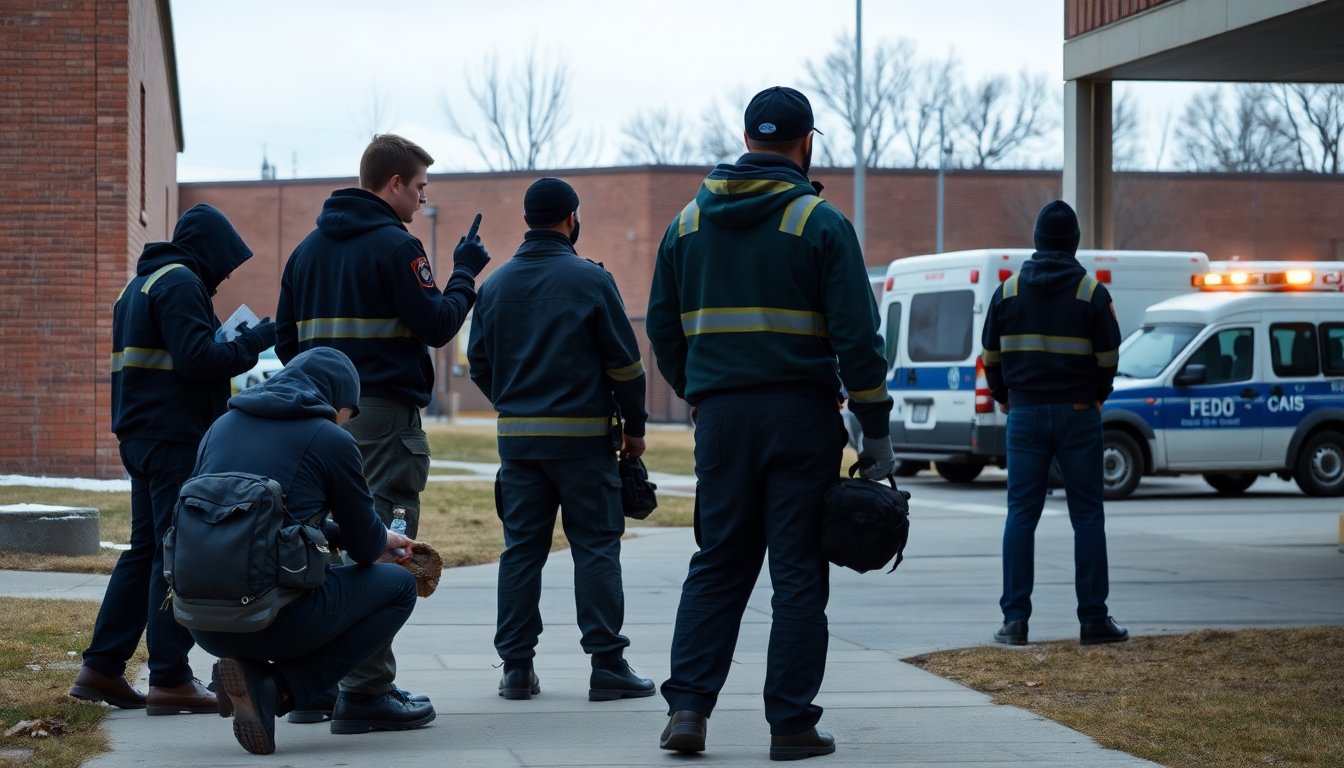
Tumbler Ridge, a small, remote town in northeastern British Columbia, was rocked by a deadly shooting that began at a private residence and moved to Tumbler Ridge Secondary School. Local RCMP and regional emergency services scrambled to both scenes. The attack left multiple people dead and wounded and prompted a large, multi-agency response focused on lifesaving care, evidence preservation and support for victims and their families.
A tiny detachment, a decisive response
The town’s RCMP detachment is tiny—just five sworn officers. When the call came, only two were on duty; two others were off and one was out of town. Despite those limits, the two on shift arrived at the school within roughly two minutes of the first report. Witnesses and officials described their actions as immediate and courageous: they entered the building while shots were still being fired and positioned themselves between the shooter and students, risking their own safety to protect others.
Neighbouring units and off-duty officers were quickly recalled. Tactical and logistical teams from Fort St. John, Chetwynd and Dawson Creek strengthened the response, helping to secure both the residence and the school and to establish control over the unfolding scene.
Remoteness and coordination challenges
Tumbler Ridge’s isolation shaped how the response unfolded. Reinforcements and specialized teams had to travel long distances, stretching response and investigative resources. Still, regional units, emergency medical teams and investigators moved quickly to contain the scene, deliver urgent medical care and begin systematic evidence collection.
Priorities shifted as the situation evolved. First came neutralizing the threat and saving lives. Once that was achieved, attention turned to triage, transporting the injured to regional hospitals, preserving forensic material and setting up family liaison services. Command established triage and treatment points, and air ambulances were flown in to move the most seriously wounded to specialized centres.
The human toll
Authorities initially withheld a full casualty list, but later confirmed eight fatalities, including the shooter. Among the dead were five students, an education assistant and two relatives of the shooter. The students named publicly were Kylie May Smith (12), Ticaria Lampert (12), Zoey Benoit (12), Abel Mwansa (12), Ezekiel Schofield (12) and Emmett Jacobs (11). The adults identified were Shannda Aviugana-Durand (39), an education assistant, and Jennifer Strang (Jacobs) (39).
In a town where families, teachers and police are tightly connected, the losses cut deeply. The school was first locked down and then evacuated under RCMP supervision. Counselling and crisis services were made available to students, staff and first responders, and community centres opened as hubs for information and support. Officials urged residents to rely on verified updates and avoid sharing unconfirmed posts, both to protect grieving families and to preserve the integrity of the investigation.
Supporting responders and the community
First responders described being profoundly affected by what they witnessed. Jeff Swann, director of the national policing federation’s Pacific region, said the officers “ran into gunfire” and helped keep people safe until reinforcements arrived. Many of those officers are community members who know the school personally; they did not seek praise, and several are now struggling in the aftermath.
Mental-health and emergency agencies prioritized psychological first aid and longer-term counselling for survivors, families and emergency personnel. Structured debriefings and ongoing mental-health support were offered to anyone in need.
Medical response in a remote setting
Tumbler Ridge normally has very limited ambulance coverage—officials said the town is typically served by one full-time unit. For this incident, multiple ground ambulances and at least three air resources were dispatched. Regional partners and air ambulance providers ramped up surge capacity while incident command coordinated triage, treatment and transport to prioritize stabilization and rapid transfer to specialized hospitals.
A tiny detachment, a decisive response
The town’s RCMP detachment is tiny—just five sworn officers. When the call came, only two were on duty; two others were off and one was out of town. Despite those limits, the two on shift arrived at the school within roughly two minutes of the first report. Witnesses and officials described their actions as immediate and courageous: they entered the building while shots were still being fired and positioned themselves between the shooter and students, risking their own safety to protect others.0
A tiny detachment, a decisive response
The town’s RCMP detachment is tiny—just five sworn officers. When the call came, only two were on duty; two others were off and one was out of town. Despite those limits, the two on shift arrived at the school within roughly two minutes of the first report. Witnesses and officials described their actions as immediate and courageous: they entered the building while shots were still being fired and positioned themselves between the shooter and students, risking their own safety to protect others.1