
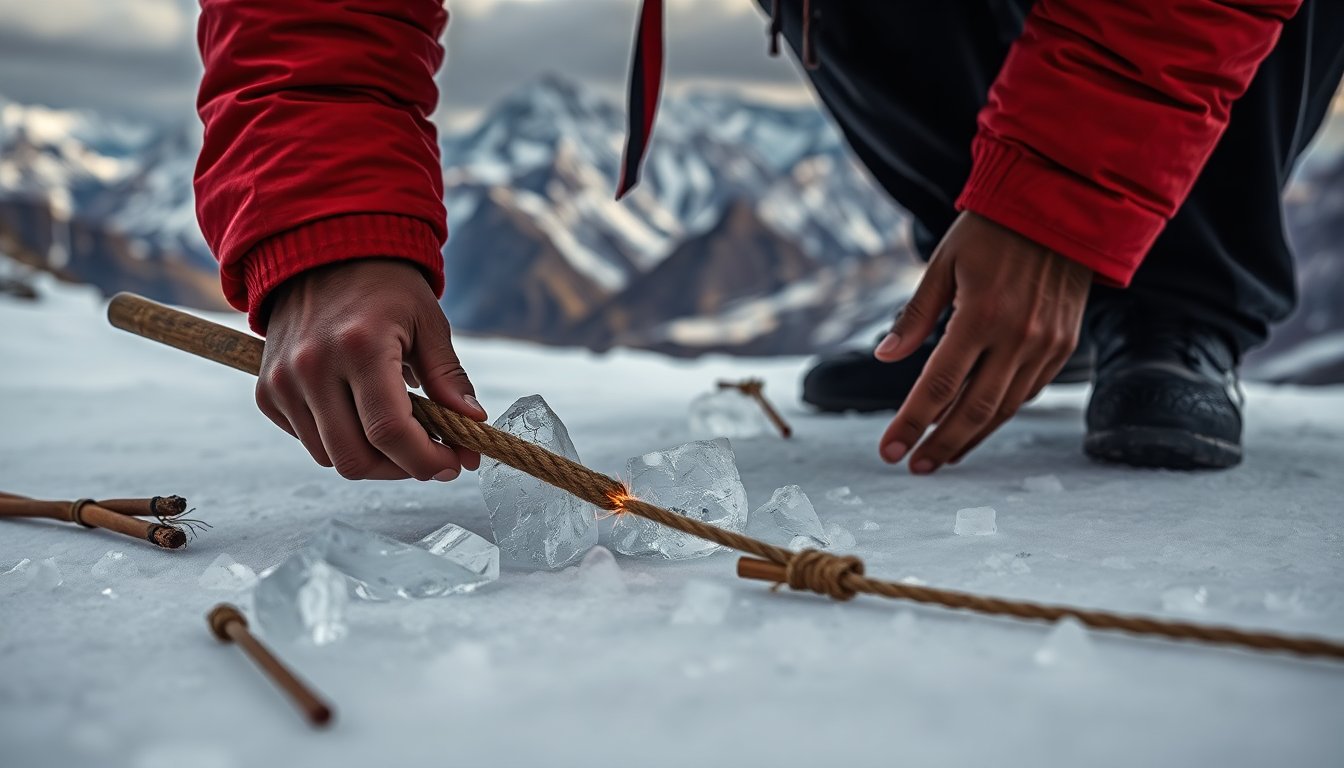
High in the mountains above Skardu and in neighbouring valleys of Pakistan’s upper Indus watershed, villagers have revived an old, careful craft to keep water running when the seasons tighten. Known locally as glacier grafting—or, more poetically, a “glacier marriage”—the practice sews pieces of ice together on shaded slopes so they slowly grow into a larger, longer-lasting body of ice. As glaciers retreat and water becomes less predictable, this ancestral technique is being brought back to life as a practical hedge against dry months, while researchers watch and learn alongside the communities.
How communities do it
Teams go to higher, more stable sources of ice and compacted snow, harvest blocks by hand or with pack animals, and carry them to chosen north-facing terraces and cirques. Work happens in the coldest months to avoid unwanted melt during transport. At the site the crew digs shallow trenches, anchors ice with stones and debris, and builds small terraces or wind-breaks that trap snow and shade the new mass.
The pieces of ice are arranged according to long-standing local rules—traditionally referred to as “male” and “female” blocks—and bound together with materials such as coal dust, salt and bundles of grass. Then, over weeks and seasons, water from nearby streams is dripped or sprinkled slowly onto the assembly so the fragments fuse into a single mass. Much of the technique is simple, hands-on craft: compaction, anchoring and shielding against sun and wind. Done right, and with patience, the planted ice accumulates enough to feed springs and irrigation channels during drier months.
Ritual, rules and community life
Glacier grafting is woven into the social fabric, not just the water system. Rituals and taboos govern how teams behave: loud music is avoided, animals are treated with care, and participants take pains that ice never touches bare ground. Elders enforce ceremonial norms about who may join the work and how it should be carried out, and local songs—like Gang Lho—are sung to the planted ice as if tending something alive.
These customs do more than sanctify the activity. They create discipline in the field, encourage cooperation, and make sure practical knowledge passes down through generations. The rites cement a sense of shared responsibility: everyone has a stake in protecting the nascent ice and the water it will eventually provide.
Limits and practical realities
Villagers see grafting as an adaptation with clear boundaries, not a cure-all. The method can lengthen seasonal runoff, but success hinges on wider climatic conditions—warmer winters, less snowfall, or erratic precipitation can all undermine efforts. New ice also takes time to mature: practitioners typically expect several years, sometimes decades, before a planted mass becomes a dependable source.
Because the work is labour-intensive and sensitive to disturbance, teams choose shaded, stable sites away from avalanche paths and flowing channels, and build redundancy into their water plans. They keep careful records of survival rates, melt patterns and weather, comparing results year by year and adjusting techniques. When social unrest or heavy human traffic damages a site, the whole enterprise can be set back.
Materials and site selection
Communities deliberately avoid modern contaminants near their grafted ice. Plastics and synthetics are shunned; binding and insulating materials come from local, natural sources. North-facing slopes and natural wind shelter are preferred to reduce sun exposure. Trenches are sited to minimize avalanche risk and to allow safe access for monitoring and upkeep. These practical choices both reduce melt and align with customary protections.
Scientific collaboration and future prospects
Researchers from regional universities and international groups are beginning to combine scientific monitoring with local knowledge. Field studies log melt rates, microclimates and stream contributions, helping communities refine where and how to plant ice. Where local programs receive modest technical training and public investment, they stand a better chance of lasting.
Still, glacier grafting is a stop-gap—an ingenious, community-driven way to buy time for households, herds and fields. It cannot replace basin-scale water management or the need for global emissions cuts. Scaling the technique would require coordinated monitoring, technical backing and sustained funding. The most promising path blends community stewardship with scientific data and policy support, so small-scale solutions can sit alongside larger strategies for a warming world.
How communities do it
Teams go to higher, more stable sources of ice and compacted snow, harvest blocks by hand or with pack animals, and carry them to chosen north-facing terraces and cirques. Work happens in the coldest months to avoid unwanted melt during transport. At the site the crew digs shallow trenches, anchors ice with stones and debris, and builds small terraces or wind-breaks that trap snow and shade the new mass.0