
Table of Contents
The emergence of subterranean missile hubs has long been central to Iran’s strategy for safeguarding its ballistic arsenal. Built to resist conventional bombardment and to complicate surveillance, these complexes—often called missile cities—combine geology, engineering and concealment. Yet recent campaigns and evolving tactics have exposed new fault lines in that protection, turning once-secure bunkers into prominent strategic liabilities.
This article unpacks the architecture of these facilities, the defensive methods used to shield missiles and launchers, and the countermeasures adversaries employ. It draws on public reporting, open-source imagery and analysis to explain why sealing entrances, targeting access points and using precision penetration munitions can neutralize an entire site without destroying every internal chamber.
How missile cities are constructed and what protects them
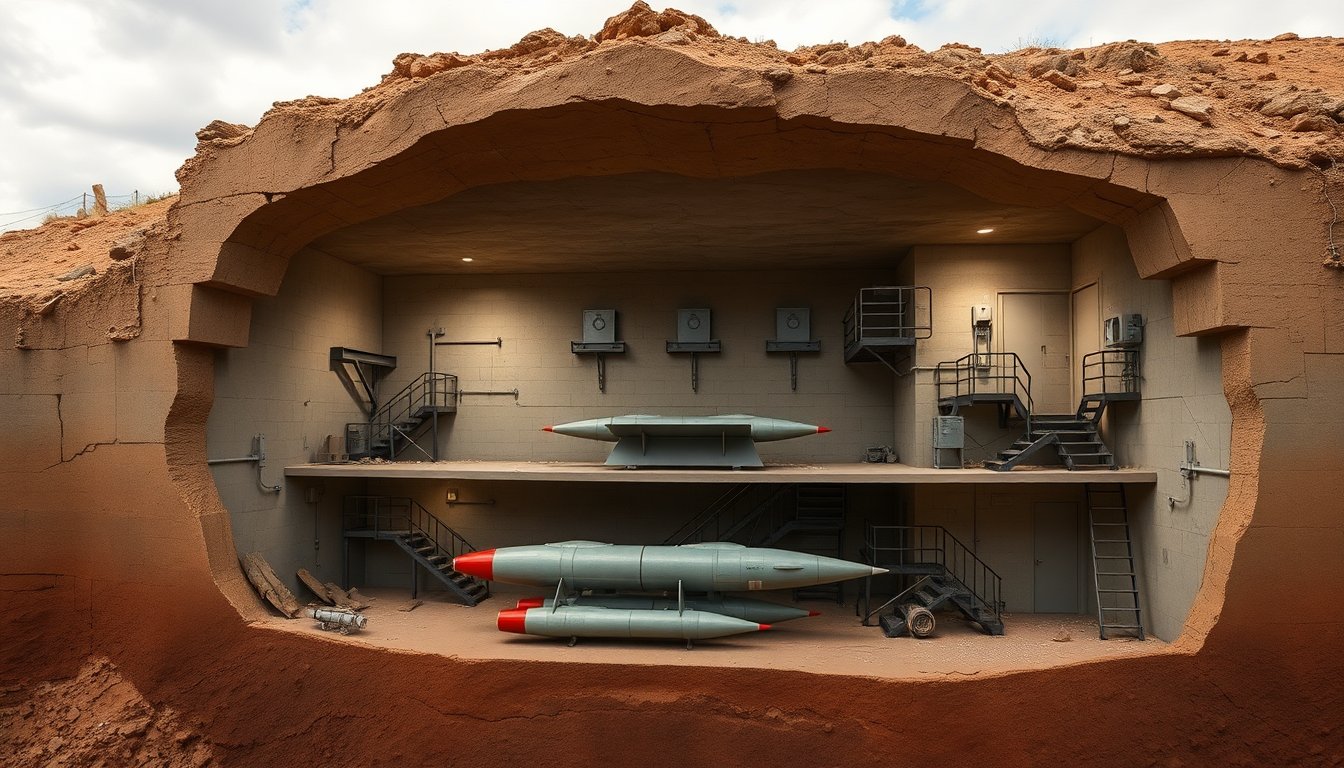
Iran’s underground complexes are typically carved into mountainous rock and engineered with layered defenses. The design emphasis is on survivability: multiple chambers, interconnecting galleries, and redundant storage areas for warheads, propellant and support systems. The overburden of hard rock and reinforced concrete acts as natural and man-made armor against air-delivered explosives.
Entrances are often recessed and reinforced with steel-clad concrete liners and heavy blast doors. Architects include blast-trap features—short dead-end shafts and compartmentalized zones—that dissipate shockwaves and prevent a single strike from compromising the whole complex. Additionally, many structures are buried beneath earth covers that mask them in satellite imagery and reduce radar signatures.
Camouflage, decoys and mobility
Deception is a core layer of defense. Sites use thermal masking, nets and painted façades to mimic civilian buildings or natural terrain, while decoys—inflatable or wooden mockups—confuse optical and infrared surveillance. Meanwhile, reliance on transporter-erector-launchers (TELs) and dispersed storage means the actual launch capability is mobile and distributed, complicating target prioritization for attackers.
Why these defenses can be turned into vulnerabilities
Despite deep burial and robust entrances, several practical limits make missile cities susceptible. First, entrances and access points constitute single points of operational vulnerability: if they are blocked or collapsed, internal assets can be rendered inaccessible. Attacking near mouths of tunnels can effectively “bottle up” a site, preventing sortie preparation and resupply even without physically entering every chamber.
Second, some caverns include overhead apertures that permit missile launches from inside the complex. While those apertures retain offensive potential, they also present exposed roof sections that can be targeted with precision bunker-busters. Neutralizing a modest number of launch bays or overhead doors can significantly reduce the complex’s ability to project missiles.
Weapons and tactics used against underground sites
Modern strike packages combine conventional penetrators and heavier specialized munitions. Where collapse or sealing is the objective, smaller BLU-109-class penetrators integrated into GPS-guided JDAMs can collapse entry runners or harm roof structures. For deeply buried chambers, very large penetrators such as the Massive Ordnance Penetrator (MOP) are designed to reach greater depth, though they are limited in number and require extremely accurate targeting to be fully effective.
Another effective tactic is to focus on the surrounding terrain and choke points: collapsing roads, destroying external support infrastructure, and sustaining persistent sensor coverage to prevent repair or reopening. In essence, an attacker does not always need to demolish every internal hall; denying access and mobility inside the complex achieves strategic paralysis.
Operational and strategic implications
Targeting underground missile hubs changes the calculus of both offense and defense. For defenders, engineering and concealment remain vital, but resources must be allocated to protect entrances, maintain redundancy and improve rapid reconstitution. For attackers, the goal is often to maximize deterrent effect while conserving expensive interceptors and munitions—removing launchers from play reduces the number of incoming threats and the corresponding need for costly air defenses.
Stealth platforms and long-range bombers introduce additional variables. Aircraft with low-observable characteristics and advanced mission planning can reach contested airspace and place precision bunker-busters on critical apertures or runners. Electronic warfare, cyber effects and surveillance suppression all contribute to improving the probability of mission success against deeply buried targets.
What this means going forward
Underground missile complexes will continue to be engineered for resilience, but their survivability is not absolute. Their strengths—concentration, concealment and durability—also create identifiable failure points. As offensive capabilities evolve, the interplay between subterranean defenses and strike techniques will remain a defining element of strategic competition. Observers and planners must therefore treat these facilities not as invulnerable bastions but as complex systems with both formidable defenses and exploitable seams.
Ultimately, the contest between buried arsenals and precision strike doctrine highlights a broader truth: in modern conflict, ingenuity in defense prompts equally inventive approaches in attack. The result is an ongoing cycle of adaptation in which tunnels and caves are as much a test of engineering as they are of resolve.