
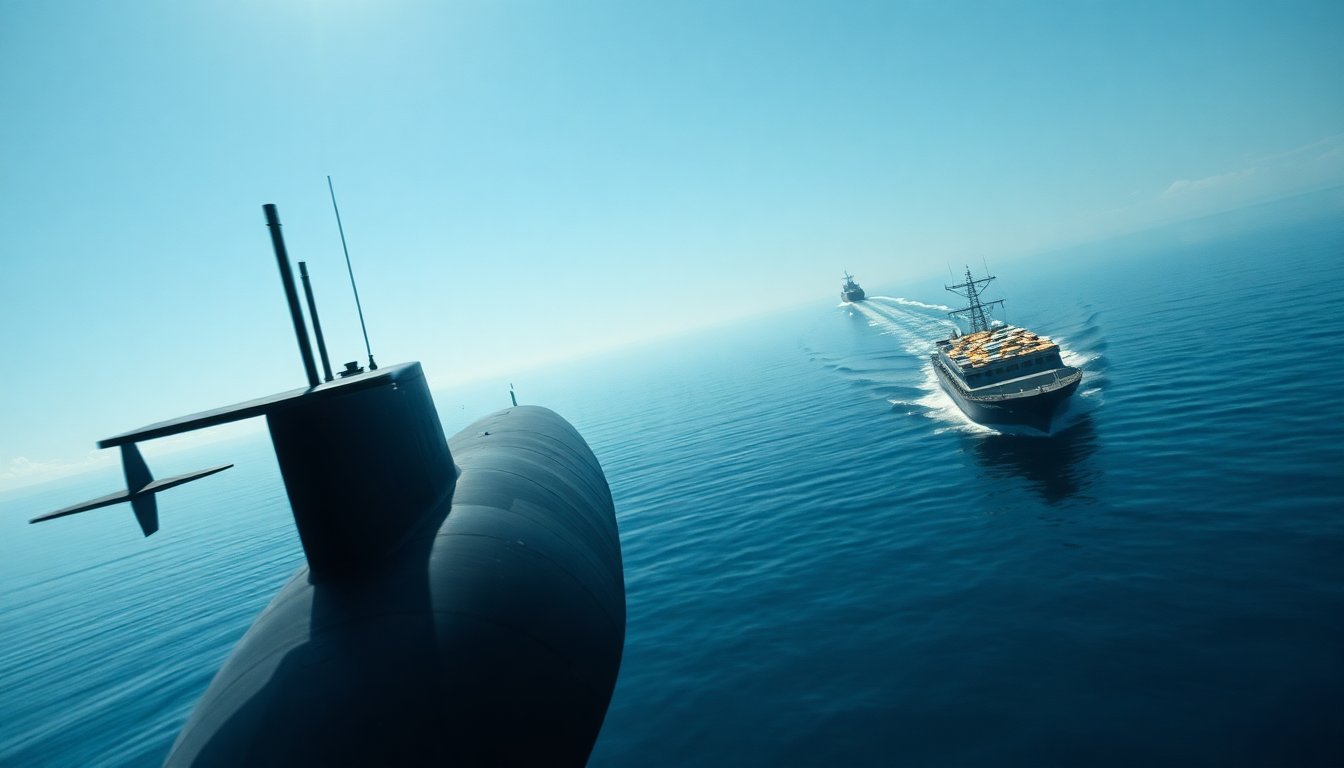
Undersea competition between Washington and Beijing is shifting fast. Over the past several years China has poured resources into quieter attack submarines, unmanned underwater vehicles and seabed operations, narrowing advantages the U.S. Navy has long taken for granted. Those advances matter because they combine with shortfalls in American munitions and strained forward logistics to raise the stakes in any high‑end maritime clash across the Indo‑Pacific.
Why undersea stealth and autonomy change the game
Quieter hulls and autonomous systems make detection harder and engagements quicker. When adversaries can disperse small, hard‑to‑track platforms or operate swarms of unmanned vehicles, defenders must spread sensors thinner and fire weapons earlier and more often. That dynamic shortens commanders’ decision windows and consumes limited inventories much faster than past planning assumed.
Where the gaps are most acute
The United States faces visible shortages in several critical weapon types:
– Long‑range land‑attack cruise missiles (Tomahawk/TLAM)
– Heavyweight torpedoes (Mk‑48 ADCAP)
– Long‑range anti‑ship missiles
Wargames and independent studies repeatedly show a disconnect between expected wartime demand and the munitions currently available. At-sea resupply is constrained by ship cargo space and the small pool of forward support vessels. Host‑nation ports help, but many lack secure yards, certified munitions‑handling gear or political arrangements that would function under the stress of crisis.
A concrete example of the risk
A recent CSIS exercise exploring a Taiwan scenario illustrated how fragile U.S. advantages can be. Success in that simulation leaned heavily on sustained submarine dominance—something that depends not just on hull numbers but on plentiful TLAMs and Mk‑48s plus robust expeditionary support from tenders and forward bases. Real‑world operations show inventories can bleed away quickly: open‑source tallies suggest a single Carrier Strike Group action—about 125 Tomahawks used against Houthi targets, plus additional strikes—can claim a significant slice of stockpiles. In a larger conflict the combination of current stocks and procurement rates could prove insufficient.
Why ramping production alone won’t solve the problem
Boosting missile and torpedo output is necessary, but manufacturing is only one link in a longer chain. Without matching investments in transport, storage, at‑sea replenishment and repair capacity, higher production simply shifts the bottleneck from factories to ports, tenders and convoys. Industrial limits—long lead times for seekers and propulsion systems, warhead components, and a finite pool of skilled technicians—mean a quick surge in output is hard to achieve. That argues for a synchronized approach that ties procurement to verifiable logistics improvements.
The logistics pinch points
Forward sustainment for these weapons and platforms is concentrated in a handful of locations. Facilities such as Yokosuka and Sasebo in Japan, and Apra Harbor in Guam, are crucial nodes capable of handling TLAMs and Mk‑48s, but they are few. Afloat support relies on several aging submarine tenders (for example, USS Frank Cable and USS Emory S. Land); replacement programs face long build times, raising the risk of a capability gap as new submarines enter service.
Major port and sustainment shortfalls include:
– A shortage of heavy‑lift cranes and certified munitions‑handling systems
– Aging utilities and limited resilience to natural disasters or deliberate attack
– Insufficient numbers of trained stevedores and ordnance crews prepared for wartime tempos
What this means for strategy
The undersea balance is no longer a simple numbers game about hulls. It blends platform performance, munition stockpiles, and the ability to keep forces supplied and repaired far from home. Policymakers and military planners need paired solutions: accelerate production of critical weapons while simultaneously bolstering the logistical network—ports, tenders, at‑sea replenishment, and trained manpower—that turns those weapons into sustained combat power.
The strategic currents beneath the waves are changing. If America wants to preserve operational freedom in the Indo‑Pacific, it must close the gap not only on the factory floor but across the entire sustainment chain.


