
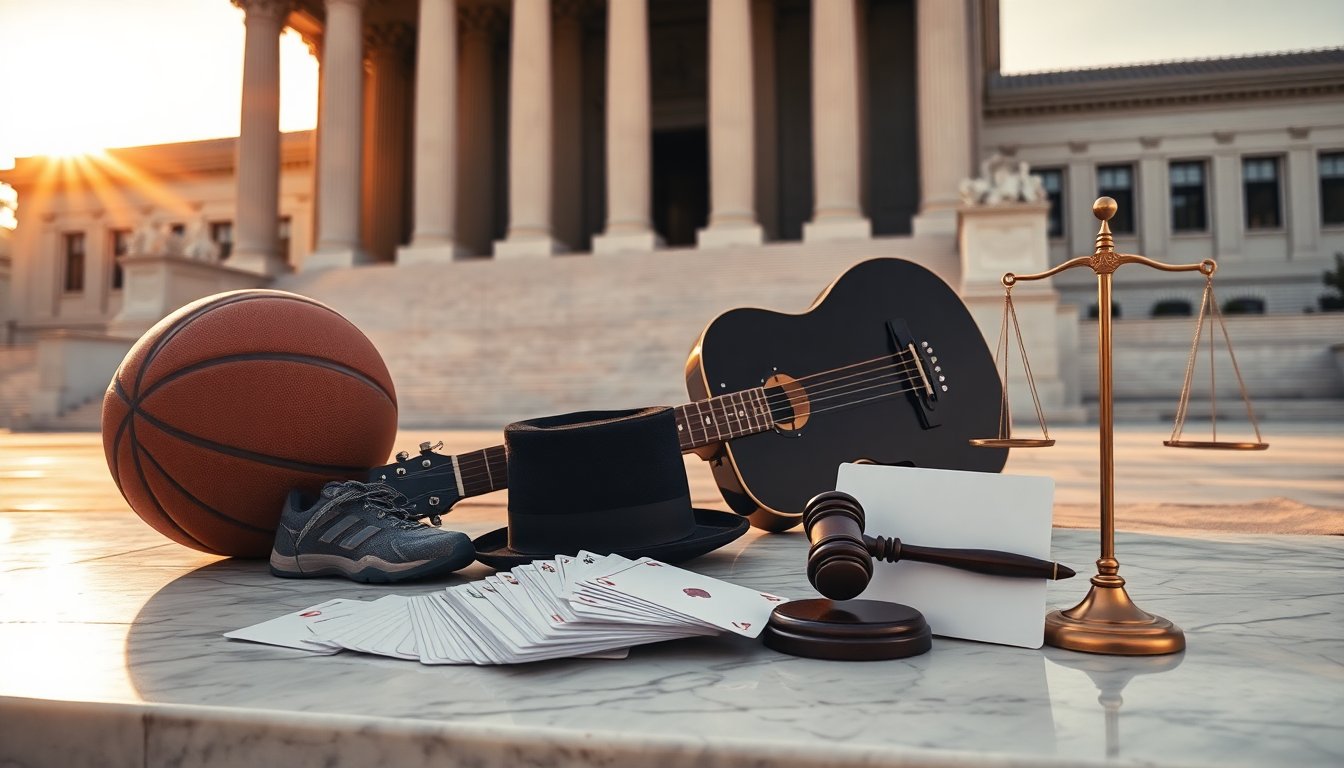
The United States Supreme court often attracts attention simply by placing a name on its docket, and a justice’s remark can remind us that litigation is as much public drama as legal argument. When Justice Sonia Sotomayor observed that being named in a brief draws scrutiny not just to a case but to a person, she underscored how fame and law intersect. In several petitions now awaiting the justices’ review, the spotlight arrived before the Court did: athletes, recording artists, and entertainers have already filed or supported filings that aim to influence whether the Court will take up these disputes.
These pending matters include challenges that touch on arbitration, the First Amendment, sentencing evidence, and the reliability of post-event memory techniques. The petitions at issue are New York Football Giants, Inc. v. Flores, Stockton v. Brown, Broadnax v. Texas, and the petition from Charles Don Flores. Each brings distinct procedural and substantive questions, and each has attracted public figures or organizations seeking to amplify legal arguments through amicus briefs and public commentary.
High-profile petitions on the court’s calendar
At the center of the most prominent labor dispute is a question about whether a league can name its own chief executive as the final arbiter of employment claims. In New York Football Giants, Inc. v. Flores, a racial discrimination suit filed in 2026 by Brian Flores expanded into a wider class action and prompted debate over the enforceability of a league-wide arbitration agreement. A federal judge in March 2026 compelled arbitration for certain contract-specific claims but left some claims in federal court; the U.S. Court of Appeals for the 2nd Circuit in August 2026 refused to enforce what it called a one-sided arbitration structure. The NFL and teams asked the Supreme Court to review that ruling, which questions the boundary between private dispute resolution and statutory employment claims.
Case snapshots: public figures and the legal issues they joined
Not every celebrity-backed petition raises the same legal mechanics. Former NBA star John Stockton joined physicians and a nonprofit in Stockton v. Brown, challenging Washington regulators for policing doctors who publicly oppose COVID-19 vaccines. A district court dismissed the case in 2026 as unripe while the regulatory proceedings continued, and the U.S. Court of Appeals for the 9th Circuit affirmed that decision in September 2026. Meanwhile, in Texas, friends of the court filed briefs in support of James Garfield Broadnax, arguing that prosecutors used over 40 pages of his handwritten rap lyrics to inflame a predominantly white jury at sentencing, a tactic defendants say exploited racial stereotypes. That petition and Broadnax’s scheduled execution on April 30 have intensified public debate about artistic expression in criminal trials. The petition from Charles Don Flores raises a distinct evidentiary claim: it contends that investigators used investigative hypnosis and suggestive procedures to produce a later identification, and high-profile magicians have weighed in to question the science and suggestibility behind such techniques.
Sports, arbitration, and institutional authority
The Flores litigation turns on whether a private organization can legitimately structure an adjudicative process that delegates both procedural and substantive decisionmaking to its top executive. Plaintiffs argue that submitting statutory discrimination claims to unilateral control by the NFL commissioner is inconsistent with ordinary arbitration practice, while the league says the Federal Arbitration Act protects parties’ chosen dispute-resolution mechanisms. The stakes go beyond one coach or one league: the Court’s decision could clarify how far employers may push arbitration rules, particularly when the procedural design appears to favor the organization that created it.
Speech, medical regulation, and public access to ideas
In Stockton v. Brown, supporters frame the dispute as a free-speech fight about whether medical boards can discipline licensed physicians for publicly disseminating views on public health. Opponents, including regulators, emphasize the state’s interest in protecting patients and maintaining standards for the practice of medicine. The case raises a procedural question—whether the claims are ripe for federal review while administrative processes are ongoing—and a substantive one about how far professional licensing oversight may reach into public statements by practitioners.
What celebrity backing actually changes
When celebrities join or support petitions, they chiefly perform a publicity function: they turn largely technical filings into news stories and can mobilize public attention. That attention may pressure institutions, spur donations, or shape public debate, but it does not automatically alter the Supreme Court’s internal decisionmaking factors, which typically focus on legal questions like circuit splits and federal importance. High-profile amicus participation can nonetheless highlight cultural and evidentiary contexts—such as the history of rap as an art form or the limits of memory-enhancing techniques—that might help the justices frame questions. Ultimately, the court will evaluate these petitions on legal merits, but the celebrity involvement ensures the cases will be watched closely both inside and outside the courtroom.


