
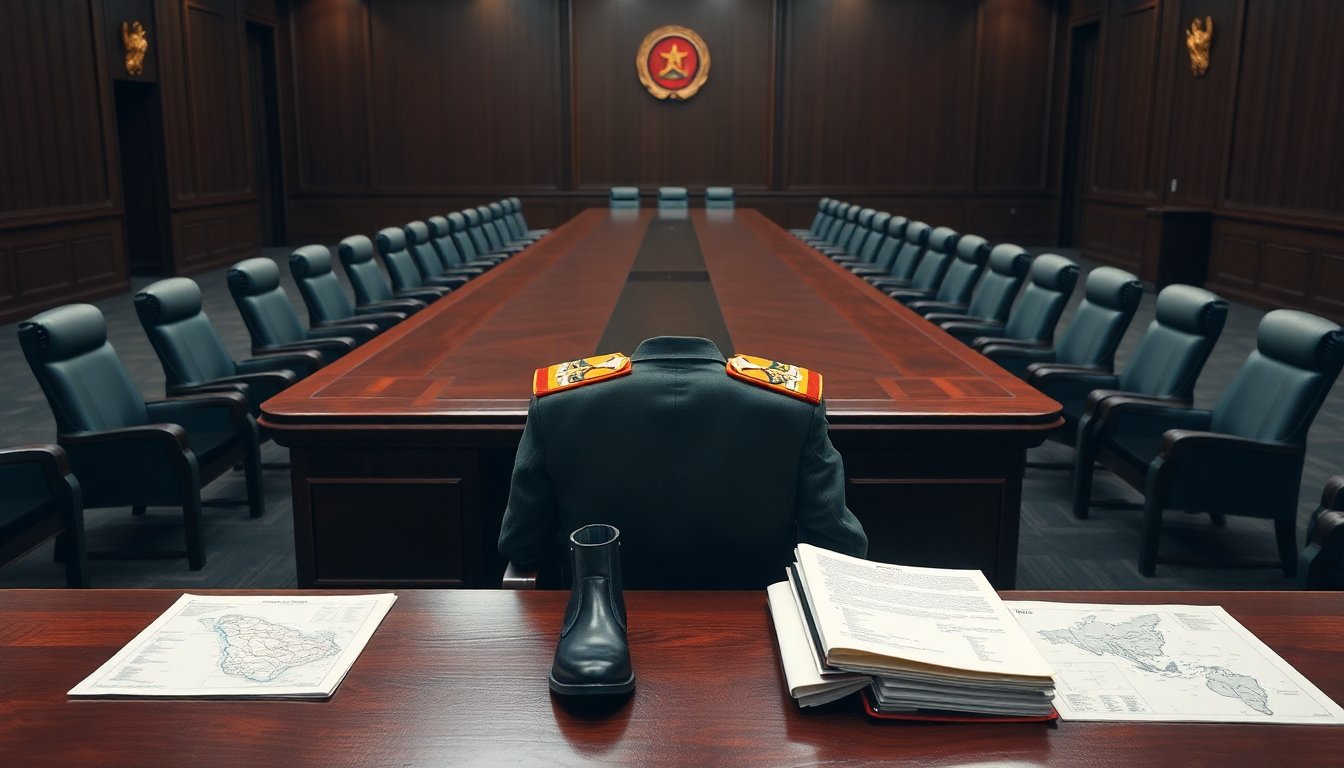
Xi Jinping’s campaigns to root out corruption, tighten ideological control, and secure the Chinese Communist Party’s monopoly have profoundly reshaped the People’s Liberation Army. Beyond purging individual officers, those efforts have produced an unexpected consequence: a thinning of seasoned senior commanders. This dispatch examines who has been affected, how the PLA’s leadership has changed, where tensions are developing, and the practical trade-offs Beijing now faces between loyalty and combat effectiveness.
A new logic of promotion
Since Xi consolidated power, political reliability has frequently outpaced operational experience as the principal criterion for senior promotion. The result: faster turnover at the top, shorter tenures in key posts, and fewer officers with deep combat, staff, and joint-exercise résumés. Promotion pathways and career incentives within the force have been altered—sometimes subtly, sometimes dramatically—pushing officers to demonstrate visible allegiance as much as professional skill.
How that plays out on the ground
Removing or sidelining long-serving figures has eroded command continuity and institutional memory. Planning cycles, joint-exercise coordination, and the accumulation of high-end operational knowledge now face gaps. Where once informal networks transmitted practical know-how and mentorship, those channels have been weakened, producing slower decision-making in some units and uneven implementation of doctrine in others.
The core dilemma: loyalty versus competence
Beijing wants commanders who are both politically trustworthy and operationally capable—but combining those attributes is hard. Elevating loyalists too quickly risks creating leaders who lack seasoning in crisis management and joint operations. Emphasizing professional credentials without rigorous political vetting, by contrast, is politically unacceptable to the Party. That tension shapes personnel choices at the highest levels and constrains the options for reform.
Institutional roots and consequences
Remember that the PLA is organized primarily as the Party’s armed wing, not as a constitutionally independent national military. At the apex sits the Central Military Commission, populated through Party channels and evaluated for political reliability. The recent rectification drives targeted corruption and patronage but also severed networks that had preserved operational knowledge. As experienced officers were forced out or marginalized, the reservoir of institutional memory shrank—affecting promotions, mentorship, and the informal coordination that underpins complex operations.
Practical effects on readiness
On the operational side, the changes have tangible costs. Units undergoing leadership rotation report slower decision cycles and greater reliance on centralized direction, which increases friction in complex missions. Informal mechanisms that once sped coordination across services are less dependable, placing added burdens on formal procedures and on commanders who now lack deep joint-experience backgrounds.
Paths for rebuilding the command
Beijing faces a constrained menu of options to restore capability while maintaining political control:
- – Accelerated promotions: Speeding up career tracks can get promising officers into senior roles quickly, but shortened seasoning leaves gaps in strategic judgment.
- Technocratic appointments: Bringing administrators and technical experts into command posts boosts managerial competence; it can, however, weaken the political predictability the Party demands.
- Investment in professional education: Expanding warfighting training and cross-service education builds durable competence, but it takes years to produce fully seasoned commanders.
- Hybrid approaches: The most viable path appears to be a calibrated mix of short-term fixes (tightening promotion rules, expanding joint exercises) and long-term professionalization (fellowships, targeted education, merit-based career lanes that also demonstrate political reliability).
What experts see
Analysts describe three complementary moves: make promotion boards more transparent and criterion-based; increase scenario-driven, integrated training to test command performance; and broaden officers’ experience—domestically and through selected international exposure—without compromising political screening. Each measure carries trade-offs, and the likely outcome will be an iterative combination of modest immediate gains and slower, deeper reforms.
Signals to watch
Personnel choices send clear messages about Beijing’s priorities. Key indicators for observers include appointments to the Central Military Commission, the service and operational backgrounds of incoming corps-level commanders, any public revisions to promotion rules, and changes in the tempo and complexity of joint exercises. If senior posts increasingly go to political figures with limited joint-command experience, the message will be a tilt toward loyalty and internal cohesion. If promotions favor officers with extensive operational résumés and theater-level command experience, the emphasis will be readiness and deterrence.
Broader implications
How the Party resolves this trade-off will shape the PLA’s trajectory. If ideological vetting continues to trump demonstrated operational skill, the force may struggle with high-end warfighting demands. If Beijing successfully rebalances loyalty and competence, the Party could field a more credible military while maintaining control over its armed instrument. For foreign analysts and policymakers, personnel patterns—more than rhetoric—will offer the most reliable clues about China’s intent and the type of military capability it prioritizes. Rebuilding institutional depth requires time, deliberate human-resource policies, and a willingness to accept trade-offs. Watch promotion cycles, command biographies, and exercise patterns—those signals will reveal whether the Party can close capability gaps without loosening the political reins.