
At the heart of Formula 1’s global broadcast engine sits a converted Boeing hangar at Biggin Hill — a purpose-built remote production centre that turns raw on-track feeds into the polished live coverage watched by about 827 million people worldwide (roughly 52 million in the U.S.). That single hub takes in signals from 24 circuits, 11 teams, 22 drivers and 22 cars, then spins them into the World Feed and dozens of tailored regional and platform-specific outputs.
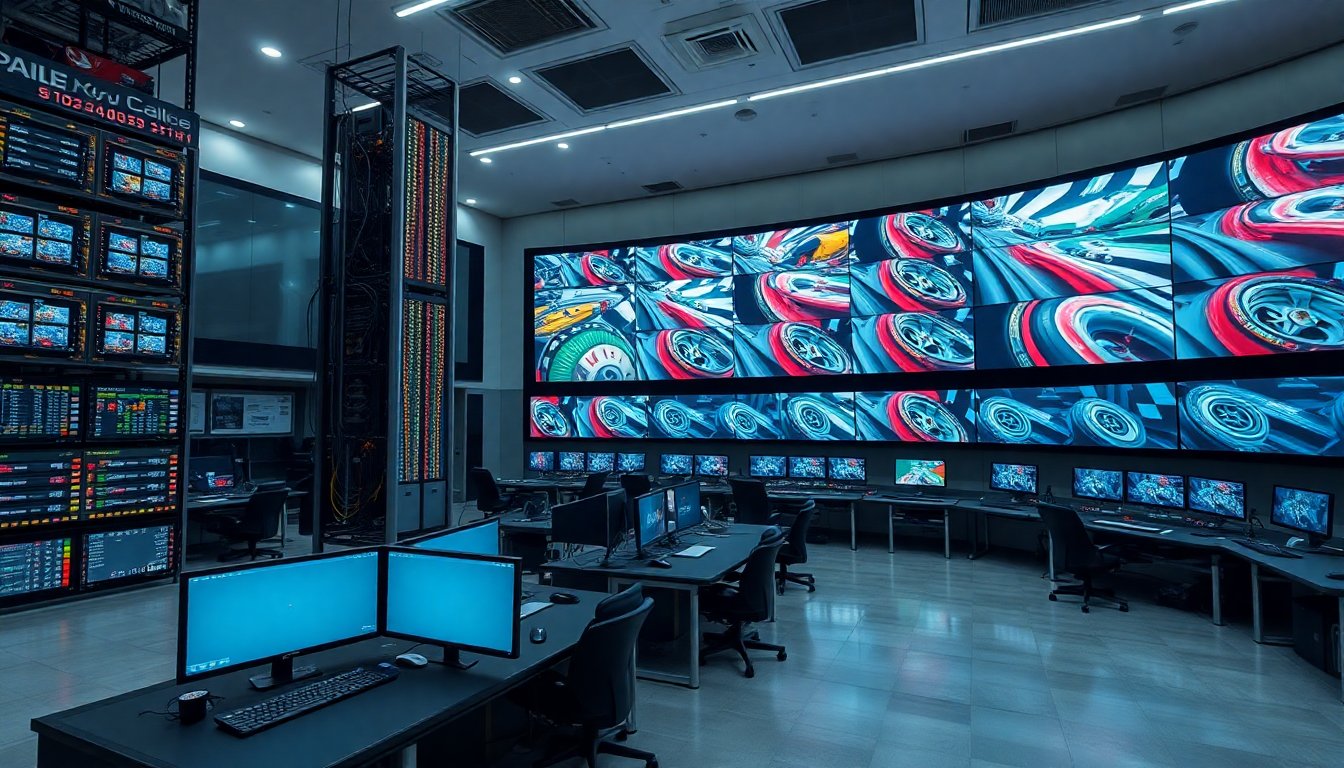
Inside the facility — which opened as F1’s remote-production base in 2026 — more than 300 screens and rows of server racks create a densely packed control room. Engineers and editors gather camera, audio and telemetry streams from races around the globe, assemble the main broadcast and then carve out bespoke versions for broadcasters, streaming services and highlight packages.
On race weekends the flow is relentless. Fiber lines snake from each track’s Event Technical Centre back to Biggin Hill, delivering camera feeds, timing data and commentary in real time. Producers recombine those sources on the fly, switching between global shots and regional variations while graphics, branding and ad insertion are applied centrally to keep a consistent look and feel.
The rigging on site mirrors that complexity: camera-operator controls, commentator booths and a Formula 1 TV studio sit alongside monitoring walls. With routing, quality checks and decision-making consolidated on one floor, latency is reduced and creative choices happen faster. During peak moments dozens of operators coordinate simultaneous outputs; between race weekends the centre repurposes its capacity for edits, archive transfers and rights feeds.
Redundancy is built into every layer. Multiple uplinks, duplicate encoders, alternative network routes and on-site generators reduce single-point failures. Engineers watch signal health constantly; when a feed falters automated systems and technicians can reroute to backups in seconds. Across an event weekend, more than 600 terabytes of data can move between a track and Biggin Hill.
Speed matters. Wherever possible the operation uses direct land links to keep viewer delay to roughly one second. Satellites are held as emergency alternatives — reliable but slower — so choices about compression, buffering and switching aim to preserve picture quality without adding lag.
Capturing the spectacle requires an enormous number of perspectives. Each car typically carries nine onboard cameras — nose, rear wing and fixed points that deliver visceral, driver-focused views — while producers also source material from 23–28 trackside cameras, pit-lane units and helmet cams. Everything is recorded in 4K and aggregated into the World Feed, which is then distributed to more than 180 territories and powers F1 TV’s direct-to-consumer service.
Sound is equally layered. Engineering teams led by audio and RF manager Emma Penney plant roughly 150 microphones around circuits and in spectator areas to capture ambient and mechanical audio. There are 44 independent team-radio feeds — driver and engineer conversations that help narrate the race — and radio producers like Ray Warner sift and select the most telling exchanges, balancing immediacy against context so clips don’t feel decontextualized. Automated transcripts speed the workflow, but human transcribers preserve nuance across dialects and slang.
The hub also handles special projects. Biggin Hill’s crews worked with Joseph Kosinski’s sound department on the feature film F1 to recreate authentic race audio — a reminder that production techniques often cross into storytelling. Dedicated editing teams shape camera and audio assets into coherent narratives designed to satisfy hardcore fans while remaining accessible to newcomers.
Audience changes have shifted how broadcasts are made. Streaming hits like Drive to Survive and film tie-ins have reframed Formula 1 as both sport and entertainment: about 43% of fans are now under 35, and roughly 42% of the global audience is female. Liberty Media’s push into storytelling, social clips and event presentation has broadened the sport’s reach — and changed not just who watches, but how the broadcasts are produced and promoted.
Inside the facility — which opened as F1’s remote-production base in 2026 — more than 300 screens and rows of server racks create a densely packed control room. Engineers and editors gather camera, audio and telemetry streams from races around the globe, assemble the main broadcast and then carve out bespoke versions for broadcasters, streaming services and highlight packages.0