
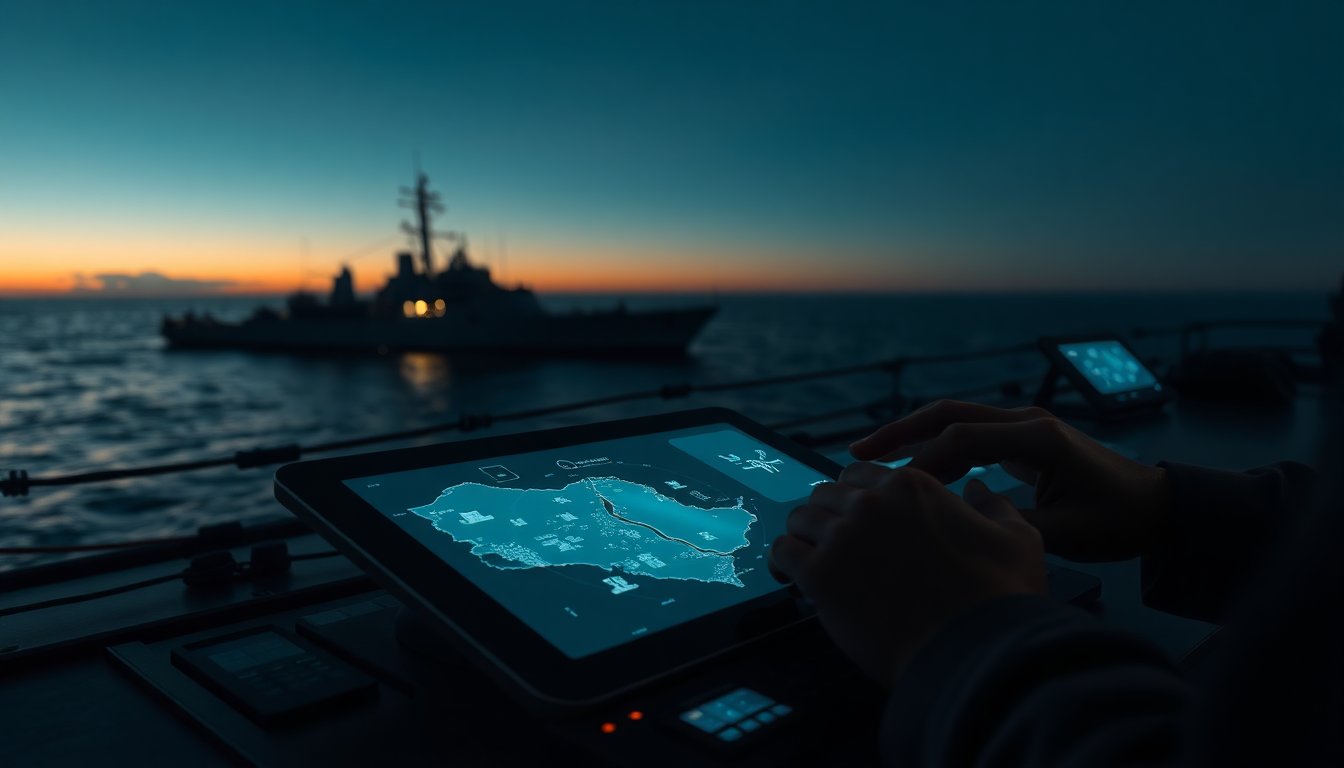
A recent sequence of events has quietly, but profoundly, changed how militaries and policymakers think about conflict in the Middle East. U.S. and regional officials say Moscow handed Tehran precise location intelligence on American ships and aircraft. That transfer—part strategic signaling, part battlefield assistance—forced Washington and its partners to alter force posture and protection measures almost overnight.
This episode didn’t happen in isolation. Three trends converged to reshape the operational picture: unorthodox cross-border intelligence sharing, a U.S. doctrinal shift toward limited interventions rather than occupation, and the rising use of commercial artificial-intelligence tools in the targeting chain. Together they compressed timelines from detection to strike, tightened windows for human review, and forced commanders to juggle tempo against control.
How information moved — and who moved it — mattered. Allied and partner services increasingly feed imagery, signals, and HUMINT into joint mission platforms. Centralized pipelines then run automated classifiers and generative models that surface candidate targets. The net effect on the battlefield has been immediate: more leads, faster processing, and higher sortie rates. Systems like embedded smart processors and off-the-shelf generative aids speeded target nomination and allowed staffs to process far greater volumes of data than before.
That acceleration brings practical benefits and thorny risks. Faster cycles improve responsiveness to fleeting threats, but they also raise the stakes for errors. Commercial AI models can magnify initial mislabels; a single mischaracterized input may cascade through scoring algorithms and elevate a benign location into a high-priority strike. Analysts are now tracking hard indicators to judge whether automation sharpens discrimination or simply increases strike volume: false-positive rates in target classification, median latency from sensor cue to engagement, and confirmation rates from post-strike battle-damage assessments.
Operational teams face legal, ethical, and procedural questions alongside technical ones. Who audits third-party algorithms? How do you establish and preserve data provenance across partner networks? Are decision logs sufficient for accountability after an operation? In response, officials are tightening data-validation pipelines, imposing higher human-in-the-loop thresholds for high-risk actions, keeping versioned model records, and mandating transparent input logs. The immediate yardsticks to watch during rollout are improved strike accuracy, independently cross-checked civilian casualty reports, and latency gains that can be directly tied to model updates.
Third-party location feeds also change the calculus of risk on the ground. When external actors can pinpoint positions quickly, exposed units grow vulnerable to precision attack. Commanders have reacted by changing movement patterns, enforcing stricter emission control, and dispersing assets — measures that reduce detectability but complicate sustainment, degrade readiness in some missions, and strain command cohesion.
Attribution becomes trickier as targeting chains lengthen. Tracing the origin of a cue — who detected it, who passed it along, and who acted on it — can lag behind an attack, delaying political responses and making escalation decisions more fraught. Robust reconstruction demands merged telemetry from diverse sensors, rigorous timestamps, and preserved provenance records so analysts can map the feed’s true influence on an operation.
Doctrinal changes have been the third force shifting outcomes. U.S. planners are increasingly favoring precise, limited interventions aimed at regime decapitation or selective pressure without long-term occupation. That approach compresses objectives into short, intense campaigns and relies heavily on intelligence partners and rapid strike options. The result: fewer boots on the ground but a heavier dependence on timely, reliable targeting information and on tools that can translate raw feeds into actionable plans at speed.
Putting those pieces together creates a field of trade-offs. Automation and intelligence sharing boost reach and responsiveness but increase the risk of misidentification and political blowback. Tighter, non-occupational doctrine reduces long-term entanglement but intensifies the need for flawless execution in compressed windows. Commanders must decide how much autonomy to grant algorithms and junior leaders in exchange for tempo—and governments must decide how much opacity in third-party systems they can tolerate.
Looking ahead, several priorities should guide policy and practice. First, build auditable chains of custody for intelligence that cross borders and commercial boundaries. Second, set clear human-review thresholds for different risk tiers so that high-consequence decisions never rest solely on opaque models. Third, invest in independent verification mechanisms for civilian-harm reporting and post-strike assessment. Finally, accept that faster engagement timelines will demand faster and more transparent political decision-making about escalation and attribution.
This episode didn’t happen in isolation. Three trends converged to reshape the operational picture: unorthodox cross-border intelligence sharing, a U.S. doctrinal shift toward limited interventions rather than occupation, and the rising use of commercial artificial-intelligence tools in the targeting chain. Together they compressed timelines from detection to strike, tightened windows for human review, and forced commanders to juggle tempo against control.0