
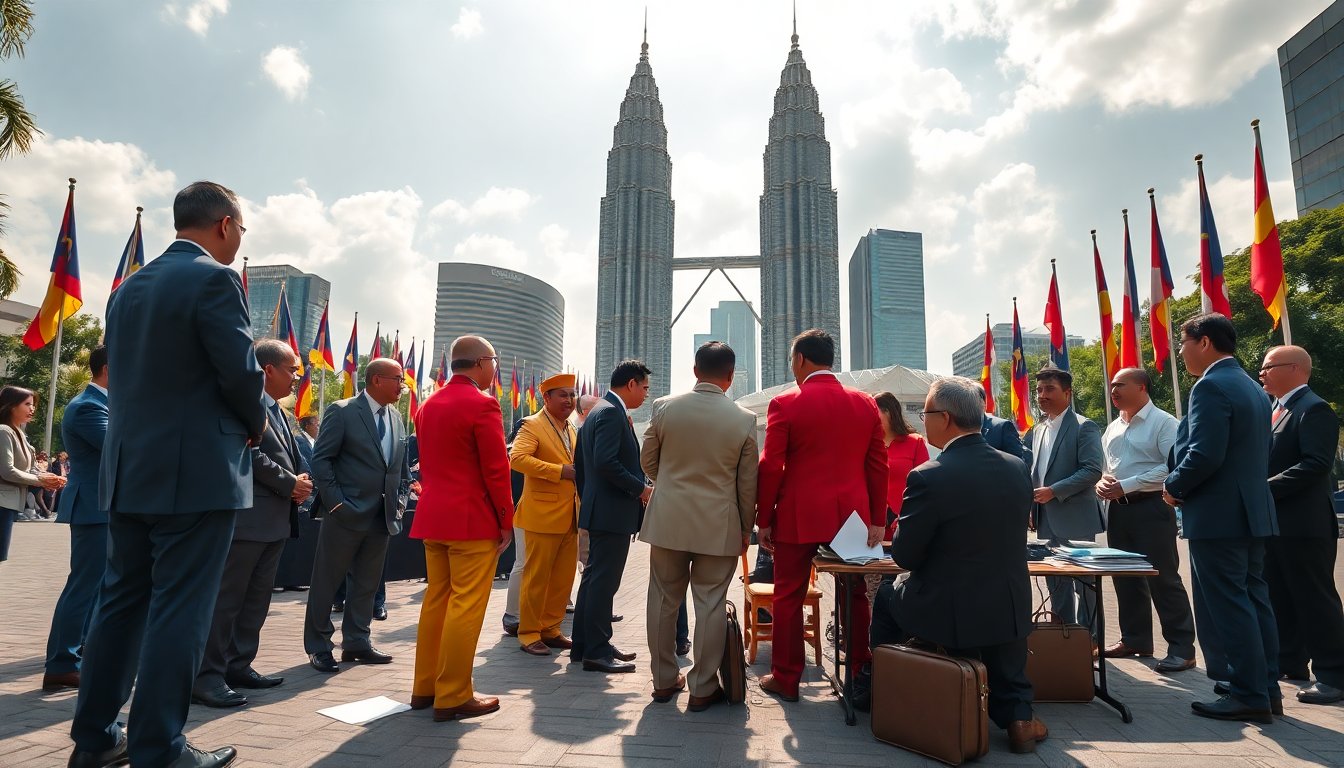
The vibrant city of Kuala Lumpur is set to host the 47th ASEAN summit from Sunday to Tuesday, attracting almost two dozen global leaders. This gathering represents a pivotal moment for the Association of Southeast Asian Nations as they address pressing concerns, including trade tensions and regional security issues.
ASEAN, which includes ten member nations—Brunei, Cambodia, Indonesia, Laos, Malaysia, Myanmar, the Philippines, Singapore, Thailand, and Vietnam—has a combined population of approximately 678 million and a gross domestic product of $3.9 trillion. This year marks a significant addition to the group with the inclusion of East Timor, which gained independence from Indonesia in 2002.
Main attendees at the summit
Leaders from nearly every ASEAN country will be present, except for Myanmar’s Senior General Min Aung Hlaing. Notable attendees include U.S. President Donald Trump, Chinese Premier Li Qiang, and Australian Prime Minister Anthony Albanese. The summit will also see participation from newly appointed Japanese Prime Minister Sanae Takaichi, South Korea’s President Lee Jae Myung, and New Zealand’s Prime Minister Christopher Luxon. Additionally, Brazilian President Luiz Inacio Lula da Silva and Canadian Prime Minister Mark Carney will join the discussions.
Agenda highlights
One of the key highlights of the summit is the anticipated signing of a peace agreement between Cambodia and Thailand aimed at resolving a longstanding border conflict. This agreement, to be overseen by Trump and Malaysian Prime Minister Anwar Ibrahim, follows a serious flare-up in July that resulted in numerous casualties and displacements. While the ceasefire was brokered with international support, critics argue that the deal may serve more as a publicity stunt rather than a genuine resolution.
Concerns over economic stability will also take center stage, particularly in light of Trump’s recent tariff initiatives. The ongoing U.S.-China trade war has left many nations grappling with the implications of increased tariffs, especially regarding access to rare earth minerals essential for high-technology manufacturing, a sector currently dominated by China.
Regional challenges and international implications
The summit will address not only economic issues but also significant political challenges. Myanmar, embroiled in a civil war, poses a destabilizing threat to the region. Myanmar’s acting president will not participate in the summit, and the country will not assume the ASEAN chair next year as planned. Instead, the Philippines will take over the role.
Humanitarian concerns and regional security
In light of the humanitarian crisis stemming from Myanmar’s conflict, ASEAN’s previous Five-Point Consensus, which called for an immediate ceasefire and humanitarian aid, will be revisited. Critics, including Charles Santiago, co-chairman of ASEAN Parliamentarians for Human Rights, have voiced concerns about the lack of progress since the consensus was established.
There is also a growing need to address the proliferation of scam centers across Southeast Asia, which have become lucrative for criminal networks. These issues not only threaten regional stability but also complicate international relations.
Looking ahead
Despite the high expectations surrounding the summit, skepticism remains about the tangible outcomes of these discussions. Many attendees are likely to seek private conversations with Trump regarding tariffs and trade agreements, as these negotiations have significant implications for their economies. As Marco Foster, an ASEAN expert, noted, the event may ultimately serve as a major photo opportunity rather than a platform for substantial policy changes.
Moreover, the unique structure of ASEAN, which prioritizes the independence of its member states, complicates the enforcement of collective decisions. Unlike the European Union, ASEAN lacks a robust mechanism to ensure compliance with its resolutions, often leading to criticism regarding its effectiveness in addressing regional crises.
ASEAN, which includes ten member nations—Brunei, Cambodia, Indonesia, Laos, Malaysia, Myanmar, the Philippines, Singapore, Thailand, and Vietnam—has a combined population of approximately 678 million and a gross domestic product of $3.9 trillion. This year marks a significant addition to the group with the inclusion of East Timor, which gained independence from Indonesia in 2002.0


