
Table of Contents
The lives of artists and the contours of civic belonging can feel like separate stories, yet together they highlight questions about recognition, access and time. On one hand is Thaddeus Mosley, a self-taught sculptor from western Pennsylvania who spent decades shaping monumental forms from oak, walnut and cherry before wider audiences noticed his work. On the other is Daisy Hernandez, whose book Citizenship: Notes On An American Myth traces how legal status and everyday access—what scholars call social citizenship—determine whether people truly belong in the United States.
Both stories illuminate how recognition can be deferred or denied: Mosley carved in a garden-studio while holding a postal job at night, and Hernandez describes families who live with limited access to health care, education and housing despite formal legal categories. These narratives ask readers to consider the difference between formal status and lived reality, whether in the slow revelation of an artist’s œuvre or in the policy choices that shape a person’s daily life.
Thaddeus Mosley: a life in hand-carved wood
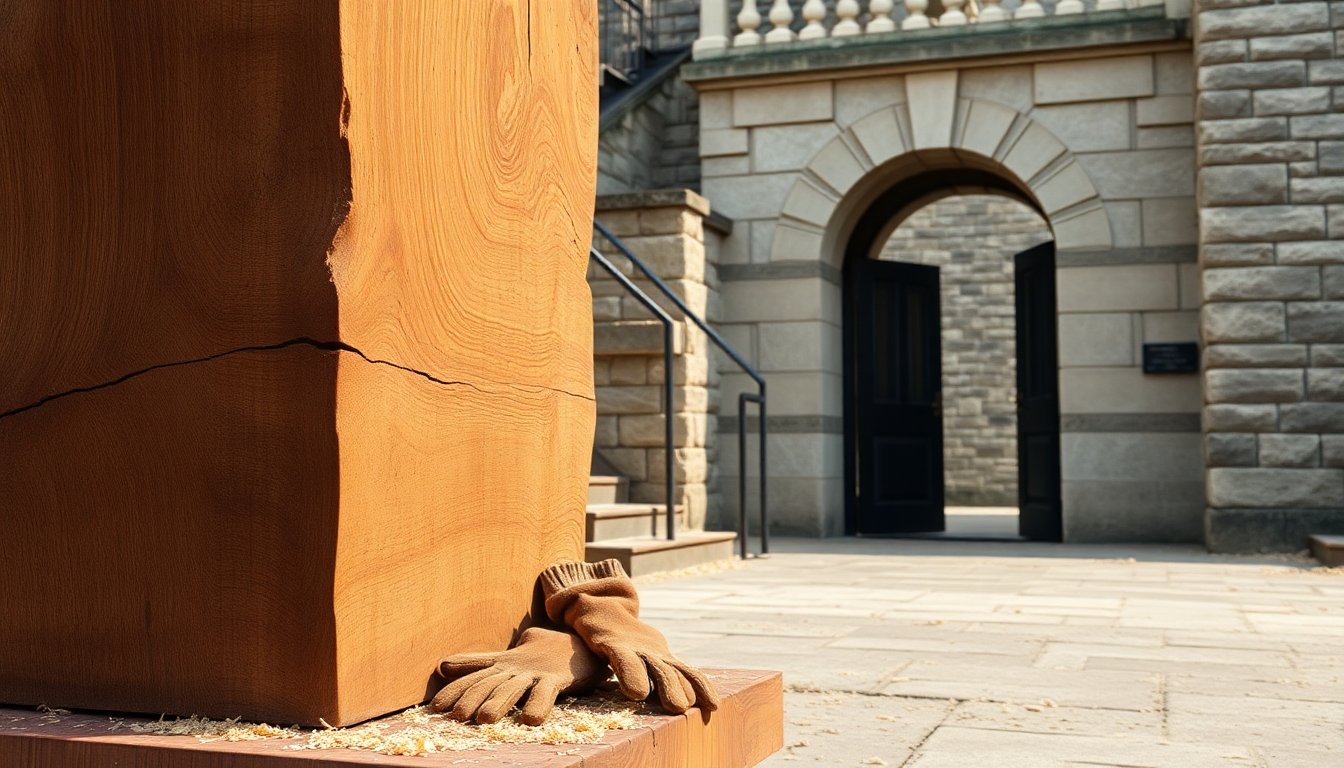
Born in New Castle and long based in Pittsburgh, Thaddeus Mosley made a career of turning salvaged tree trunks into works that feel both monumental and airily balanced. A lifelong practitioner who never attended art school, he gathered wood from his neighborhood, kept to hand tools and worked in an open-air studio that left surfaces alive with grain, knots and scars. This tactile fidelity to material set him apart: his sculptures read as gestures of restraint and response, where every cut answers the tree’s history. Despite working outside major art markets for decades, he later found exhibition space at institutions such as the Carnegie Museum of Art and international events including Frieze Sculpture in London.
Mosley’s approach valued improvisation and endurance. He was a devoted listener to jazz, and the music’s spontaneity informed his practice: forms emerge like improvised phrases rather than preplanned designs. Comparisons have been made to other modern masters, but Mosley preserved the wood’s memory instead of smoothing it away, creating forms that feel both ancient and contemporary. His late-career recognition reframed him from a regional craftsman to a major figure whose work now resides in prominent collections and public places.
Daisy Hernandez and the idea of social citizenship
In Citizenship: Notes On An American Myth, Daisy Hernandez reframes citizenship as more than paperwork by foregrounding the concept of social citizenship—the idea that belonging includes access to essentials such as health care, schooling and housing. Drawing on the work of T. H. Marshall, she explains that political and civil rights are only part of the story: a full civic life depends on material supports that make participation possible. Hernandez blends family memoir—she grew up in a Latino household in Union City, New Jersey, with a Cuban father and a Colombian mother—with historical episodes that show citizenship’s shifting rules, from exclusionary laws to the expansions of the 1960s and 1970s.
Her book recounts how policy choices create unequal access. Hernandez recalls growing up without employer-based health coverage and relying on community clinics and health fairs, and she shares a personal moment when, after getting her first solid job, she tried to enroll family members as dependents on her insurance and found the system closed to that need. She also traces legal history back to the early naturalization rules of 1790, the Chinese Exclusion era, mass deportations in the 1930s and later reforms—illustrating that citizenship in the United States has always been contested and rearranged by politics and power.
Personal stories as windows into policy
Hernandez argues that making these private stories public matters because silence can let inequality harden into policy. By naming how families navigated healthcare, work and immigration rules, she offers a language—social citizenship—to describe disparities that are often reduced to abstract debates. The anecdote about marriage as a pathway to benefits, for example, shows how intimate choices become ways to extend social protections when institutions fail to do so, and why legal status alone may never guarantee daily security.
Why both narratives resonate now
Viewed together, Mosley’s slow, patient making and Hernandez’s insistence on naming lived exclusion both insist on time and attention. Mosley’s work proves that creativity and value can exist outside immediate recognition, while Hernandez reminds readers that civic worth depends on material conditions and political will. Each story asks for a change in perspective: to attend to what has been overlooked, whether an artist carving in a garden-studio or the many families whose access to care and rights is partial and provisional. That shared call—to see, to value and to act—offers a clear prompt for cultural institutions and policymakers alike.