
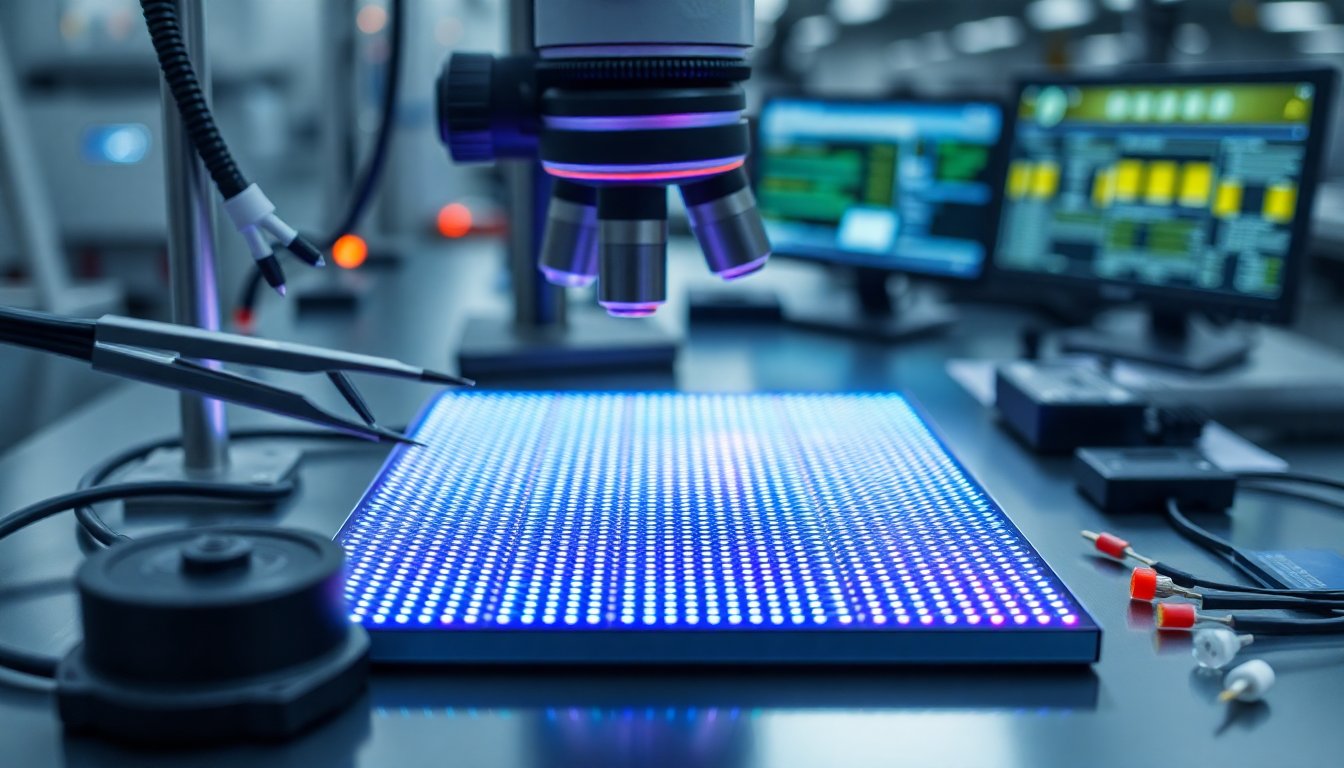
MicroLED displays are quietly reshaping how we think about screens. Instead of relying on backlights or organic materials, MicroLED uses millions of tiny inorganic LEDs—each one a self-contained pixel—to produce images. That change in basic architecture brings a handful of meaningful advantages: far higher peak brightness, deep blacks from per-pixel control, rapid response times, and long operational lifetimes. But it also introduces one stubborn challenge: manufacturing at scale.
What MicroLED actually is
– At its heart, a MicroLED panel is a dense array of microscopic inorganic LEDs, typically only a few micrometres across. Each LED can be driven independently, so instead of a global backlight or filter, every pixel is its own light source.
– Color can come from native red/green/blue emitters or from color-conversion layers placed over blue or UV LEDs. Drive electronics on the backplane control current to each diode, determining brightness and color.
How these displays are made
Think of the production flow as building a high-resolution mosaic at nanometre precision:
1. LED chips are grown and processed on donor wafers using high-resolution epitaxy and wafer-level fabrication.
2. Mass-transfer systems pick up millions (or billions) of these minute dies and place them onto the display substrate with micrometre or sub-micrometre accuracy. Techniques range from parallel pick-and-place arrays to electrostatic transfer tools.
3. Electrical interconnects and mechanical packaging are completed—using solder, conductive adhesives, or hybrid bonding—and optical alignment and thermal solutions are added.
Thermal management is crucial. Inorganic LEDs tolerate higher temperatures than OLEDs, but dense arrays still generate heat that must be dissipated without compromising lifetime or uniformity.
Why MicroLED matters (and what it does well)
– Brightness and contrast: Because each pixel emits light independently and can be turned fully off, MicroLEDs deliver exceptional peak luminance and near-perfect blacks—ideal for HDR content and outdoor visibility.
– Response and motion: Fast response times translate to reduced motion blur, an advantage for gaming and immersive video.
– Longevity and burn-in resistance: Inorganic emitters typically outlast organic counterparts and are far less prone to permanent image retention.
– Pixel density potential: Extremely small pixel pitches enable super-high perceived resolution, which is particularly valuable for near-eye displays and compact AR optics.
– Efficiency in practice: For mixed content, power can be lower than backlit LCDs because only lit pixels consume energy—beneficial for wearables and battery-powered devices.
The practical trade-offs
– Manufacturing complexity: The biggest hurdle is moving and reliably connecting millions (or billions) of tiny LEDs. Sub‑micron placement accuracy, consistent interconnects, and high yields are non-negotiable but technically demanding.
– Cost and yield pressure: Yield loss at the die and transfer stages quickly drives up per-panel costs. Defect repair and calibration add time and expense.
– Color uniformity: Integrating RGB emitters at scale—or using color conversion—creates challenges in variance, binning, and per-pixel calibration.
– Capital intensity: New pick-and-place tools, inspection systems, and repair equipment require heavy upfront investment, slowing cost parity with OLED and advanced LCD for mass markets.
Where MicroLED is already a fit
MicroLED is finding traction where its unique strengths outweigh the premium:
– High-end TVs and reference monitors that prioritize HDR performance and long-term brightness.
– Wearables and smartwatches that need bright displays with low standby power and good outdoor readability.
– AR and near-eye displays, where tiny pixel pitches deliver high perceived resolution in a small form factor.
– Outdoor signage, automotive HUDs, and specialized industrial displays that demand durability and continuous operation.
Market dynamics and commercialization
The current landscape is a patchwork of pilot lines, research projects, and small-scale commercial products. Major display makers and deep-pocketed startups are investing in mass-transfer automation, wafer supply chains, and advanced backplanes. Progress will hinge on three linked areas:
– Mass-transfer systems: Faster, more accurate placement with integrated defect detection and repair.
– Wafer and die quality: Higher usable-die counts per wafer reduce per-pixel cost pressure.
– Backplane and driver integration: Driver architectures that support local repair, redundancy, and low standby leakage.
There are some clear technical benchmarks analysts watch. For billion-pixel panels, transfer yields above 95% would be a meaningful milestone. Equally important for handheld devices is driving per-pixel standby leakage down toward the microwatt range—industry targets often cite <1 μW per pixel to meet realistic power budgets.
The near-term outlook
Expect incremental advances rather than a sudden leap. Improvements in mass-transfer throughput, automated calibration, and color-conversion chemistry will expand MicroLED’s addressable market from high-value niches into broader categories. Hybrid approaches—such as microLED-on-CMOS or microLED-OLED stacks—may help bridge gaps while pure MicroLED economies mature. The technical foundation is solid; the barrier is industrial. If manufacturing yield, transfer speed, and repair automation continue to improve, MicroLED could move from a premium specialty into a mainstream display option—starting in places where brightness, lifetime, and resolution matter most.