
Table of Contents
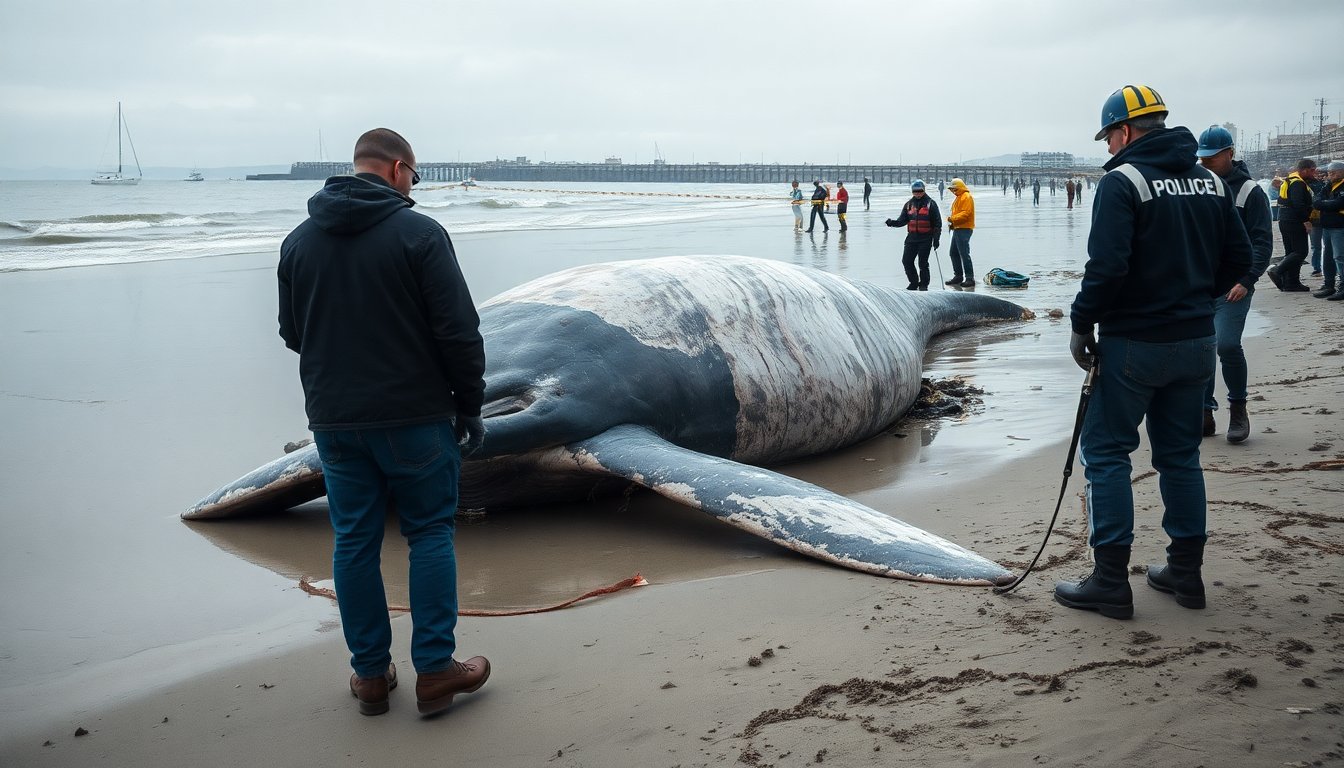
On March 26 a large marine mammal washed ashore at Rockaway Beach, prompting a multi-agency response. The carcass, identified as a Sei whale of roughly 40 feet in length, was first seen floating offshore before drifting toward the peninsula and coming ashore near the Beach 95–96 area. City and state crews moved quickly to cordon off the site, both to protect public safety and to preserve the scene for scientific examination. Representatives from the Atlantic Marine Conservation Society and the National Oceanic and Atmospheric Administration prepared to perform a formal necropsy — an animal autopsy — to determine why the whale died.
The initial field assessment and the follow-up examination revealed concerning trauma concentrated on one side of the animal. Specialists reported visible abrasions along the right flank and deep bruising within adjacent tissues, findings that investigators say align with the pattern of injuries typically seen in a boat strike. While teams will continue laboratory tests and more detailed study, those early observations led officials to list vessel collision as the likely cause while they rule out other possibilities such as disease or entanglement. The site was monitored and secured by the New York State Department of Environmental Conservation and NYC Parks during the work.
Findings from the necropsy
The formal necropsy conducted by conservation scientists examined both external wounds and internal trauma. Examiners noted pronounced skin abrasion consistent with contact against a hard surface, and extensive hemorrhaging in the muscle and connective tissues on the animal’s right side. Those internal signs of blunt-force trauma are being treated as key evidence pointing toward a collision with a vessel propeller or hull. Lab samples have been collected for toxicology and disease screening, because a complete cause-of-death determination requires ruling out medical conditions or toxins that could have weakened the animal prior to impact. Throughout the process, teams emphasized adherence to protocols designed to preserve forensic detail.
Why the injuries suggest a collision
Investigators say the distribution and depth of the wounds correspond with documented patterns from previous boat strike cases: surface abrasions where a hull may have contacted skin and deeper bruising where underlying tissues absorbed kinetic energy. The term boat strike describes trauma inflicted when a vessel collides with a marine mammal, and it is a well-recognized threat to large whales. Although definitive attribution can take weeks as samples are analyzed, the combination of external and internal trauma observed so far makes a collision the leading hypothesis. Scientists remain cautious and are completing a full set of tests.
Public safety, response and next steps
Officials repeatedly warned that standing close to a stranded whale is hazardous: the decomposition process can cause the carcass to bloat and rupture, releasing gases and creating dangerous conditions. For that reason, the public was kept behind barriers while crews carried out their work, and local agencies planned to bury the animal on-site after examinations are complete. The response involved coordination among municipal and state teams, plus marine mammal experts, reflecting standard procedure when large protected animals wash ashore. Organizers also asked residents to avoid disturbing evidence and to report any relevant sightings from before the stranding.
Context and conservation concerns
The stranded animal is a reminder that large whales are present in coastal waters but remain vulnerable. Sei whales are protected under the Endangered Species Act, and researchers are monitoring their local presence and threats. Rockaway has seen other strandings in recent years, including a large humpback discovered last May and earlier cases such as a 25-foot minke in February 2026, plus a juvenile sperm whale that washed ashore in a prior year. Authorities plan to publish a full report when all necropsy results are compiled, and conservation groups hope the findings will inform measures to reduce collisions and improve marine mammal protection.