
Table of Contents
In the ongoing debate surrounding immigration enforcement in the United States, recent events have underscored a troubling reality: even U.S. citizens are not exempt from aggressive tactics employed by U.S. Immigration and Customs Enforcement (ICE). This was starkly illustrated when Amanda Trebach, a dedicated intensive care nurse, found herself on the receiving end of violence typically directed at undocumented individuals.
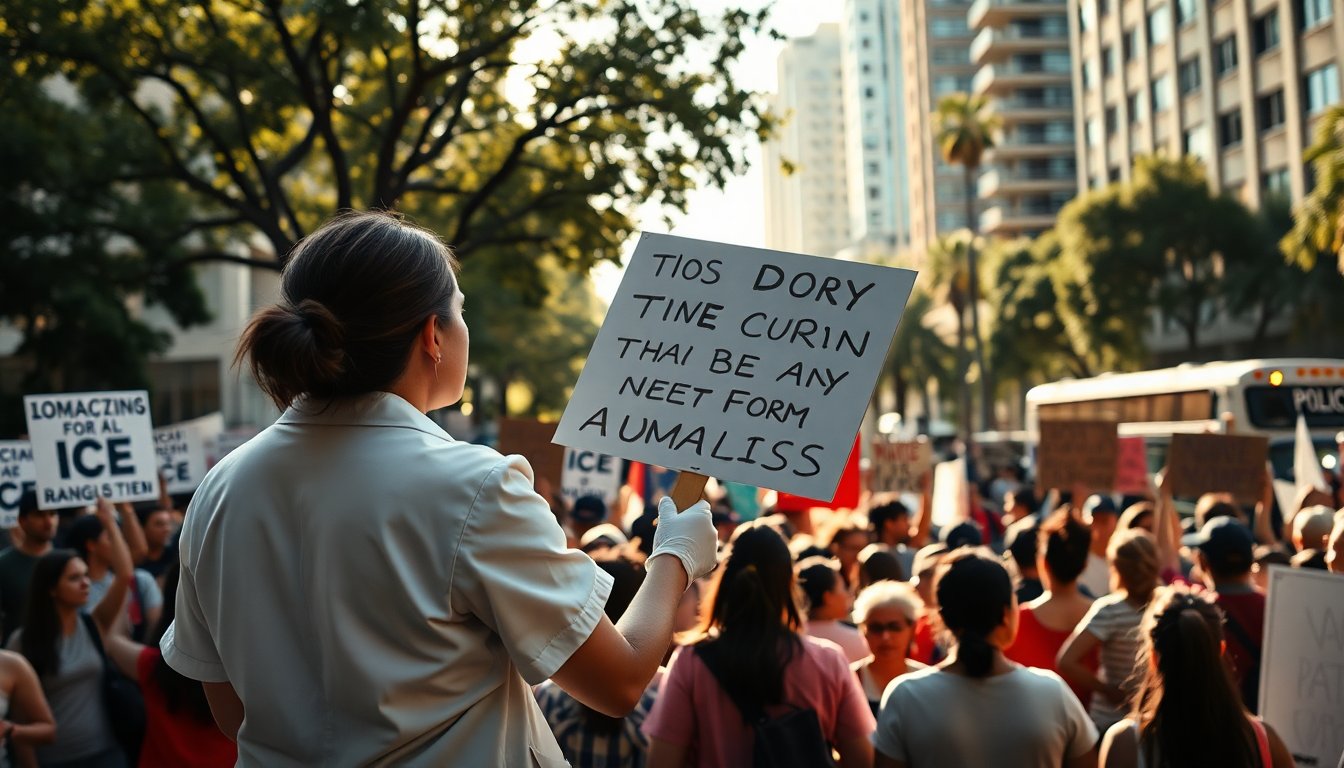
In August, Trebach participated in an activist group in Los Angeles known as Harbor Area Peace Patrols, which works to protect vulnerable migrant communities from ICE raids. The group had been documenting the movements of ICE agents, aiming to alert those at risk. However, during a routine observation of agents preparing for a raid, Trebach’s efforts encountered harsh resistance.
The alarming arrest of Amanda Trebach
On August 8, while Trebach and her fellow activists were capturing images of ICE vehicles, the situation escalated dramatically. Federal agents abruptly confronted Trebach, forcibly taking her to the ground, handcuffing her, and placing her in a van. In her own words, she described the experience as akin to being kidnapped by masked individuals. “You don’t know who they are. They don’t identify themselves. There’s no due process,” Trebach recounted to CBC News.
This incident, which left Trebach shaken, was not an isolated case. It highlights a disturbing pattern where citizens, even those engaged in peaceful monitoring of ICE activities, find themselves subjected to violent detentions. After hours of being held, Trebach was released without charges, a fact that speaks volumes about the law enforcement practices currently in play.
A broader investigation into ICE’s practices
According to a recent investigation by ProPublica, Trebach is among over 170 U.S. citizens who have been detained by immigration enforcement as of early October. University of California law professor Jonathan Zasloff commented on this alarming trend, stating that ICE appears to operate with a sense of impunity, able to violate constitutional rights without repercussion.
The case of George Retes
Another worrying example is that of George Retes, a U.S. Army veteran, who found himself inadvertently caught in an ICE operation while heading to work. Retes was driving to his job at a legal marijuana facility when he arrived at a scene filled with federal officers clad in military gear. As tensions escalated, agents unleashed tear gas on the crowd, engulfing Retes’ vehicle in smoke.
Despite identifying himself as a citizen, Retes experienced excessive force firsthand. He described how agents shattered his window and pepper-sprayed him while others stood by. “Even though I’m just complying, an agent puts his knee on my back and another agent puts his knee on my neck,” he explained, recounting his desperate plea, “I can’t breathe.”
The implications of aggressive enforcement
ICE has publicly defended its actions, alleging that Retes was obstructing law enforcement. However, the rapid escalation of force raises serious questions about the appropriateness of their methods. During this particular operation, over 360 individuals were detained, with several U.S. citizens among them, further showcasing the widespread impact of ICE’s tactics.
Retes, after spending three days in detention, was released but remains haunted by the experience. He missed significant family events, including his daughter’s birthday, and is now pursuing legal action against the federal government for what he describes as an unconstitutional detention.
Community impact and political ramifications
The recent ICE raids have not only affected individuals but have also instilled a palpable fear within immigrant communities. Many migrants are now hesitant to seek essential services, such as medical care, due to fears of being detained. Trebach articulated this fear, emphasizing how the current administration has created a climate of anxiety designed to exert control over immigrant populations.
In August, Trebach participated in an activist group in Los Angeles known as Harbor Area Peace Patrols, which works to protect vulnerable migrant communities from ICE raids. The group had been documenting the movements of ICE agents, aiming to alert those at risk. However, during a routine observation of agents preparing for a raid, Trebach’s efforts encountered harsh resistance.0
In August, Trebach participated in an activist group in Los Angeles known as Harbor Area Peace Patrols, which works to protect vulnerable migrant communities from ICE raids. The group had been documenting the movements of ICE agents, aiming to alert those at risk. However, during a routine observation of agents preparing for a raid, Trebach’s efforts encountered harsh resistance.1