
Table of Contents
Fire at Palm Jumeirah building injures four, authorities say
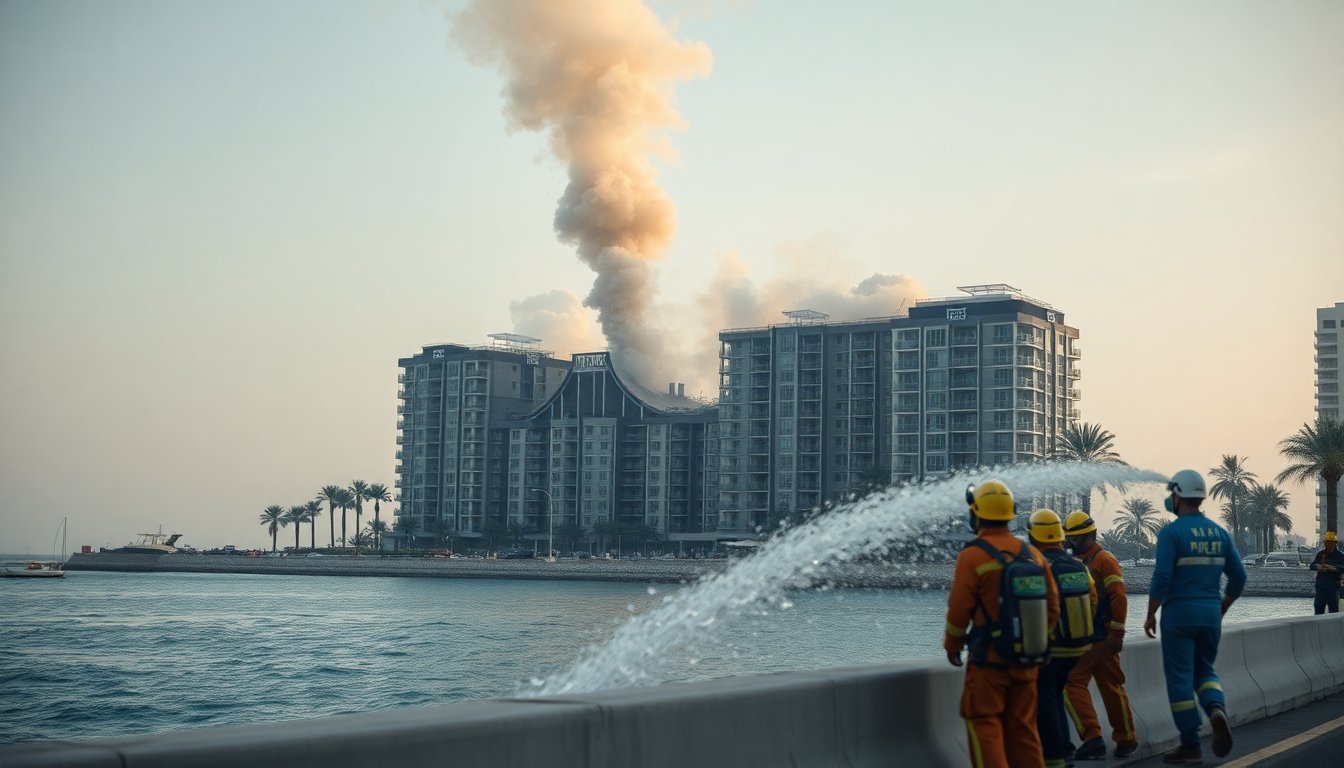
The United Arab Emirates reported a fire at a building in Dubai’s Palm Jumeirah after witnesses heard a loud explosion. Emergency teams contained the blaze and authorities confirmed four people were injured. The Dubai Media Office said the scene was secured and urged the public to rely on official updates rather than sharing unverified footage on social platforms. Local officials described the event as \”an incident\” while emergency responders completed initial containment and assistance efforts.
The trending moment
Who: Emirati emergency services and the Dubai Media Office led the response. What: A fire broke out following reports of an explosion at a building on Palm Jumeirah. Where: The incident occurred in the Palm Jumeirah area of Dubai. When: Authorities released information contemporaneously with the response. Why: Officials have not publicly detailed the cause as of the initial containment and assistance phase.
Expert insights
Industry experts confirm that rapid containment reduces the risk of wider structural damage in high-density coastal developments. Those in emergency management know that prompt cordons and verified communication are critical after any reported explosion. The Dubai Media Office’s appeal to avoid unverified footage aligns with international best practice for public safety and operational security.
Official guidance and next steps
Emergency teams remain on site to complete assessments and provide assistance to those affected. Authorities are expected to release further updates as investigations proceed and medical evaluations conclude. The public is advised to follow verified channels for official statements and to avoid sharing unconfirmed material that could hinder response efforts.
What to watch for
Officials will likely report on the cause of the explosion, the condition of the injured and any structural impact once investigations advance. Expect formal statements from the Dubai Media Office and the relevant safety agencies as they confirm findings and next steps.
What authorities and witnesses reported
Following the earlier notice from the Dubai Media Office, authorities said they were examining whether the blast and subsequent fire were linked to the wider round of regional strikes attributed to Tehran. Officials did not immediately assign a definitive cause. Emergency responders reported four people injured at the Palm Jumeirah site and firefighters controlled the blaze.
Regional air defenses and related incidents
Gulf air-defense forces, including those of the United Arab Emirates, reported intercepting incoming projectiles during the same period. One account from emergency crews and building staff indicated that an object struck the hotel structure, causing the loud explosion witnesses described. Separate explosions and air-defense activity were reported in other countries hosting U.S. forces, showing the confrontation affected multiple locations across the region.
What to expect next
Investigators from safety agencies and security services will continue on-site examinations and review surveillance and radar data. The Dubai Media Office and relevant authorities are expected to issue formal findings and next steps after completing their assessments. Industry experts confirm that such probes typically take several days as teams reconcile physical evidence with air-defense records.
Regional context: exchanges, condemnations and military posture
Official statements stressed public safety and urged calm. The Dubai Media Office reminded residents and visitors that safety is the top priority. It asked people to avoid circulating videos that could spread misinformation.
The UAE’s Ministry of Defense described the country as having been \”subjected to a blatant attack involving Iranian ballistic missiles.\” The ministry said national air defense systems had \”successfully intercepted a number of missiles.\” It added that the UAE \”reserves its full right to respond.\”
These messages framed the hotel fire as part of a larger security event rather than an isolated accident. Industry experts confirm that such framing can shape both domestic perceptions and international diplomatic responses.
Investigations are continuing. Industry experts confirm that probes typically take several days as teams reconcile physical evidence with air-defense records. Authorities say results will inform any further military or diplomatic steps.
Observers note the incident occurs amid heightened regional tensions and shifting military postures. The immediate effect has been increased scrutiny of air-defence readiness and communications from regional capitals.
The immediate effect has been increased scrutiny of air-defence readiness and communications from regional capitals. Across the Gulf, several governments issued sharp diplomatic rebukes. They described the strikes as acts of aggression and reiterated support for regional partners. Qatar publicly asserted its right to self‑defense and described incidents on its territory as violations. Saudi Arabia warned of grave consequences for continued breaches of sovereignty. Reports also tied explosions in Bahrain, Qatar, Kuwait and Jordan to wider security reverberations near locations where U.S. forces are stationed.
UAE and allied responses
The United Arab Emirates and its partners joined the chorus of condemnations. Their statements emphasized protection of territorial integrity and regional stability. Industry experts confirm that such coordinated rhetoric aims to deter further escalation and reassure allied forces. Military officials in the region said they were reviewing patrol patterns and surveillance postures. Diplomatic channels remained active as governments sought clarity on responsibility and intent. The trend that’s taking over in official communications is firm language paired with calls for measured responses.
Those in regional security circles know that public statements serve multiple purposes. They signal resolve to domestic audiences and provide a framework for allied consultations. Analysts say enhanced intelligence sharing and joint contingency planning are probable next steps. The most innovative states focus on strengthening early‑warning systems and interoperability among air‑defence networks. Expect further official briefings as investigations proceed and as partners assess risks to military facilities and critical infrastructure.
Expect further official briefings as investigations proceed and as partners assess risks to military facilities and critical infrastructure. The UAE’s announcement that missiles were intercepted, and its public reserve of the right to retaliate, illustrates how states are positioning themselves amid a widening escalation. Officials in the region characterized recent moves as defensive responses to Iranian strikes that targeted both Israeli and U.S. assets. For civilians, the immediate consequences included disruption and physical damage in urban centers such as Dubai, and authorities issued directives prioritizing safety and verified information to limit alarm.
The U.S. military role and the Tomahawk factor
U.S. forces in the region have signalled a deterrent posture while seeking to avoid direct escalation. Industry experts confirm that the availability of cruise missiles, notably the Tomahawk, shapes both planning and public rhetoric. Commanders assess options that range from patrol and presence operations to more kinetic measures, while allies coordinate rules of engagement. The presence of long-range precision weapons increases the complexity of any response. Military spokespeople stress proportionality and legal justification for operations in shared air and maritime spaces.
Expert insights
Defense analysts note a shift toward layered responses combining diplomatic pressure and calibrated military steps. Those in regional security circles know that intercept claims and counter-threats serve multiple purposes: reassuring domestic audiences, deterring adversaries, and signalling commitment to partners. Experts warn that misinformation can worsen tensions, underscoring the need for transparent, verified reporting from official channels. Independent analysts call for clear timelines on investigations and for multilateral channels to reduce the risk of miscalculation.
Local impact and safety directives
Authorities emphasised civilian protection through targeted advisories and verification mechanisms for information. Emergency services conducted damage assessments in affected neighborhoods and urged residents to follow official updates. Communications from governments aimed to maintain calm while preserving operational security. The evolving picture suggests continued diplomatic and military consultations across the region as partners balance deterrence, de-escalation and the protection of critical infrastructure.
The strike and immediate response
U.S. forces carried out strikes that included the use of a Tomahawk cruise missile system as part of a wider response in the region. The action followed diplomatic and military consultations among partners balancing deterrence, de-escalation and protection of critical infrastructure. Officials described the strikes as targeted and limited in scope. Industry experts confirm the choice reflects a preference for stand-off options that minimise personnel risk while aiming to degrade specific capabilities.
Capabilities and strategic use
The Tomahawk is a long-range, ship- and submarine-launched cruise missile known for precision in early phases of limited operations. Historically manufactured by Raytheon, now RTX, it can deliver a heavy warhead across hundreds of miles. Commanders value its combination of range, guidance accuracy and the ability to strike without deploying large numbers of forces. Those in defence planning say the system provides rapid response options that can be tailored to political and military objectives.
Expert insights
Analysts note the weapon’s utility depends on reliable intelligence and clear legal authority. Industry and defence experts confirm accuracy and persistence of guidance systems remain crucial. The trend that’s taking over in modern operations is reliance on stand-off precision munitions to limit escalation and reduce coalition exposure. Military planners also emphasise the need to pair strikes with diplomatic measures to avoid unintended consequences.
What comes next
Officials expect further briefings as assessments continue and partners evaluate risks to facilities and maritime routes. The most innovative defence strategies focus on integrating intelligence, diplomacy and calibrated force options. Future developments will likely reflect ongoing efforts to balance deterrence with de-escalation in a volatile operational environment.
Future developments will likely reflect ongoing efforts to balance deterrence with de-escalation in a volatile operational environment. Military planners face a narrow set of tools to signal resolve without widening a conflict. Tomahawk cruise missiles remain one such tool, valued for their long range and precision. Industry experts confirm that policymakers prefer options that minimise personnel risk while delivering a clear tactical effect. At the same time, cost and inventory constraints shape when and how these systems are employed.
The Tomahawk’s operational role
The Tomahawk has been used in conflicts ranging from the Gulf War to recent operations. Its precision guidance and extended range allow strikes on fixed targets with limited exposure of forces. Analysts say those capabilities make it a frequent choice when leaders aim to send a calibrated signal. Cost per round and available stocks, however, have influenced targeting decisions and campaign tempo. Production has at times lagged behind demand, prompting planners to factor sustainment and replenishment into naval and carrier deployments.
Separate security flashpoint: cartels and paramilitary arsenals
Alongside state-to-state tensions, nonstate armed groups present distinct risks in the region. Cartels and paramilitary forces have acquired heavier weapons and organised arsenals. The growth of these arsenals complicates threat assessments for naval and coalition forces operating nearby. Those groups can exploit gaps in maritime security and challenge local law enforcement, increasing the chance of incidents that could draw wider military attention. The presence of robust nonstate arsenals also affects regional partners’ force-posture and cooperation priorities.
Expert insights
Analysts highlight three strategic considerations. First, striking fixed targets with long-range systems reduces immediate personnel exposure. Second, finite inventories and high unit costs require selective use and careful messaging. Third, the broader posture of U.S. naval and carrier assets must reflect both deterrence aims and de-escalation pathways. Industry experts confirm that sustainment and production capacity will remain central to policy choices. The trend that’s taking over among planners is integrating kinetic options with diplomatic channels to limit escalation.
What to watch next
Expect future policy moves to balance visible deterrence with restraint. Military planners will weigh inventory levels, production timelines and regional political sensitivities. Continued coordination with allies and partners should shape force posture and target selection. Those in fashion with defence planning know that messaging and timing can be as decisive as the weapons employed.
The trending moment: paramilitary capabilities surface in Mexico
Those in fashion with defence planning know that messaging and timing can be as decisive as the weapons employed. In a high-profile security operation in Mexico, authorities killed Ruben “Nemesio” Oseguera Cervantes, known as “El Mencho”. The raid yielded heavy weapons, rocket launchers and armored vehicles. Officials said some seized systems were capable of engaging aircraft. The scale and sophistication of the haul highlighted the paramilitary reach of criminal networks and introduced a new variable into regional security calculations.
Expert insights: what the seizure reveals
Industry experts confirm the equipment involved exceeds typical criminal arsenals. The mix of armored vehicles and anti-aircraft-capable weapons indicates access to battlefield-grade materiel. That access may stem from diversified supply chains and illicit trafficking networks. Those dynamics complicate law enforcement responses and blur lines between criminal and quasi-military operations. Analysts note such capabilities enable sustained, coordinated actions that demand specialized countermeasures beyond routine policing.
State response and operational implications
The operation combined specialized units, aircraft support and rapid-reaction forces. That coordination illustrates how state actors are adapting to powerful nonstate threats. Deploying aviation and fast-response elements signals a shift toward integrated, high-intensity law enforcement tactics. The outcome raises questions about resource allocation, escalation risks and the long-term effectiveness of kinetic operations against entrenched networks. Future developments will likely test whether such tactics degrade capabilities or shift the battlefield elsewhere.
What to watch next
Future developments will likely test whether such tactics degrade capabilities or shift the battlefield elsewhere. In the beauty world, it’s known that messaging and timing shape outcomes as much as force. Here, the immediate indicators will be operational: whether organized attacks persist, whether clashes concentrate in cities or rural corridors, and whether civilian displacement grows
Engaging opening
Observers are tracking immediate assessments of the Dubai explosion and subsequent actions by the UAE or allied forces. Questions centre on how regional diplomacy will respond and whether clashes will shift toward urban centres or rural corridors. Industry experts confirm that monitoring weapons flows and the capabilities of nonstate groups like the CJNG is essential to map force projection. In the beauty world, it’s known that timing and messaging shape perceptions; in security affairs, verified information and measured responses determine whether tensions escalate or de-escalate.
The immediate watchlist
Who: UAE authorities, allied states, and regional partners will lead initial inquiries. What: Officials will seek to determine the explosion’s cause and any links to external or nonstate actors. Where: Gulf diplomatic reactions and security postures across nearby states will be consequential. Why: Findings will inform defensive measures, alliance coordination, and public advisories.
Why weapons flows matter
Tracking arms movements clarifies how both state and nonstate actors sustain operations. The trend that’s taking over among analysts is integrated monitoring of supply chains, finance, and battlefield adaptations. Those in fashion of security analysis emphasise that nonstate groups’ access to weapons alters escalation dynamics far beyond incident locations. Industry experts confirm that interdiction efforts, sanctions enforcement, and intelligence sharing shape long-term capability trajectories.
What authorities advise
Authorities urge the public to follow verified updates from official channels and established media outlets. Prioritise safety by avoiding areas of active operations and complying with local directives. Avoid amplifying unconfirmed reports, imagery, or rumours that can hamper response efforts and inflame tensions. Clear, accurate information supports emergency services and informed diplomatic choices.
Looking ahead
Analysts will watch whether organized attacks persist, whether clashes concentrate in cities or corridors, and whether civilian displacement grows. Expect further scrutiny of weapons flows and nonstate actor networks as determinants of regional stability. For now, authorities and experts recommend focusing on verified reporting, preserving civilian safety, and sustaining international information sharing to limit escalation.