
Table of Contents
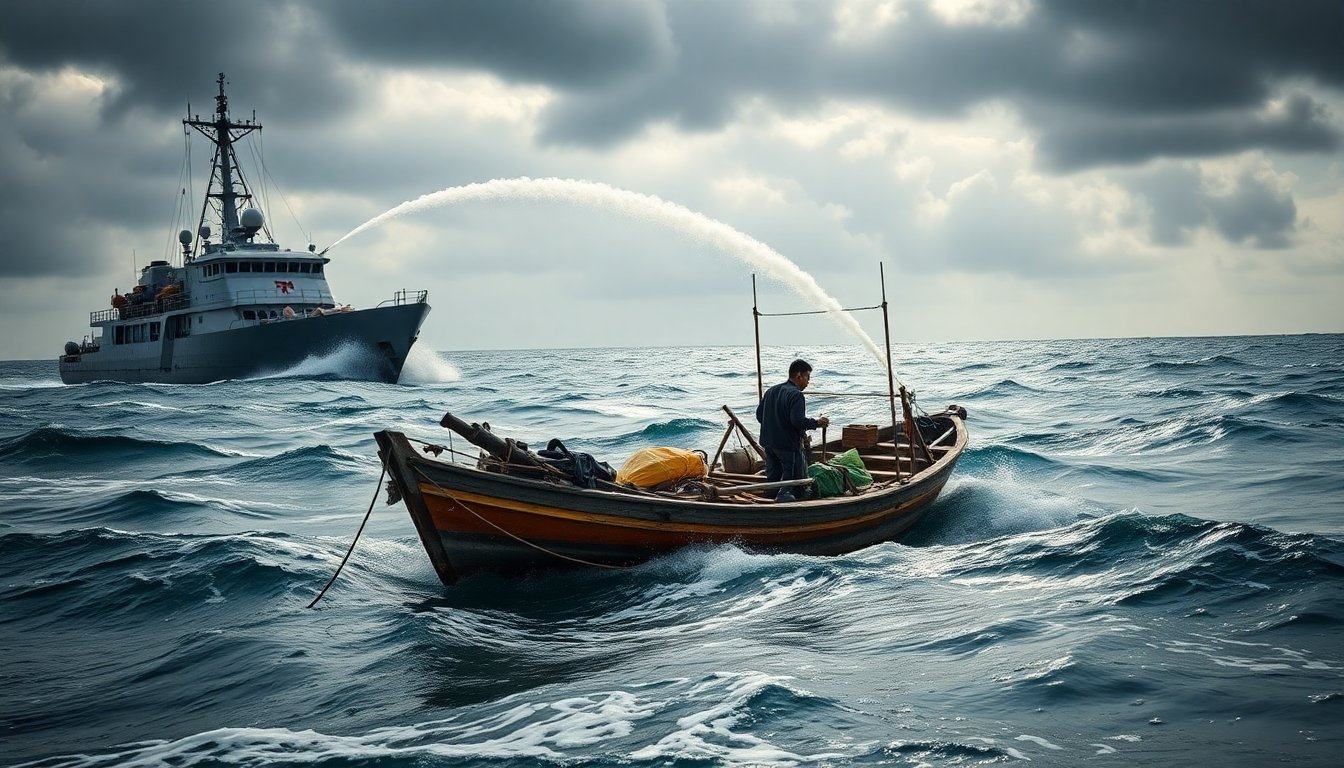
In a troubling incident that highlights the ongoing tensions in the South China Sea, the Philippine coast guard reported that three Filipino fishermen were injured during a confrontation with Chinese vessels. This clash occurred near Sabina Shoal, an area claimed by both nations, bringing the contentious territorial disputes to the forefront once again. The Philippine coast guard accused Chinese ships of employing aggressive tactics, including the use of water cannons, against Filipino fishing boats.
The event unfolded on a Saturday, following reports of nearly twenty Filipino fishing vessels being targeted by Chinese coast guard ships the day prior. Officials stated that these Chinese vessels utilized powerful water cannons, injuring fishermen and damaging their boats. This incident not only underscores the risks faced by local fishermen but also raises significant concerns regarding sovereignty and law enforcement in the disputed waters of the South China Sea.
Details of the incident
According to the Philippine coast guard (PCG), the fishermen were operating within the country’s Exclusive Economic Zone (EEZ), approximately 150 kilometers from Palawan. The PCG reported that the Chinese coast guard engaged in aggressive maneuvers, blocking Filipino boats and firing high-pressure streams of water. Commodore Jay Tarriela, a spokesperson for the PCG, indicated that three fishermen sustained injuries, including bruises and lacerations, as a result of these actions.
Chinese response and justification
In response to the allegations, the Chinese coast guard defended its operations, asserting that their actions were necessary to secure their territorial sovereignty over the shoal, referred to as Xianbin Jiao by China. Chinese spokesperson Liu Dejun claimed that appropriate measures were taken to control the situation, including issuing warnings to the Philippine vessels. However, Tarriela suggested that the Chinese statement effectively acknowledged their aggressive behavior.
History of maritime tensions
This clash is merely one of many incidents in the South China Sea, where territorial disputes have long been a source of friction between China and the Philippines. The region is rich in resources and vital for global trade, making it a hotspot for competing claims. Notably, an international tribunal ruled in 2016 that China’s expansive claims in the area were unlawful, yet Beijing has dismissed this ruling and continues to assert its dominance.
Prior to this incident, another confrontation occurred at the Scarborough Shoal, where Chinese military forces reported expelling Philippine aircraft from what they consider their airspace. These recurring conflicts illustrate the increasing dangers that Filipino fishermen face as they navigate these disputed waters.
International implications and future outlook
The geopolitical landscape in the South China Sea is further complicated by the involvement of other nations, including the United States, which has reiterated its commitment to defend the Philippines, its longstanding ally. This commitment comes amidst rising tensions, as the U.S. has expressed concern over Chinese military activities in the region. Ongoing conflicts serve as a reminder of the fragile state of peace in the South China Sea, where incidents like these could easily escalate into larger confrontations.
As the Philippine coast guard continues to patrol its waters, they have called upon the Chinese coast guard to adhere to internationally recognized standards, emphasizing the need to prioritize the safety of fishermen over aggressive enforcement measures. The recent clash serves as a crucial reminder of the high stakes involved in these maritime disputes, not only for local fishermen but also for regional stability.