
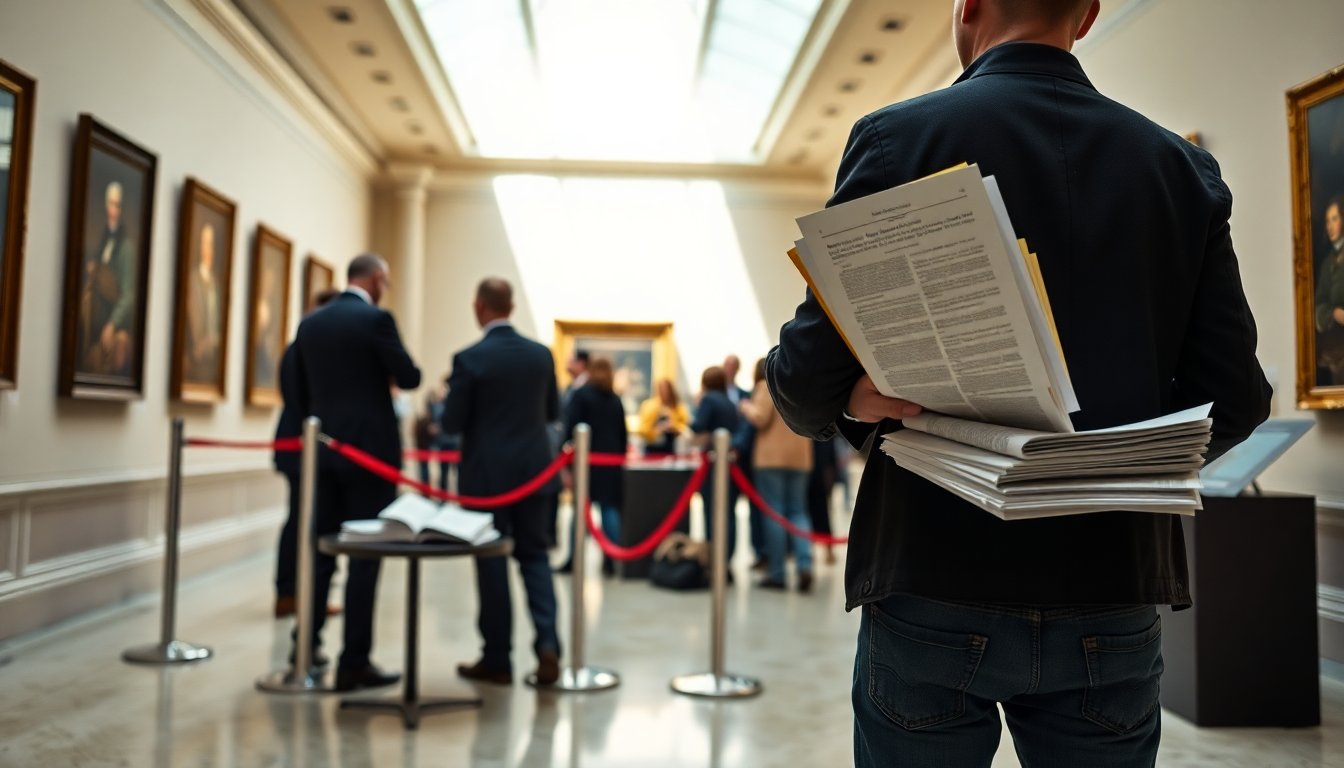
Headline: Scholar’s Unscheduled Outreach Prompts Brief Closure at Smithsonian’s National Portrait Gallery
Summary: On 25/02/2026 historian James Millward entered the National Portrait Gallery carrying printed notes and began talking with visitors about a revised exhibit label. Staff stopped the distribution, closed the gallery temporarily, and launched an internal review. The episode highlights tensions between museums’ duty to protect collections and visitors’ desire for immediate interpretation — especially when displays touch on recent, contested events.
What happened – Date and place: On 25, a disturbance in one gallery of the Smithsonian’s National Portrait Gallery prompted staff to close that gallery briefly. – The action: Historian James Millward walked into the space with a stack of printed notes and began speaking to passersby about a changed label on a presidential portrait. Museum staff intervened, and security was called while personnel evaluated the situation. No charges were filed and Millward did not escalate the confrontation, according to the museum.
Why Millward acted – His concern: Millward says he noticed a label accompanying a presidential portrait had been edited after a photo swap earlier in January — specifically, he believes references to impeachments and the Jan. 6 events were removed. He brought printed notes to distribute and, by his account, aimed to prompt conversation and add historical context rather than stage a protest. – Outreach, not protest: Millward described the materials as a form of academic outreach. “My intent was to draw attention to the altered label and offer context,” he said. Whether framed as outreach or intervention, the presence of unsanctioned interpretive text inside an exhibit space raised immediate operational questions for museum staff.
Museum response and operational concerns – Policy and safety: Gallery officials treated the activity as a breach of museum policy governing demonstrations and literature distribution on gallery floors. Staff cited visitor safety, the integrity of the exhibition environment, and the need for consistent messaging as reasons for intervening. – Tactical closure: The temporary closure served as a precaution: it gave staff space to de-escalate, document the event, and assess risks without affecting adjacent galleries. Museum statements say the closure and response followed established escalation protocols. – Process review: The museum announced it will review how the label change was implemented and whether signage adequately explains curatorial decisions to the public.
Broader implications for museums and public history – A recurring dilemma: The incident illustrates a persistent tension in public institutions. Museums aim to be open sites for learning and civic dialogue while also protecting collections, curatorial standards, and visitor order. Unsanctioned interventions force institutions to balance those competing obligations in real time. – Interpretation and transparency: When label edits — especially on politically sensitive subjects — are not clearly communicated, they can prompt public challenge. Clear, concise visitor-facing explanations about how and why labels change help reduce confusion and the chance of confrontation. – Front-line readiness: Operational gaps often show up in signage, staff authority, and crowd-management procedures. Consistent enforcement of rules, plus training in de-escalation and quick decision-making, are essential for handling spontaneous on-floor events.
Concrete next steps the institution can take – Audit curatorial workflows: Review who signs off on label edits and how those changes are logged and communicated. – Strengthen communications: Add brief on-site explanations of curatorial intent and a visible path for visitors to ask questions (e.g, a “talk to staff” placard or QR code linking to more context). – Convene external reviewers: Consider consulting independent historians or stakeholders when an exhibit touches on recent contested history. – Train staff: Expand front-line training in de-escalation, legal boundaries around speech on museum grounds, and protocols for preserving evidence and documenting incidents.
Why this matters The event at the National Portrait Gallery is more than a local disturbance. It reflects a wider shift: scholars, citizens, and visiting audiences increasingly expect to participate in meaning-making inside public museums. How institutions respond — by clarifying interpretive authority, improving transparency, and strengthening on-floor protocols — will influence public trust and the relationship between museums and the communities they serve.
What to watch next Museum officials say the review triggered by the 25/02/2026 incident will determine whether procedural or communication changes are needed. Expect clearer visitor guidance, possible updates to label-change procedures, and renewed conversations about how to balance open academic exchange with the responsibilities of stewardship and safety.