
Table of Contents
In a significant display of military power, China has initiated extensive live-fire exercises around the island of Taiwan. Lasting approximately ten hours, these drills are part of the largest military exercises ever conducted by China, aimed at simulating a blockade of the self-governing island. This escalation follows the announcement of a record arms package for Taiwan by the United States, which China has vehemently opposed.
As tensions rise, Taiwan has placed its military forces on high alert, labeling the Chinese government as a major disruptor of peace in the region. The Eastern Theatre Command of the Chinese military has announced that its operations will continue until 6 p.m. local time, encompassing air and maritime zones surrounding Taiwan.
Details of the military drills
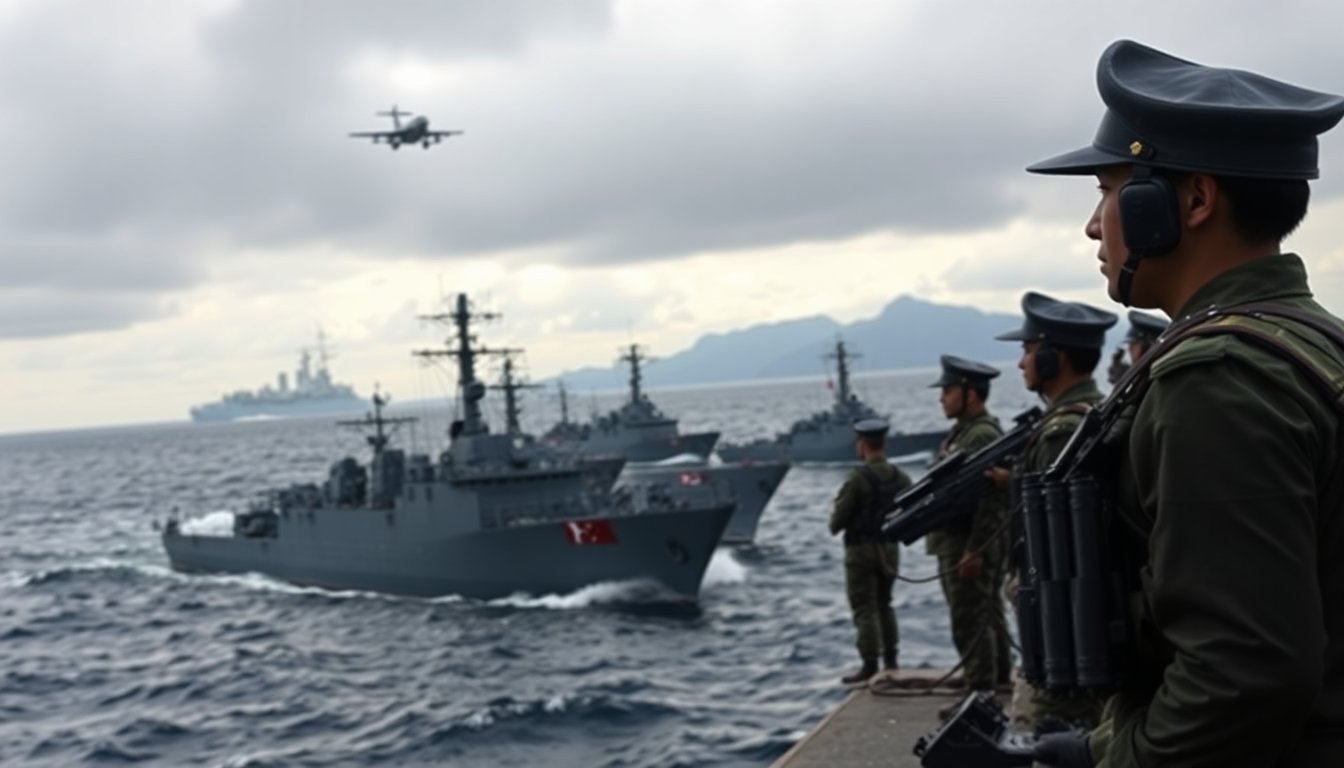
These military exercises, dubbed “Justice Mission 2025,” involve a comprehensive array of assets, including amphibious assault ships, bombers, and warships. Analysts have noted that the drills are designed to rehearse a rapid encirclement of Taiwan, targeting key military installations to neutralize its defenses and obstruct any potential resupply efforts from allies such as Japan and the United States.
According to Taiwan’s aviation authority, over 100,000 international travelers are facing disruptions due to flight cancellations or diversions, with only limited routes available. The exercises have closed off commercial airspace in several areas, particularly affecting flights to offshore islands like Kinmen and Matsu.
Strategic implications
China’s military maneuvers reflect a shift in the strategic landscape of the Taiwan Strait, an area critical for global trade, with approximately $2.45 trillion in trade traversing the strait annually. The ongoing military activities are seen as a clear attempt by China to assert its dominance and reshape the regional order.
A senior security official from Taiwan expressed concern, stating that such military drills are a blatant provocation and pose a threat to international stability. The official highlighted the potential for further provocations, including missile overflights of Taiwan, reminiscent of similar events during previous military exercises.
International responses and concerns
The international community is closely monitoring the developments, particularly in light of recent tensions between China and Japan. The backdrop of the current exercises includes a significant arms deal between the U.S. and Taiwan, amounting to $11.1 billion, which has drawn sharp criticism from Beijing. The Chinese government has framed the exercises as a necessary measure to safeguard its territorial integrity and national sovereignty.
Amidst these tensions, U.S. President Donald Trump commented that he was unaware of the military exercises in advance but downplayed the situation, asserting that China has been conducting naval drills in the region for many years without incident. Trump expressed confidence in his relationship with Chinese President Xi Jinping, suggesting that an attack on Taiwan was improbable.
Taiwan’s position and internal dynamics
In response to the escalating tensions, Taiwan has reaffirmed its position that only the people of Taiwan can determine the future of the island. The internal political landscape in Taiwan is also complex, with divisions among political parties regarding approaches to China. The opposition party, which advocates for dialogue with Beijing, has recently challenged the current government’s defense spending policies.
As China continues its military drills, the situation remains precarious. With both sides on high alert, the potential for miscalculation or unintended escalation is significant. The geopolitical stakes in the Taiwan Strait are higher than ever, and the world watches closely as events unfold.