
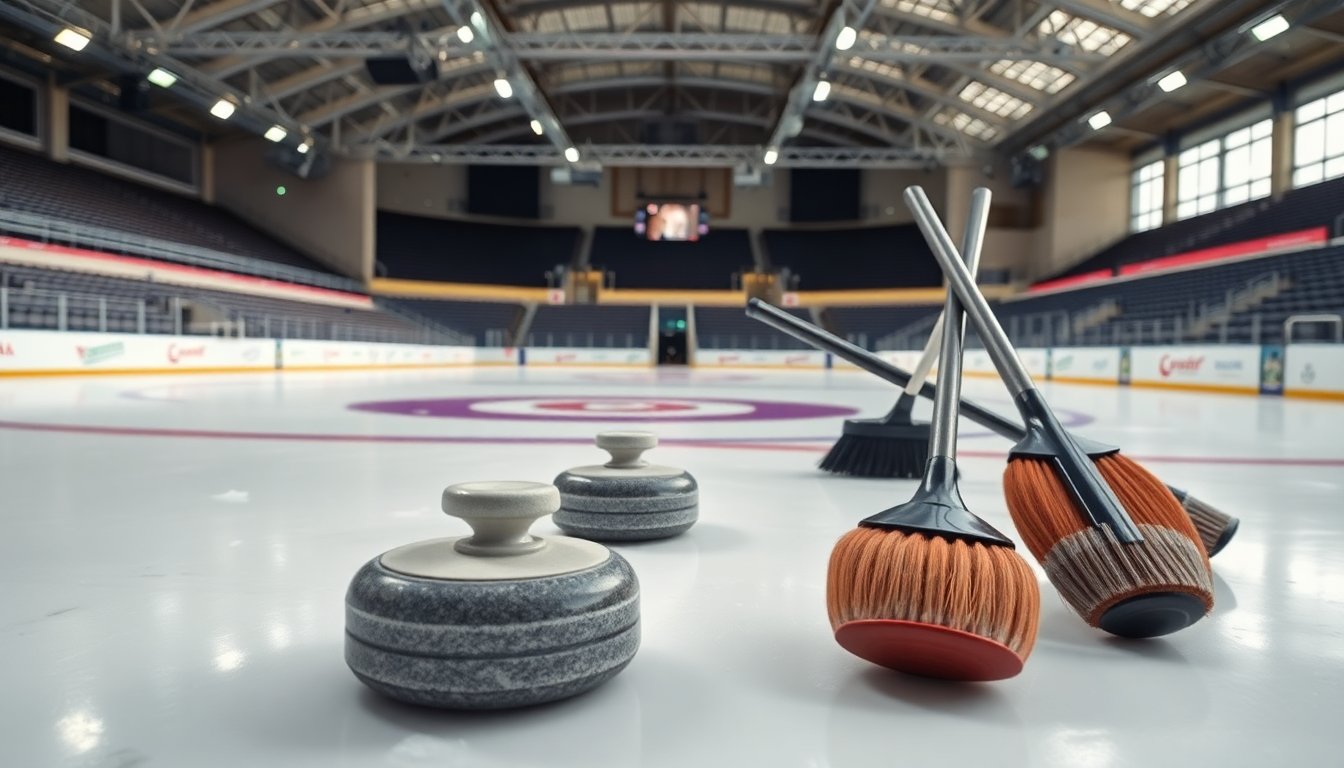
The sport of curling is getting an unconventional showcase this season with the arrival of Rock League, a new professional competition staged at Toronto’s Mattamy Athletic Centre. Even after a full calendar that included Grand Slams, national championships and the Olympics, the week of Rock League action is positioned as a late-season highlight designed to experiment with format, boost entertainment value and test technologies. Organizers promise a compact festival of competition featuring six clubs, a mix of international stars and a prize pool that includes a $100,000 US payout for the champions and an individual MVP prize of $5,000.
Beyond prize money, Rock League is being presented as a preview season: a single-week trial that will inform a longer multi-week rollout in the future. The rostered players are high-calibre athletes — of the 60 curlers taking part, 39 competed at the Milano-Cortina Olympics — and include names such as Brad Jacobs, Brett Gallant, Anna Hasselborg and members of the Rachel Homan rink. Strategic advisors and Canadian curling figures Jennifer Jones and John Morris helped assemble balanced squads that mix nationalities and themes, so expect familiar faces on unfamiliar teams throughout the week.
How the competition is structured
Rock League’s schedule condenses a tournament into daily draws with a unique match architecture: each encounter between two clubs contains three separate contests — a men’s game, a women’s game and a mixed-doubles game — spread across parallel sheets. Each of the six teams fields a roster of 10 players (five men and five women), and general managers must submit lineups in advance while retaining the right to reshuffle within a sheet as a game unfolds. Clubs face each other once in a round robin, producing seedings for the weekend’s mixed-fours knockout stage where the top seed meets the sixth, second plays fifth and third takes on fourth.
Rules tweaks, scoring quirks and technology trials
Expect rule adjustments aimed at intensifying late-game drama. Fours matches are shortened to seven ends while mixed doubles remain at eight ends. Teams are discouraged from excessive blanks — in fours, a team may blank an end only once every four ends or forfeit the hammer — and concessions are disallowed because total points scored are used as a standings tiebreaker. If teams remain tied, the resolution will be a draw to the button, a precision-oriented shootout that decides placement when points are level.
Final-end incentives and hog-line scrutiny
One dramatic innovation: in fours matches, any stone resting on the button during the seventh end counts as two points, a rule designed to crank up tension in the closing moments. Rock League will also pilot a hog-line camera during the weekday draws and apply it fully for the weekend, with each side allowed one hog-line challenge per game. That experiment arrives amid lingering debate about hog-line interpretations from recent international play and will almost certainly be a talking point if contested calls arise.
Teams, payouts and what success looks like
The six clubs — including outfits captained by figures such as Rachel Homan, Brad Jacobs, Bruce Mouat, Korey Dropkin and Chinami Yoshida — are intentionally mixed-nationality affairs with thematic identities (for example, the Alpine-themed club features multiple European athletes alongside Canadian participants). Each club plays multiple formats across the week: individual men’s and women’s matches, mixed doubles and the mixed-fours knockout. Monetary rewards cascade beyond the winner’s $100,000 US prize, with second place earning $60,000, third capturing $35,000, and special honors such as the league MVP and the peer-voted Ultimate Competitor each carrying $5,000 awards.
Why this week matters for curling’s future
While some innovations might be dismissed as gimmicks, Rock League is being framed as a guarded experiment rather than a hostile challenger to existing circuits. League owner Nic Sulsky is using a single-week Toronto showcase to demonstrate viability before committing to a multi-week schedule across Canada and the U.S. next season. If the format produces compelling television, close games and credible officiating with the new camera tests, the concept could become a valued complement to the established circuit; if it misfires, the experiment will provide equally useful feedback. Either way, the event will be judged on whether it enhances the sport’s excitement without compromising competitive integrity.


