
Table of Contents
In a significant escalation of military rhetoric, Russia has launched a hypersonic missile targeting a site in western Ukraine, close to the Polish border. This action, viewed as a show of power, has raised concerns throughout the European Union and beyond. Senior Russian officials have emphasized the missile’s capabilities, framing it as a stern warning to Western nations.
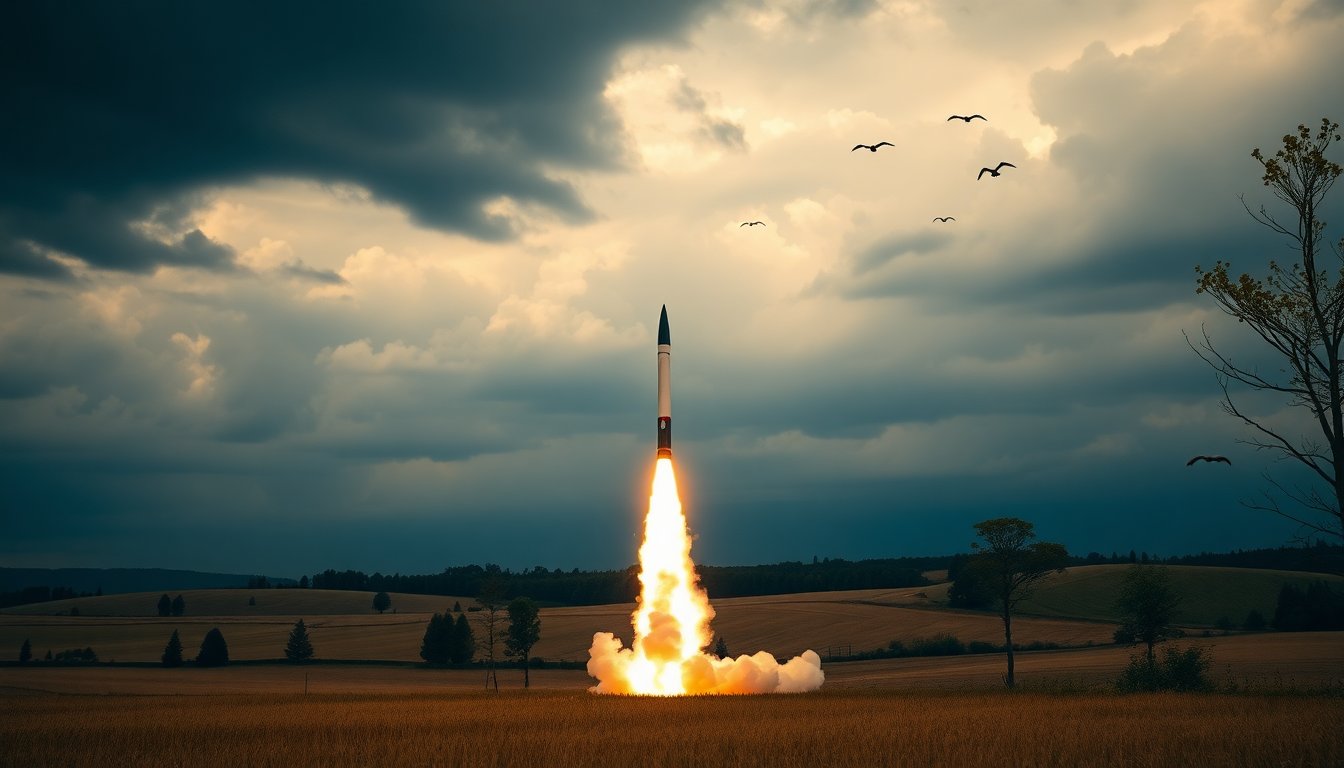
The missile, named Oreshnik, is reported to travel at speeds of 13,000 kilometers per hour and can carry multiple warheads. Ukraine’s air force has confirmed the missile’s use, although specific target details remain undisclosed, prompting questions about the broader implications of this strike.
Political undertones behind the missile launch
Experts suggest that the deployment of the Oreshnik missile goes beyond mere military strategy; it is a calculated political maneuver. The decision to use such a sophisticated weapon amidst other munitions, including drones and ballistic missiles, seems aimed at delivering a clear message.
Former Russian President Dmitry Medvedev, now deputy chairman of the security council, likened the missile strike to the need for an anti-psychotic remedy in a world filled with irrational actors. This metaphor highlights Russia’s narrative of positioning itself as a stabilizing force amid chaos.
Reactions from global leaders
The international community has responded swiftly to Russia’s actions. Leaders from the UK, France, and Germany have condemned the missile’s deployment. Canadian Prime Minister Mark Carney has described it as a dangerous escalation. The EU’s foreign policy chief, Kaja Kallas, has labeled the strike a direct warning to both the United States and European nations, indicating a heightened state of alert.
On the ground in Ukraine
On the streets of Kyiv, however, local residents perceive the hypersonic missile as another tool in Russia’s arsenal rather than a game-changing weapon. In the aftermath of recent strikes, debris fills the streets, and the ongoing fear of drone strikes dominates public consciousness. Oleksandr Poliak, a 30-year-old resident, emphasized that the immediate threat comes from the numerous Shahed drones frequently targeting the capital.
Poliak stated, “It is more important to focus on this type of weapon than the Oreshnik. To me, the Oreshnik feels more like a propaganda weapon.” His perspective underscores the psychological warfare at play and the need for the Russian government to showcase its military might on the global stage.
The technical specifics of Oreshnik
The Oreshnik missile is notable for its hypersonic capabilities and its ability to deliver multiple warheads to various targets. Defense researcher Marina Miron explained that the missile operates in three phases: the initial boost, the separation of the Multiple Independently-targetable Reentry Vehicle (MIRV), and the final trajectory adjustment before warheads are deployed. This complex mechanism allows for a potential rain of destruction, with up to six warheads dispersing multiple submunitions upon descent.
Given its design, intercepting the Oreshnik is nearly impossible for Ukraine, as they lack the necessary hypersonic interceptors. The challenges associated with targeting such a weapon as it navigates through space are formidable, akin to attempting to intercept a bullet with a thrown stone—a task with minimal chances of success.
Strategic implications of the missile launch
The timing of this missile launch has raised questions regarding its intent. Some analysts suggest that Russia’s use of the Oreshnik was strategically planned to convey a message to Ukraine’s allies, indicating that it can strike European capitals within minutes. The mayor of Lviv, Andriy Sadovyi, highlighted the geographical proximity to the EU, raising the stakes for European leadership.
The missile, named Oreshnik, is reported to travel at speeds of 13,000 kilometers per hour and can carry multiple warheads. Ukraine’s air force has confirmed the missile’s use, although specific target details remain undisclosed, prompting questions about the broader implications of this strike.0
The missile, named Oreshnik, is reported to travel at speeds of 13,000 kilometers per hour and can carry multiple warheads. Ukraine’s air force has confirmed the missile’s use, although specific target details remain undisclosed, prompting questions about the broader implications of this strike.1