
Table of Contents
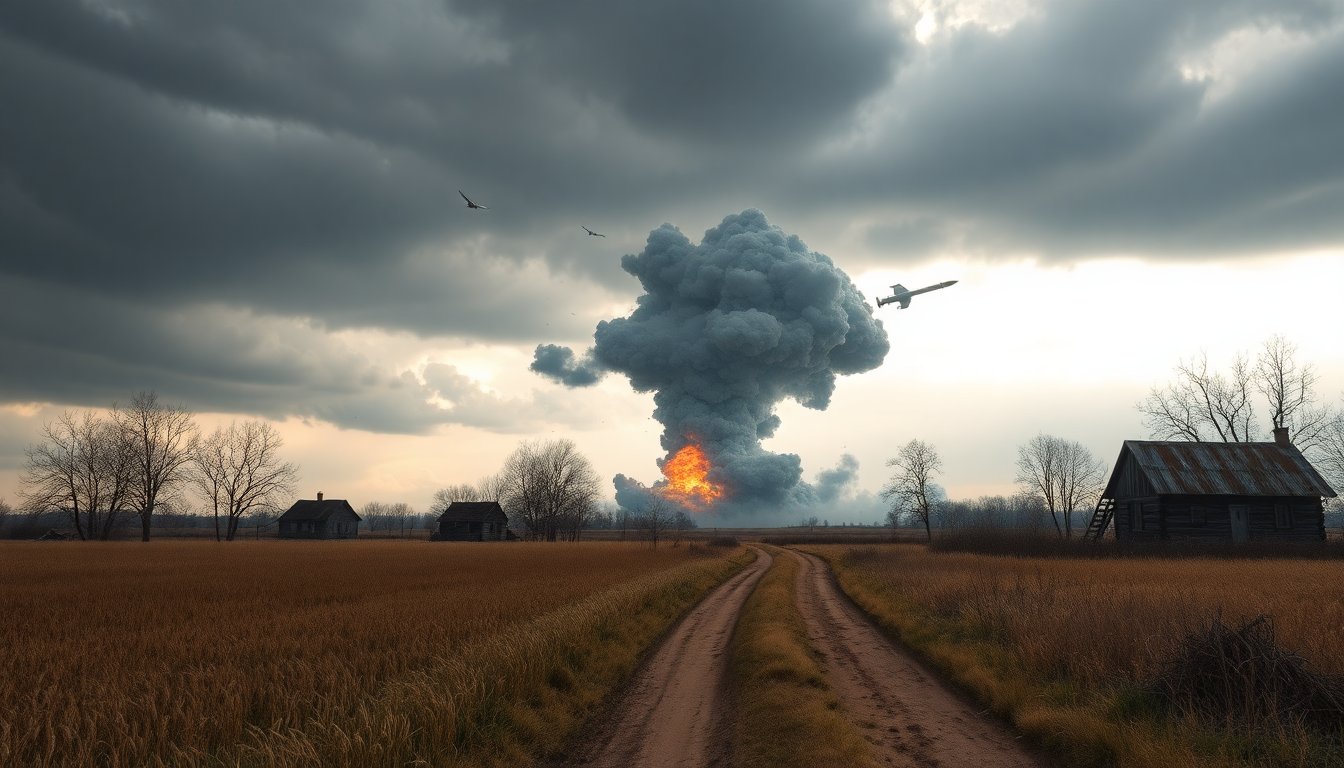
In a significant escalation of military aggression, Russia has launched a hypersonic missile targeting a location in western Ukraine near the Polish border. This action has intensified the conflict and served as a pointed message to Western nations regarding Russia’s military capabilities. The missile, known as the Oreshnik, is noted for its remarkable speed and destructive potential, further complicating the already fraught geopolitical landscape.
According to Ukraine’s air force, the Oreshnik can travel at speeds reaching up to 13,000 kilometers per hour and can carry multiple warheads. However, details regarding the specific target of this recent strike remain undisclosed. This missile strike reportedly marks the second deployment of the Oreshnik against Ukraine, underscoring its strategic importance in Russia’s arsenal.
Strategic implications of the missile strike
The choice to deploy the Oreshnik missile, along with a variety of other military assets like ballistic missiles and drones, suggests that Moscow is not solely focused on military objectives but is also engaged in a form of political signaling. Prominent Russian officials have boasted about the missile’s capabilities on social media, with former President Dmitry Medvedev likening the strike to administering essential anti-psychotic medication to a world plagued by irrational actors.
Public reaction in Ukraine
In Kyiv, the sentiment among residents is one of grim acceptance rather than outright fear of the Oreshnik. Many locals, including 30-year-old Oleksandr Poliak, express primary concern for the ongoing barrage of Shahed drones, which they perceive as a more immediate threat. Poliak stated, “While the Oreshnik may be a statement of power, it’s clear that drones pose a more tangible danger to our daily lives.” He emphasized that Russia tends to resort to such displays of force when negotiations do not align with their interests.
Understanding the Oreshnik missile system
Russia’s Oreshnik missile stands out due to its hypersonic capabilities. Unlike conventional missiles, the Oreshnik can exceed speeds of Mach 10. Experts like Marina Miron from King’s College London explain that the missile operates in three distinct phases. Initially, it enters a boost phase, propelling it into space. Following this, a component called the Multiple Independently-targetable Reentry Vehicle (MIRV) separates, continuing its trajectory while releasing warheads toward multiple targets.
Challenges of interception
The nature of hypersonic missiles like the Oreshnik poses significant challenges for interception. Ukraine currently lacks the necessary hypersonic interceptors, making it nearly impossible to counter such advanced weaponry. Miron likens the difficulty of intercepting a hypersonic missile to attempting to hit a moving target with a thrown stone—where luck may occasionally prevail, the odds remain overwhelmingly unfavorable. Although some interceptor systems owned by the U.S. and Israel could theoretically counter such missiles, their efficacy remains untested in real scenarios.
Political motives behind the launch
The timing and location of the missile strike have raised eyebrows among analysts, suggesting it was not merely a tactical move but rather a calculated political statement. Following the missile strike, Lviv’s mayor noted that the location was only a stone’s throw from the European Union’s borders, reinforcing the message that any future missile could easily reach major European capitals within minutes. The implication is clear: Russia is asserting its ability to project power across significant distances.
Despite the military implications, defense experts like Glen Grant argue that deploying such an expensive weapon against conventional targets lacks strategic logic. Instead, he posits that the true intention behind the Oreshnik’s use lies in its role as a political tool—a means to remind both Ukraine and its allies of the capabilities that Russia possesses.
As the situation continues to evolve, the international community watches closely, understanding that each missile launch not only affects the battlefield but also reverberates through the corridors of diplomatic negotiations and geopolitical strategies worldwide.