
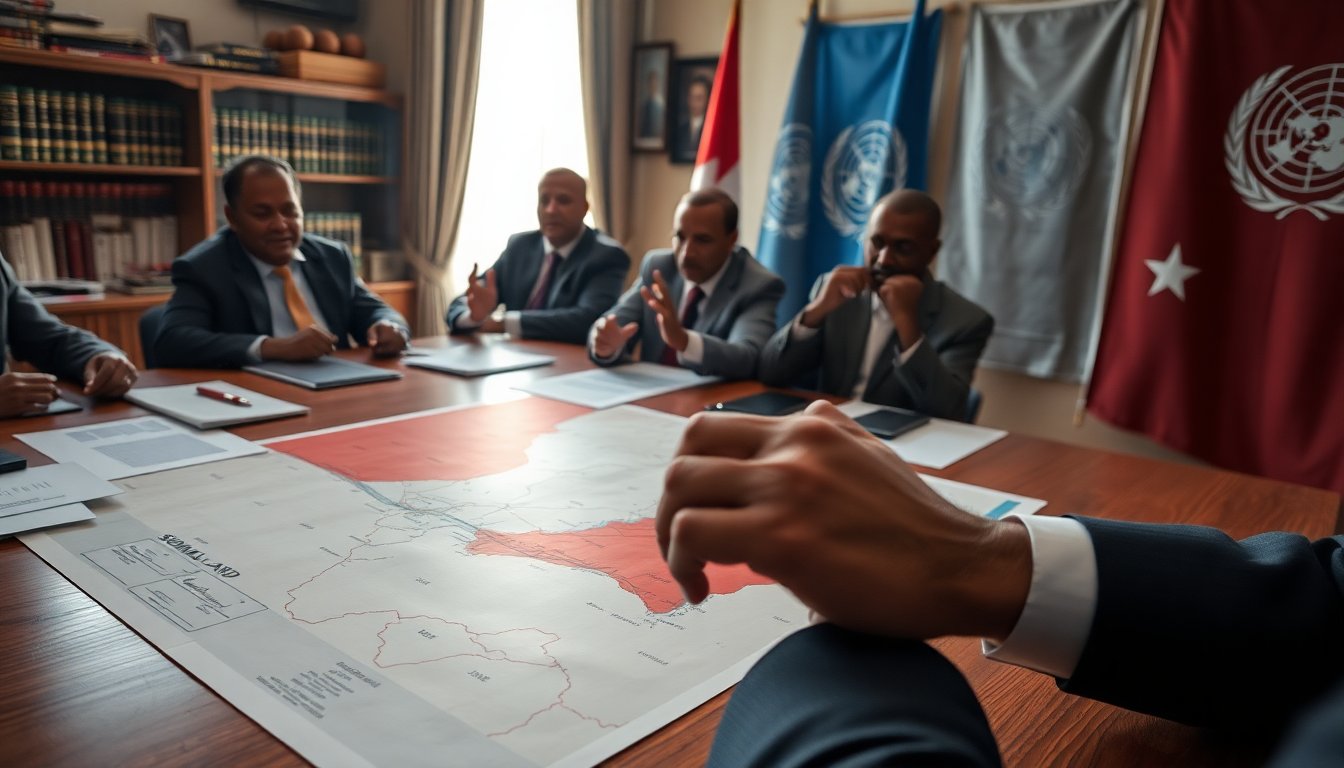
Amid escalating tensions in the Horn of Africa, the Somali government has expressed profound discontent following Israel’s recent recognition of Somaliland, a region that declared independence from Somalia over three decades ago. This move has been interpreted by Somali officials as a significant breach of their national sovereignty and a potential catalyst for further regional instability.
On December 29, Somalia addressed the United Nations Security Council (UNSC), articulating their position that Israel’s endorsement of Somaliland as a sovereign state presents a dire threat to international peace. They labeled the act as “morally indefensible,” emphasizing the risks associated with such recognition in a historically contentious area.
The facts
Israel’s affirmation of Somaliland as an independent entity marks a significant diplomatic shift. It is the first country to extend such recognition, which Israel claims aligns with the principles of the Abraham Accords, a series of agreements aimed at normalizing relations between Israel and various Arab nations. Somalia, however, contests that this recognition could serve as a pretext for the forced relocation of Palestinians to the region, further complicating an already volatile situation.
In their correspondence to the UNSC, Somali officials highlighted their concerns regarding the potential destabilization of the Horn of Africa and the broader Red Sea region. They posited that Israel’s actions not only undermine Somalia’s sovereignty but also threaten collective regional efforts to maintain peace and security.
International reactions to the recognition
The international community has responded with mixed messages. The United Kingdom reaffirmed its support for Somalia’s territorial integrity, explicitly stating that it does not recognize Somaliland’s independence. The UK urged both the Federal Government of Somalia and Somaliland authorities to engage in constructive dialogue to resolve their differences and address shared challenges, particularly the presence of armed groups that exploit internal divisions.
Additionally, China echoed similar sentiments, advising against external support for separatist movements that could destabilize other nations. A spokesperson for the Chinese Ministry of Foreign Affairs remarked, “No country should encourage or support other countries’ internal separatist forces for its own selfish interests.”
Somalia’s diplomatic stance
Abu Bakr Dahir Osman, Somalia’s representative to the UNSC, reinforced the government’s position, asserting that Somaliland lacks the legal standing to enter into international agreements or receive recognition from foreign states. He described Israel’s actions as aggressive, asserting that they aim to fragment Somalia, thus warranting unequivocal condemnation from the international community.
In contrast, the United States responded by asserting Israel’s right to establish diplomatic relations. During discussions at the UN, Deputy Representative Tammy Bruce criticized perceived double standards within the UNSC, noting the lack of urgency regarding recognition of a non-existent Palestinian state despite the recognition of Somaliland.
The history of Somaliland’s quest for recognition
Somaliland has sought international recognition since declaring independence from Somalia in 1991, following a devastating civil war. The region has established its own governance structures, including a constitution, currency, and flag, but remains unrecognized by the majority of the global community. Its claims are primarily based on the borders of the former British Somaliland protectorate, though significant portions of the territory are under the control of the internationally recognized Somali government.
Despite its self-governance, Somaliland’s quest for legitimacy on the world stage has been fraught with challenges. The recent endorsement by Israel could be seen as a double-edged sword, potentially complicating Somaliland’s diplomatic relations with neighboring countries that oppose its independence.
On December 29, Somalia addressed the United Nations Security Council (UNSC), articulating their position that Israel’s endorsement of Somaliland as a sovereign state presents a dire threat to international peace. They labeled the act as “morally indefensible,” emphasizing the risks associated with such recognition in a historically contentious area.0


