
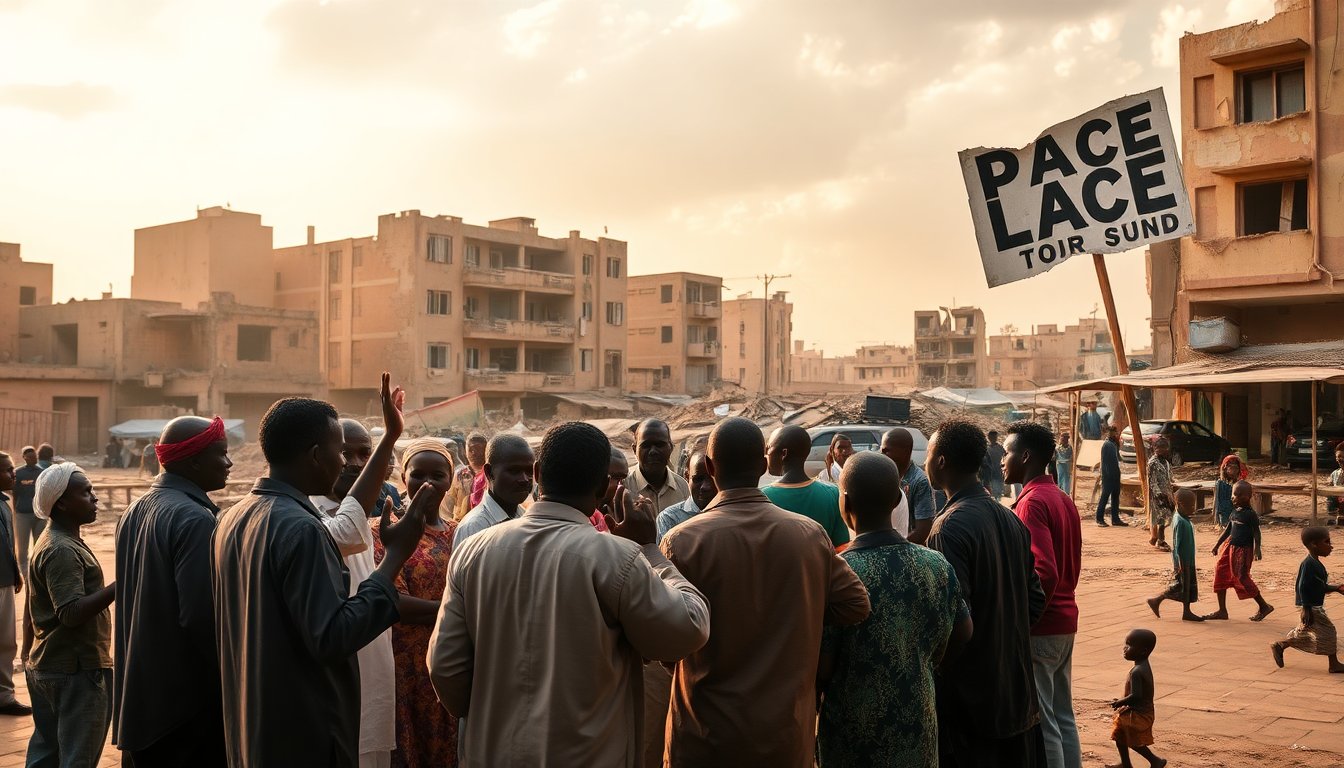
The conflict in Sudan has lasted nearly three years, leading to pressing questions about the country’s path to peace. A senior member of Sudan’s Transitional Sovereignty Council (TSC) recently stated that negotiations with the paramilitary group, the Rapid Support Forces (RSF), are no longer an option. This statement comes amid a worsening humanitarian crisis, which has sparked urgent appeals for intervention from both local and global communities.
Government’s stance on the conflict
In a meeting held in Port Sudan, the Transitional Sovereignty Council’s (TSC) deputy chairman, Malik Agar Ayyir, clearly stated the government’s position regarding the Rapid Support Forces (RSF). He emphasized that there would be no discussions or ceasefire agreements with what he termed an “occupier.” Agar maintained that the path to a just peace in Sudan must align with the vision articulated by the nation’s people and their government. He asserted that the ongoing violence should not be mischaracterized as a struggle for democracy, but rather recognized as a conflict over resources and demographic control.
Recent developments and proposed peace plans
In response to escalating tensions, Sudan’s Prime Minister Kamil Idris has put forward a comprehensive plan to the United Nations Security Council aimed at addressing the ongoing conflict. This proposal urges the Rapid Support Forces (RSF) to relinquish control of key areas in western and central Sudan. It includes provisions for disarmament and the creation of camps for RSF fighters, with a focus on reintegrating those not implicated in war crimes into civilian life.
However, the RSF has categorically rejected these proposals. An advisor to RSF commander Mohamed Hamdan “Hemedti” Dagalo labeled the government’s plan as unrealistic, characterizing it as more of a fantasy than a viable political solution. The conflict has resulted in the displacement of approximately 14 million people, and the RSF continues to bolster its hold on seized regions despite widespread international criticism.
Humanitarian crisis and international response
The humanitarian crisis in Sudan has worsened significantly, particularly after the Rapid Support Forces (RSF) took control of el-Fasher, the capital of North Darfur state. This takeover has intensified food shortages and limited access to essential resources for civilians trapped in conflict zones. Reports from international aid organizations highlight distressing instances of mass killings, sexual violence, and attempts to conceal war crimes, as the RSF works to eliminate evidence of their actions.
Despite overwhelming evidence contradicting their claims, RSF officials state that their primary goal is to protect civilians from armed groups. They have announced new territorial gains, asserting control over areas such as Abu Qumra. However, these assertions starkly contrast with the grim reality faced by civilians, who continue to suffer immensely from the ongoing violence.
Calls for accountability and peace initiatives
The international community, particularly the United Nations, has raised significant concerns regarding the ongoing flow of weapons into Sudan, which has fueled the violence. Khaled Khiari, a senior UN official, highlighted that the current influx of advanced weaponry is a critical factor exacerbating the conflict. He urged the Security Council to take decisive action against those profiting from the war and to ensure accountability.
In his peace initiative, Prime Minister Idris proposed a four-step process designed to break the cycle of violence that has afflicted Sudan for decades. This plan includes a comprehensive ceasefire monitored by international organizations, the withdrawal and disarmament of militia forces, and the unrestricted delivery of humanitarian assistance to affected communities. The aim is to establish a semblance of stability in a nation ravaged by years of turmoil.
The road ahead for Sudan
The ongoing conflict in Sudan presents a bleak outlook for peace. The Sudanese government’s refusal to negotiate with the Rapid Support Forces (RSF) highlights a deeper resistance to compromise. This situation complicates efforts to resolve the crisis. As reports of atrocities increase and a humanitarian disaster unfolds, the international community is intensifying its calls for an immediate end to hostilities.
The country’s future may depend on its leaders’ ability to navigate these challenging circumstances, engage in meaningful dialogue, and prioritize the needs of the population over personal political gains. The potential for a peaceful resolution remains uncertain in a nation that has faced significant hardship.


