
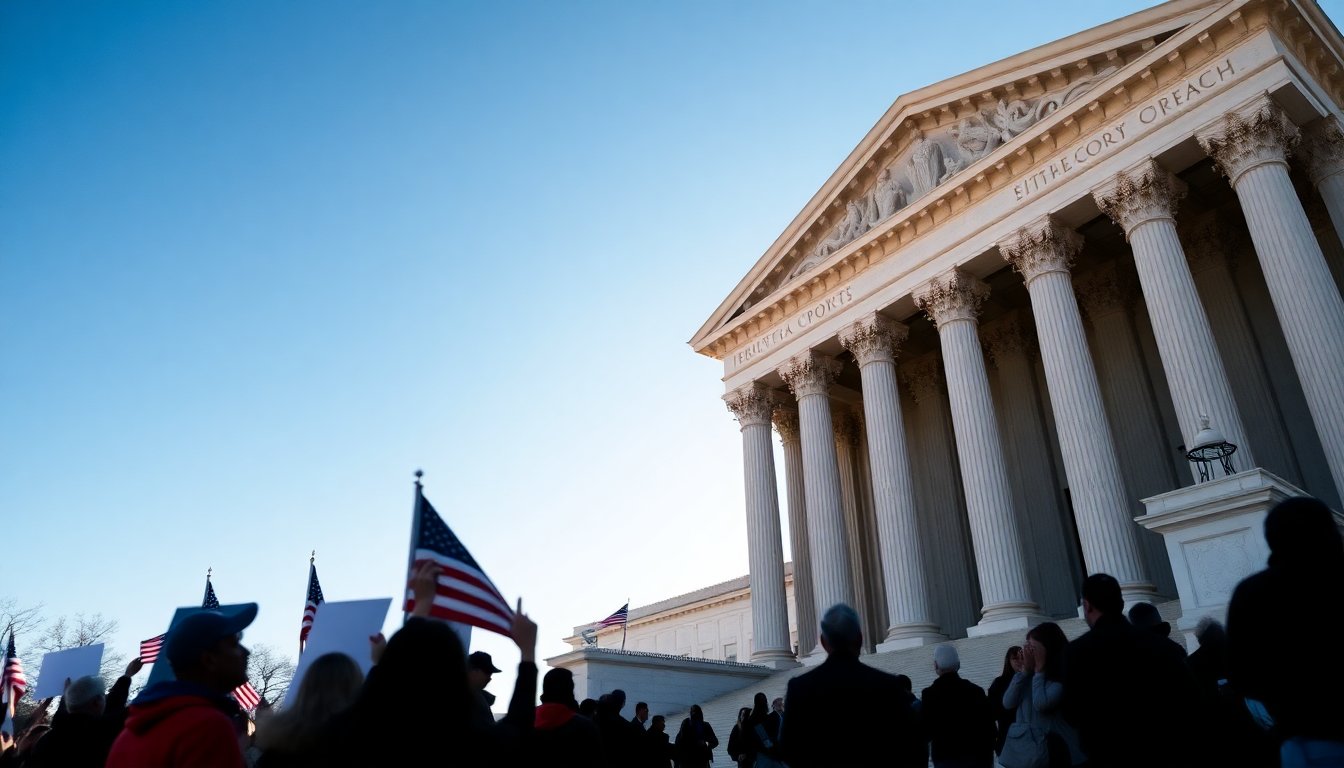
The upcoming session of the United States Supreme Court is set to address a contentious issue surrounding the legality of President Donald Trump’s executive order aimed at terminating birthright citizenship. This case comes amidst a broader context of immigration reforms initiated by the Republican administration. In the wake of lower court decisions deeming the order unconstitutional, the Supreme Court’s ruling is anticipated with great interest.
Scheduled for oral arguments in the early months of next year, the court’s decision will likely be revealed in June. The matter in question involves the longstanding principle that anyone born on U.S. soil automatically acquires citizenship, as enshrined in the 14th Amendment. A series of lower court rulings have blocked Trump’s attempts to redefine this principle, labeling the executive order as a violation of constitutional rights.
Background of the executive order
On his first day in office, President Trump issued an executive order specifying that children born to undocumented immigrants or individuals holding temporary visas would no longer be granted automatic citizenship. This directive was grounded in the administration’s interpretation that such individuals are not fully subject to the jurisdiction of the United States.
However, this interpretation has faced severe scrutiny, particularly given a significant Supreme Court ruling from 1898 that established a broader understanding of jurisdiction. Legal experts argue that Trump’s approach misrepresents the intention of the 14th Amendment, which was ratified to ensure rights for former slaves.
Arguments and counterarguments
In defending the executive order, Trump’s legal team, led by Solicitor General John Sauer, contends that the expansion of citizenship to the children of undocumented migrants has led to adverse effects on U.S. immigration policies. Sauer asserts that this has incentivized illegal immigration and undermined national integrity.
Critics, including the American Civil Liberties Union (ACLU), have vehemently opposed these claims. Cecillia Wang, the ACLU’s national legal director, emphasizes that the attempts to revoke birthright citizenship threaten a fundamental aspect of American democracy. She expresses optimism that the Supreme Court will ultimately reject the executive order, reinforcing the rights that have been a cornerstone of U.S. citizenship for over 150 years.
Implications of the Supreme Court’s ruling
The Supreme Court’s decision could have far-reaching consequences for immigration policy and citizenship rights in the United States. A ruling in favor of Trump could set a precedent that alters the interpretation of citizenship for future generations. This could lead to a significant decline in birthright citizenship, affecting thousands of children born to non-citizen parents.
Additionally, the court has previously sided with the Trump administration on several immigration-related issues this year, including policies that have facilitated deportations and revoked legal protections for migrants. This history raises questions about how the current conservative majority on the bench will approach the upcoming case.
Current legal landscape
As the case approaches, several federal courts have consistently rejected efforts to limit birthright citizenship, reinforcing the constitutional protections enshrined in the 14th Amendment. The legal community is closely monitoring how the Supreme Court will navigate these complex issues, particularly in light of its recent rulings that have allowed various Trump administration policies to take effect.
With a 6-3 conservative majority, the court’s decision will reflect not just legal interpretations but also prevailing political ideologies. The implications of this ruling will not only affect immigration policies but will also shape the understanding of citizenship in an increasingly diverse nation.


