
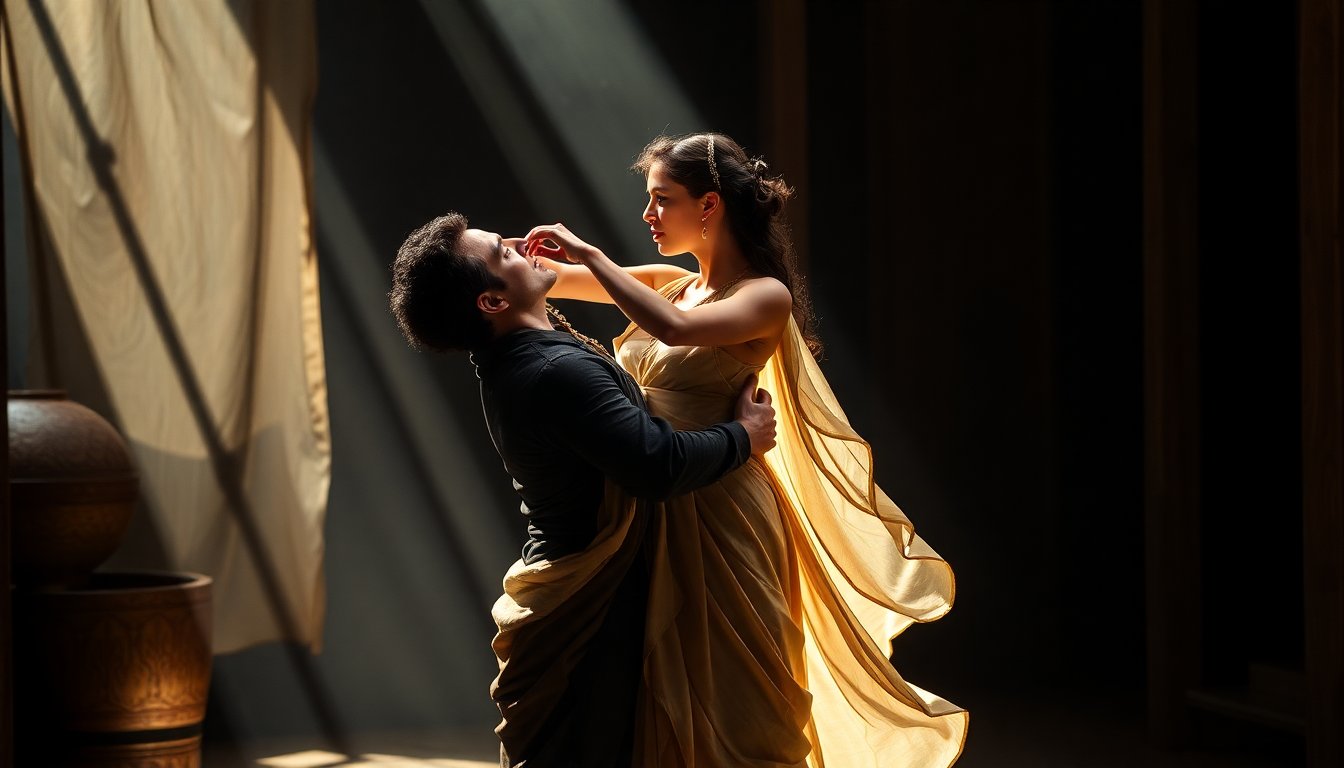
The latest rendition of Antony and Cleopatra by Synetic Theater showcases a unique exploration of love and political intrigue, presented entirely without dialogue. This approach emphasizes the physicality of Shakespeare’s characters, allowing audiences to witness the emotional depth of their union through movement and expression. Directed by Paata Tsikurishvili and choreographed by Irina Tsikurishvili, the production captures the essence of the tragic romance between Mark Antony and Cleopatra, set against the backdrop of the ancient Roman Empire.
The tale unfolds with Cleopatra, portrayed by Irina Kavsadze, on the verge of reclaiming her throne amidst a bitter conflict with her brother. Her alliance with Julius Caesar temporarily secures her position but also ties Egypt to the expanding Roman Empire. The lavish costumes designed by Erik Teague effectively highlight cultural contrasts, enveloping the Egyptians in flowing fabrics while draping the Romans in bold, warrior-like reds.
The facts
This interpretation of Antony and Cleopatra delves deeper than a mere love story; it explores themes of jealousy, ambition, and the illusion of power. After Julius Caesar’s death, Antony’s loyalties are tested, transforming the narrative from a political saga into a poignant love affair. The choreography showcases the tension and passion between the leads as they navigate their tumultuous relationship amidst the weight of their respective empires.
Reactions
The absence of spoken lines allows the physical performances of Kavsadze and Vato Tsikurishvili (as Antony) to take center stage. Their palpable chemistry expertly balances their characters’ regal responsibilities with emotional vulnerabilities. The supporting cast, including Zana Gankhuyag as Enobarbus and Stella Bunch as Mardian, enriches the narrative, highlighting complexities of loyalty and desire.
Synetic Theater has established a reputation for innovative storytelling, blending dance and physical theater. This production continues that tradition, emphasizing visual aesthetics. The scenic design, crafted by Phil Charlwood, features a pyramidal structure reminiscent of a bustling metropolis, evoking the grandeur of ancient Egypt while embodying a modern sensibility.
Choreography plays a pivotal role in shaping the story’s emotional landscape. From Antony’s heart-wrenching dream sequences to the dramatic climax at sea, the entire production pulses with kinetic energy. Colin K Bills enhances this with intricate lighting design, creating geometric patterns that illuminate and deepen the tragic undertones.
As the narrative unfolds, the audience is invited to reflect on the intricacies of power dynamics in relationships. The production prompts viewers to consider the fine line between love and ambition, and how they can distort perceptions. Visual metaphors, such as a torn map of Italy and a fragmented throne, reinforce themes of fragmentation and conflict. While some may find these symbols overly simplistic, they create a palpable tension throughout the performance.
Despite its strengths, some critics argue that the revival feels more like a historical artifact than an opportunity for innovation. Certain design choices may evoke nostalgia, hinting at a bygone era in theater. Nonetheless, the heart of Antony and Cleopatra remains intact, with themes of love, betrayal, and the human condition resonating powerfully within this production.
The performance runs for 95 minutes without an intermission, providing an immersive experience that draws the audience into its world. Whether one is a Shakespeare aficionado or new to his works, Synetic Theater’s revival of Antony and Cleopatra promises to engage and provoke thought through its unique blend of movement and storytelling.