
Table of Contents
In a significant development aimed at quelling escalating violence, Thailand and Cambodia have formally agreed to a ceasefire after weeks of intense military confrontations along their border. This agreement comes as a much-needed relief for the region, which has witnessed a tragic loss of life and displacement of civilians.
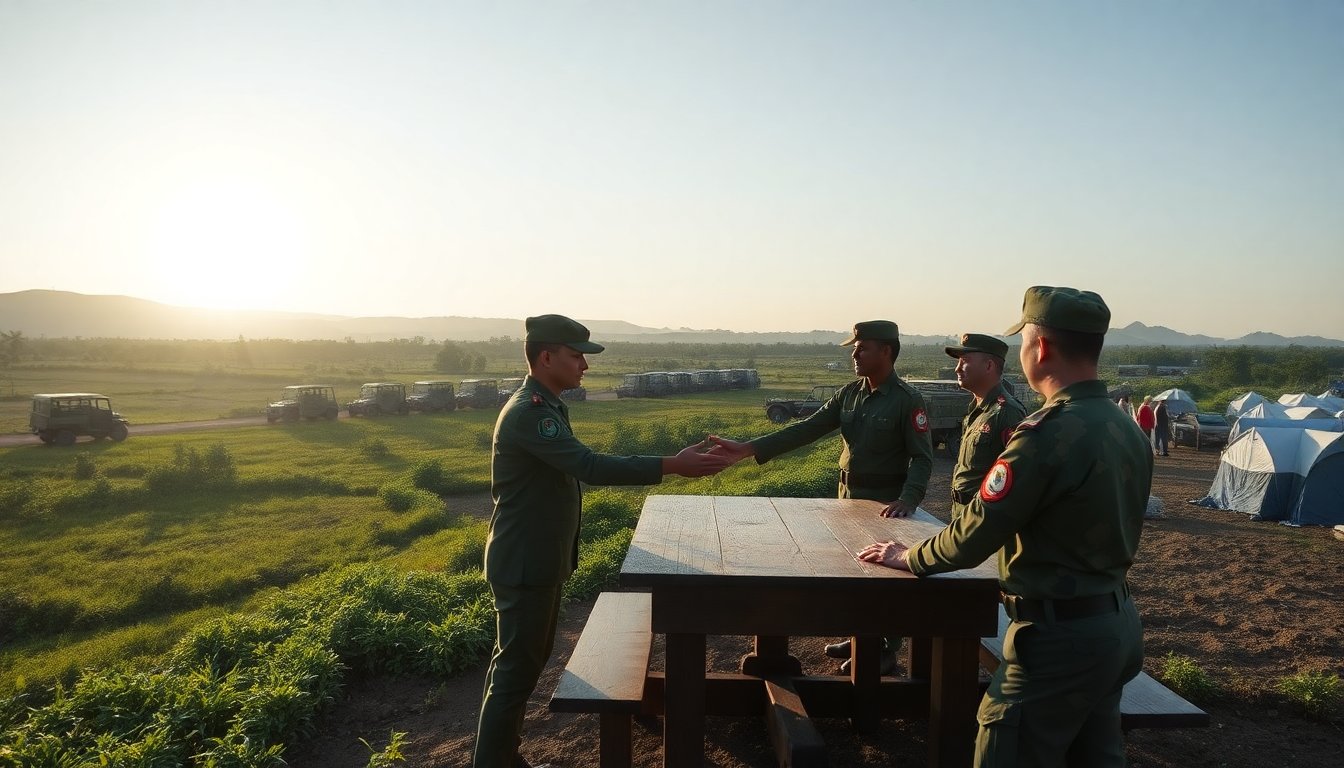
The ceasefire, signed by the defense ministers of both nations on Saturday, marks a crucial step towards stabilizing the situation that had spiraled out of control since a prior truce collapsed earlier this month. With reports indicating over 100 fatalities and hundreds of thousands displaced, the urgency for peace has never been greater.
Details of the ceasefire agreement
Effective immediately at noon local time on Saturday, the ceasefire encompasses a complete halt to military operations and prohibits any further troop movements from either side. The ministers emphasized in their joint statement the importance of maintaining current troop positions without additional deployments.
This agreement extends to all military engagements, including airstrikes, which Thailand had previously executed against Cambodian targets. Reports confirm that airstrikes had occurred as recently as Saturday morning, indicating the precarious nature of the situation just before the ceasefire was enacted.
Key provisions and conditions
Among the critical stipulations of the ceasefire is the commitment to return 18 Cambodian soldiers who had been captured during earlier conflicts, contingent upon a 72-hour period of unbroken peace. This return has been a long-standing demand from the Cambodian side, marking a significant gesture towards reconciliation.
Furthermore, both nations have pledged to avoid any actions that could provoke further clashes and have committed to refraining from spreading misinformation that could escalate tensions. A team of observers from the Association of Southeast Asian Nations (ASEAN) will oversee the compliance of this agreement, ensuring both parties adhere to the terms laid out.
Context and implications of the conflict
This latest flare-up of violence is rooted in longstanding territorial disputes that have plagued relations between Thailand and Cambodia for decades. The border, stretching approximately 800 kilometers (500 miles), has been a contentious area, particularly surrounding several ancient temples claimed by both nations.
The recent escalation of hostilities follows a brief truce in July, which had been brokered by international mediators including the United States and China. Despite previous agreements, sporadic violence continued, culminating in the severe conflict observed in December.
The road ahead for peace
As the ceasefire takes effect, the next few days are deemed critical in determining its sustainability. Observers note that while initial reports indicate a reduction in hostilities, apprehension remains among the displaced populace, many of whom are hesitant to return home until they feel secure.
In the wake of the ceasefire agreement, Cambodian Foreign Minister Prak Sokhonn is scheduled to engage in trilateral discussions in China with his Thai counterpart and the Chinese Foreign Minister. This meeting is anticipated to foster mutual confidence and facilitate ongoing dialogue aimed at establishing a lasting peace.
The ceasefire, signed by the defense ministers of both nations on Saturday, marks a crucial step towards stabilizing the situation that had spiraled out of control since a prior truce collapsed earlier this month. With reports indicating over 100 fatalities and hundreds of thousands displaced, the urgency for peace has never been greater.0