
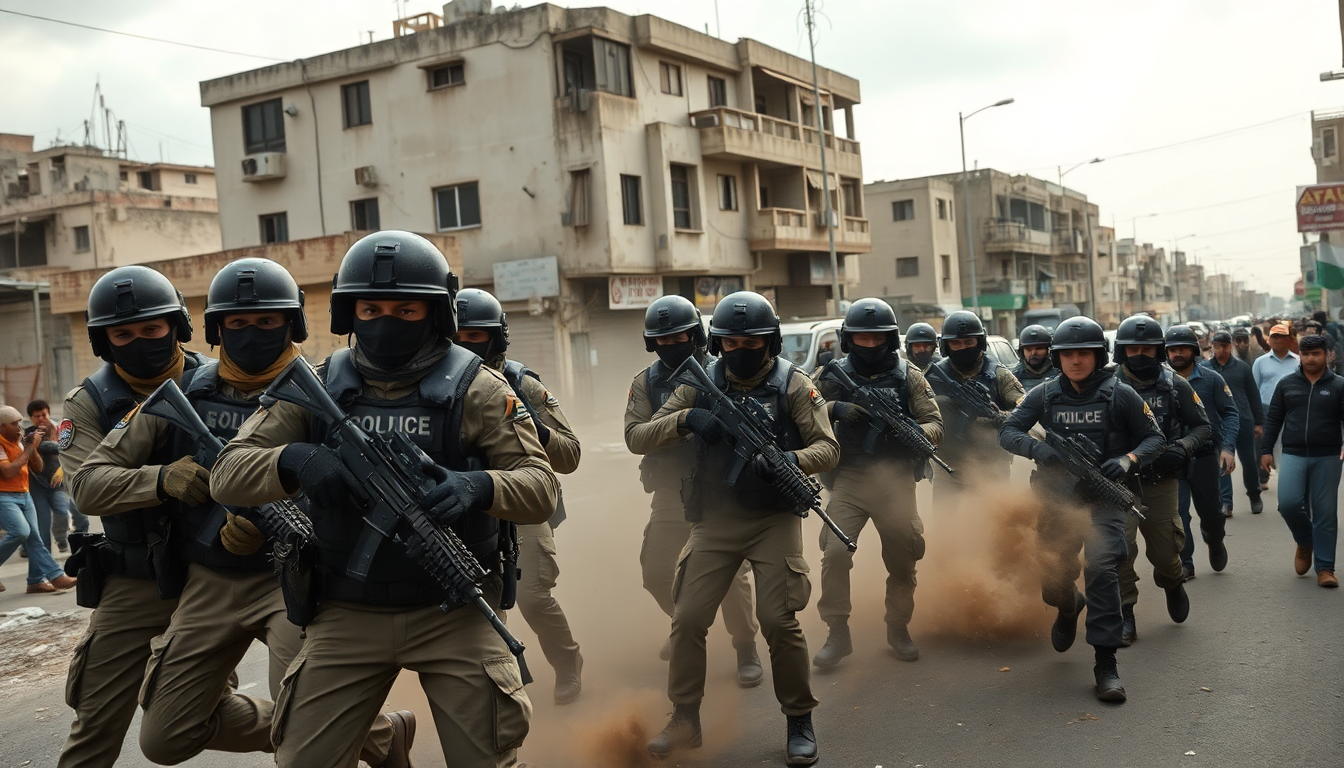
In a troubling escalation of tensions, Iraqi police recently clashed violently with members of the Popular Mobilisation Forces (PMF) in Baghdad. This incident, which tragically resulted in the death of at least one police officer and the detention of fourteen militia fighters, highlights the ongoing struggles in Iraq over the balance of power between state authorities and armed groups. The confrontation took place in the Karkh district when PMF fighters disrupted a meeting at the Ministry of Agriculture, aiming to block the appointment of a new director. This violent episode raises serious concerns about the stability of Iraq’s security framework and the significant influence of militia groups within the political landscape.
The Incident: A Breakdown of Events
The confrontation kicked off on a Sunday in Karkh, as the PMF—a state-sanctioned paramilitary group—stormed the Ministry of Agriculture. This group, primarily made up of Shia militias, was formed in response to the rise of the Islamic State (ISIS) and has since integrated into Iraq’s armed forces. Witnesses reported that the PMF fighters intended to block the new director’s appointment, leading to a gun battle that injured several police officers and triggered an emergency response. The Ministry of Interior condemned the PMF’s actions, firmly stating that it would not tolerate any group attempting to impose its will through violence.
As the situation unfolded, police forces found themselves under fire, underscoring the precarious nature of security operations in Iraq. Reports indicate that nine officers were injured, prompting the government to swiftly address the chaos, with the detained PMF members being referred to the judiciary. This incident not only highlights the tension between official state mechanisms and militia groups but also reveals the extent of the PMF’s influence within local governance.
The Broader Implications of Militia Influence
Often called Hashd al-Shaabi, the PMF has woven itself deeply into Iraq’s socio-political fabric since its inception. Originally formed to combat ISIS, its integration into the armed forces has blurred the lines between state authority and militia power. The 2017 law that legitimized the PMF has sparked much debate, as it runs counter to the interests of Iraq’s Ministries of Interior and Defense. With factions closely aligned with Iran, the PMF raises significant concerns about Iraq’s sovereignty and the future of its political landscape.
There’s growing anxiety about the PMF’s ongoing involvement in Iraq’s political affairs, especially regarding armed confrontations with state institutions. Observers point out that these continuous clashes threaten to destabilize Iraq’s already fragile security apparatus, leading to increased uncertainty about governance and the rule of law. The PMF’s actions reflect a broader struggle for influence between Iran and the United States, particularly in the aftermath of the 2003 invasion that reshaped Iraq’s political dynamics.
Looking Ahead: The Future of Iraqi Governance
In response to the recent violence, Prime Minister Mohammed Shia al-Sudani has ordered an investigative committee to delve into the events surrounding the clashes. This move signifies an acknowledgment of the complex and often tumultuous relationship between state authorities and militia groups. As Iraq continues to navigate its post-ISIS reality, the PMF’s role remains a central concern for both policymakers and citizens.
Looking ahead, the real challenge will be managing the delicate balance of power while ensuring that the rule of law prevails. The influence of armed groups like the PMF complicates efforts to establish a stable governance structure, especially in regions where security forces struggle to operate effectively. The coming months will be crucial in determining how Iraq can tackle these challenges and work toward a more unified approach to governance.


