
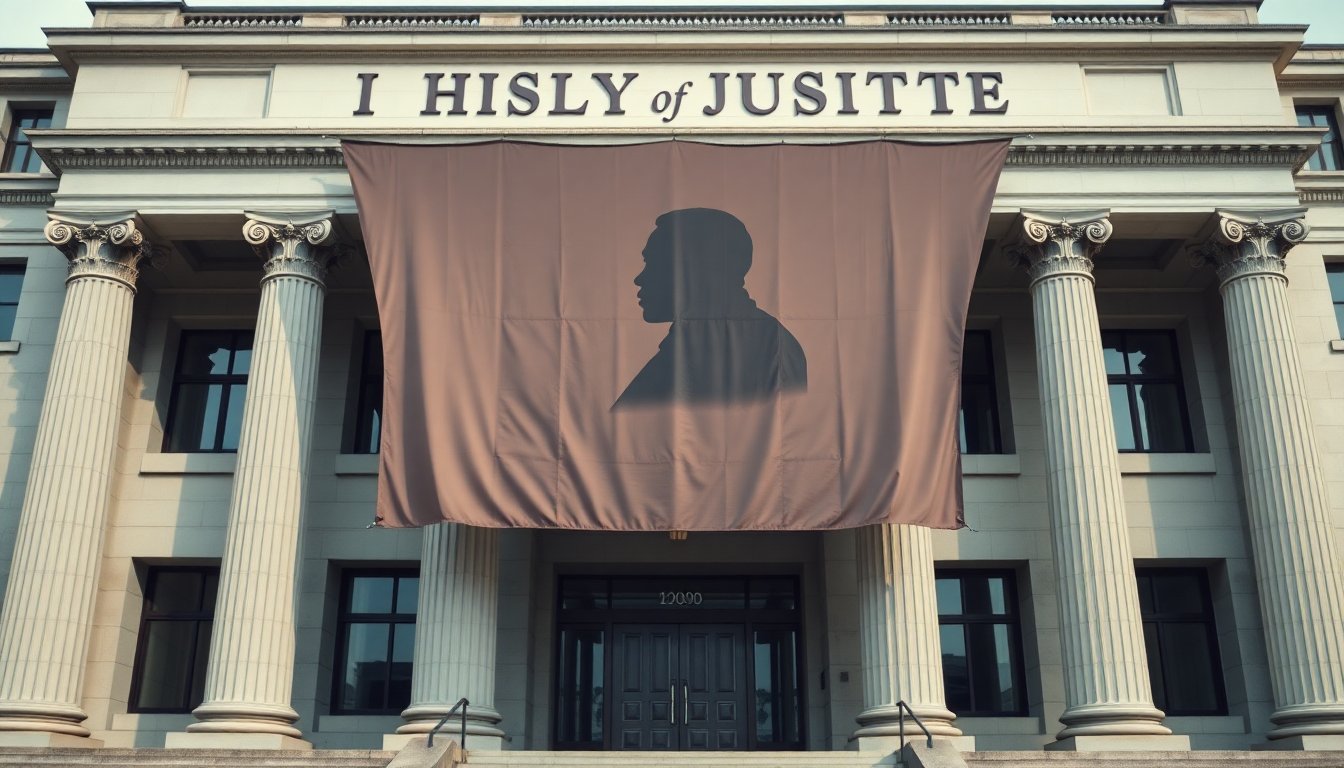
On Feb. 19, 2026, a massive banner of President Donald Trump—his portrait paired with the slogan “Make America Safe Again”—was unfurled on the façade of the U.S. Department of Justice. Planted on a building long seen as a symbol of legal independence, the image set off an immediate firestorm: for many, it felt less like decoration and more like a challenge to the idea that the Justice Department operates apart from partisan politics.
That reaction wasn’t limited to cable-TV hot takes. Former and current officials, legal scholars and watchdog groups warned that turning the department’s exterior into a campaign backdrop risked eroding a cornerstone of democratic governance: public confidence in impartial law enforcement. Supporters pushed back, arguing the display projected a law-and-order message. Whatever the intent, the banner forced questions about institutional norms and the symbolism that shapes public trust into the open.
Symbols matter because they shape expectations. A motto chiseled into marble or a banner draped across a portico does more than decorate; it signals who an institution serves and how it carries out its mission. By staging a political portrait on the Justice Department, critics said, the administration blurred the boundary between the White House and the nation’s chief law enforcement agency—an unusual step that alarmed those who worry about long-term damage to the department’s reputation for objectivity.
The banner controversy came amid other stressors, notably Attorney General Pam Bondi’s increasingly public alignment with the president. Her combative exchanges during oversight hearings, disputes over document redactions and questions about resource allocation have intensified scrutiny of the department’s culture and priorities. Those headline moments encouraged closer attention to who gets charged, what cases are pursued, and whether political considerations are creeping into prosecutorial choices.
Several high-profile prosecutions and dismissals fed that unease. Federal prosecutors brought charges against former FBI director James Comey and New York Attorney General Letitia James; a judge later dismissed those charges after finding faults in the prosecutor’s appointment. Critics read the dismissals as signs of politically driven prosecutions; defenders said the investigations stemmed from legitimate legal concerns. Legal experts note a crucial distinction: procedural flaws in how a case was brought don’t automatically resolve the facts underneath, but they do expose weaknesses in the system that can be exploited or misinterpreted.
Other inquiries broadened the debate. The Justice Department looked into testimony by Federal Reserve Chair Jerome Powell, reviewed remarks by Minnesota officials tied to immigration enforcement, and considered criminal referrals involving lawmakers accused of urging troops to resist orders—though at least one grand jury declined to indict. Civil‑liberties groups cautioned that aggressive use of prosecutorial power could chill public speech, while advocates for special counsels argued many of these steps are routine fact-finding, not partisan vendettas. How the department balances those tensions will shape not only courtroom outcomes but broader public and market confidence.
In that climate, lawmakers moved to legislate guardrails. On Feb. 17, 2026, Sen. Richard Blumenthal (D‑Conn.) and Rep. Dan Goldman (D‑N.Y.) unveiled the Prohibiting Political Prosecutions Act. The bill’s sponsors describe it as a tool to stop the justice system from being wielded as a political weapon by increasing transparency and accountability around charging decisions.
Key proposals include a private right of action allowing individuals to sue federal officials—among them prosecutors and law‑enforcement leaders—for selectively motivated or malicious prosecutions. The draft also calls for broader disclosure to grand juries (including exculpatory and impeachment-related evidence), stronger court authority to dismiss charges when political motives are credibly alleged, and explicit bans on White House instructions about specific criminal cases. Investigators and prosecutors would face new certification requirements—under penalty of perjury—declaring that charges were not politically motivated and that the evidence could support a conviction beyond a reasonable doubt.
The debate over the banner and the larger pattern of prosecutions and policy proposals illustrates a bigger issue: Americans expect their justice system to be fair and above politics. Whether through legislation, internal policy shifts, or renewed respect for old norms, the challenge now is to rebuild or reinforce the guardrails that make that expectation credible. How leaders respond—at the Department of Justice, on Capitol Hill, and in the courtroom—will determine whether public trust is restored or further frayed.