
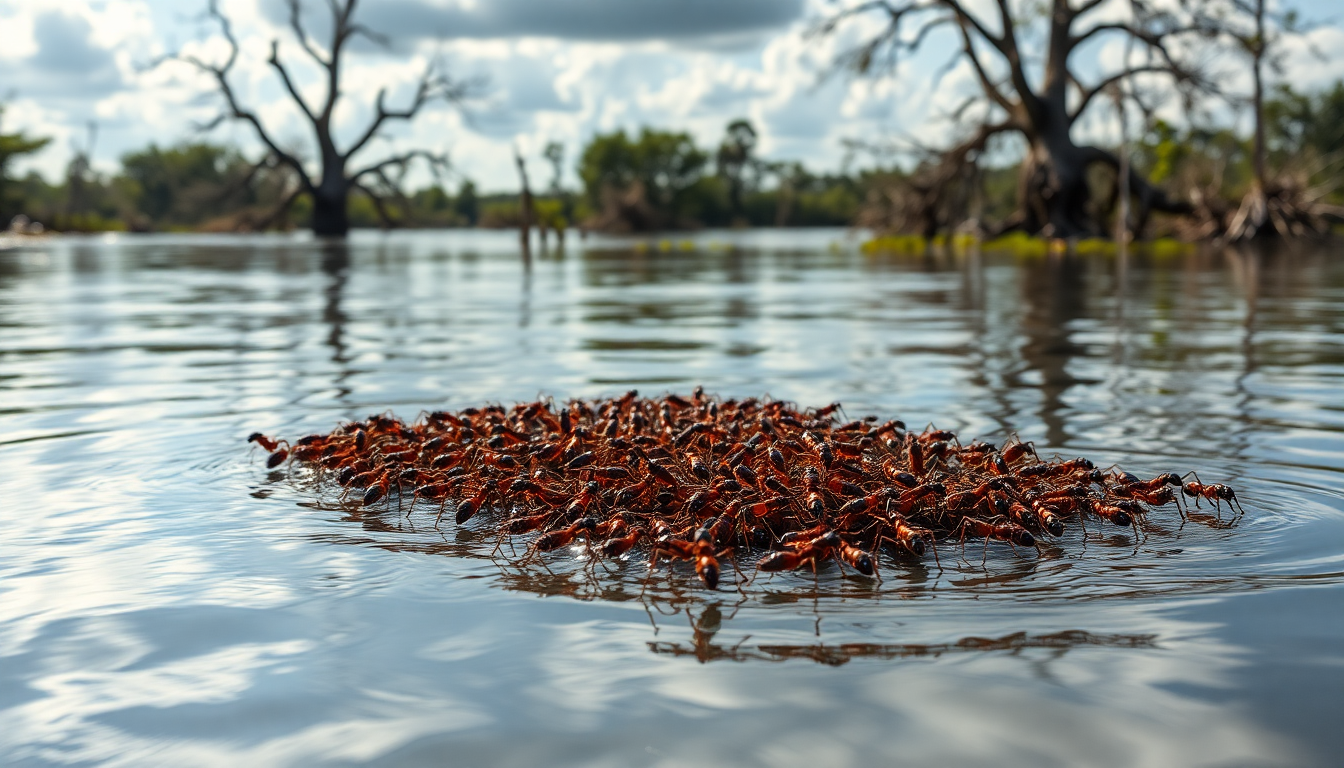
In the heart of Texas, something extraordinary is happening that’s turning heads and stirring conversations among residents and nature lovers alike: fire ants are floating on floodwaters, forming rafts made entirely of their own bodies. This eye-catching behavior not only showcases the resilience of these tiny creatures but also highlights the clever strategies they employ to survive tough conditions. As communities navigate the aftermath of heavy rains, the sight of these floating colonies serves as a fascinating reminder of nature’s adaptability.
The Phenomenon of Fire Ant Rafts
When floods inundate their underground nests, fire ants display a captivating self-organizing behavior. They link their limbs and jaws, creating buoyant structures that allow them to float on water. This phenomenon, recently observed in Lake Travis, has been captured in videos circulating on social media, igniting discussions among residents who have stumbled upon these unsettling formations. One observer humorously described it as “a floating ball of pure hate”—a fitting reflection of the discomfort many feel when confronted by these swarming stingers.
Known for their painful stings, fire ants can pose a significant danger during flooding events. As their homes are submerged, these insects instinctively band together to form rafts, a survival tactic that helps them traverse water in search of safety. This remarkable self-assembling process is unique to social insects, highlighting their ability to work collectively for the benefit of the entire colony.
Scientific Insights into Self-Organization
Research scientist Ed LeBrun from the University of Texas sheds light on this behavior, explaining that self-organization is crucial for the survival of fire ants during floods. This strategy not only aids in their immediate survival but also helps them move to safer ground. The ability to form such structures is a testament to the evolutionary adaptations of social insects, where cooperation and collective action are key to the colony’s success.
LeBrun points out that fire ants are not alone in their ability to create complex structures. Other ant species, like army ants, also exhibit similar behaviors, such as constructing bridges across rivers. This adaptability is vital for navigating their environments, especially in areas prone to flooding. The instinctual response of fire ants to link together during crises showcases their resilience and the intricate social dynamics that govern their colonies.
Community Reactions and Environmental Implications
The emergence of fire ant rafts has sparked a range of reactions within the community, from fear to fascination. Many residents have shared their unexpected encounters, recounting stories of unwittingly wading into these floating masses during nighttime outings. The discomfort associated with crossing paths with fire ants in such large numbers is palpable, leading some to jokingly propose more drastic measures to handle them.
As these insects continue to thrive in Texas, understanding their behavior becomes increasingly essential. The phenomenon of fire ant rafts serves as a reminder of the intricate relationships between species and their environments. It raises important questions about the effects of climate change and extreme weather patterns on insect behavior and survival strategies.
In conclusion, the sight of fire ants forming rafts during floods isn’t just an odd quirk of nature; it’s a powerful illustration of resilience, adaptability, and the remarkable strategies that social insects employ to ensure their survival. As we keep an eye on these behaviors, we deepen our appreciation for the complexities of the natural world and the fascinating ways in which life endures.


