
Table of Contents
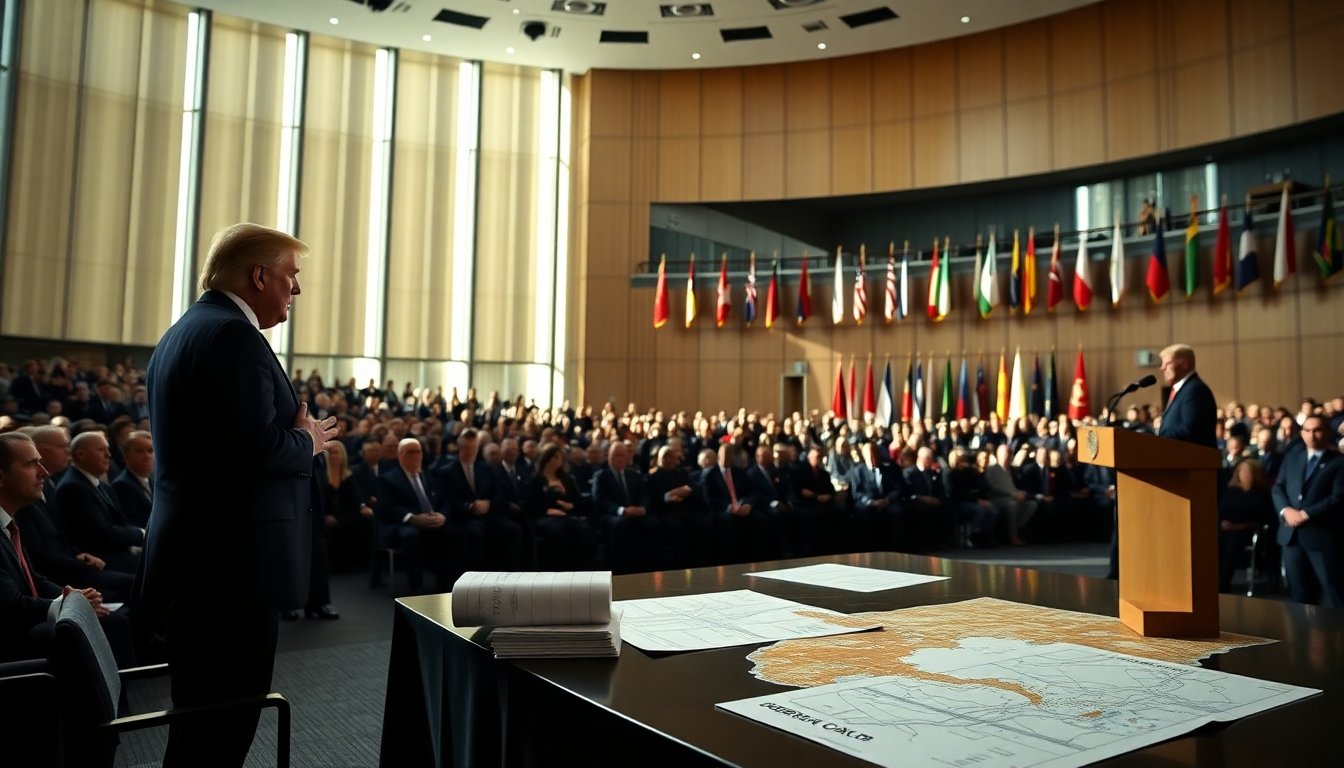
In an ambitious move that has generated significant attention worldwide, U.S. President Donald Trump recently unveiled the Board of Peace during a ceremony at the World Economic Forum in Davos, Switzerland. This initiative aims to tackle various global conflicts, with a particular focus on the reconstruction of Gaza. The announcement has elicited a mix of interest and skepticism from the international community. Approximately 30 nations, including Bulgaria and Belarus, have already expressed support, raising questions about the initiative’s implications for the existing framework of global governance.
The concept of the Board of Peace evokes a sense of an extraordinary organization, perhaps reminiscent of a children’s game where rules are fluid and aspirations are lofty. Trump described the board as an entity capable of achieving significant outcomes once fully operational, stating, “Once this board is completely formed, we can do pretty much whatever we want to do.” While this declaration is ambitious, it raises critical questions regarding the board’s legitimacy and its intended role in relation to the United Nations.
Critiques and concerns over the Board of Peace
Critics argue that this initiative represents an attempt by the Trump administration to undermine the established authority of the UN and its operations. Yossi Mekelberg, a fellow at Chatham House, expressed concerns about Trump’s apparent disregard for the UN’s norms, stating, “I don’t think that Trump has much respect for the UN… he drives to ignore it and to create an alternative which is dictated by him.” This perspective reflects broader unease about the potential erosion of multilateralism in favor of a more unilateral approach to diplomacy.
Membership and structure
Membership in the Board of Peace is contingent upon invitation, with a permanent seat costing an estimated $1 billion. Critics fear this financial barrier may restrict participation to wealthier nations, further entrenching global inequalities. The board’s structure reportedly excludes Palestinian representatives, despite its focus on Gaza, raising ethical questions about who is included in peace negotiations. Notably, influential Middle Eastern countries, such as Egypt and Saudi Arabia, have accepted invitations, while many traditional U.S. allies remain hesitant.
Interestingly, the board’s inception was authorized by UN Security Council Resolution 2803, which endorsed Trump’s ceasefire plan for Gaza. This paradox places the board in a complex position, seeking to operate alongside the UN while simultaneously challenging its authority.
The future of global governance
As the international community grapples with the implications of the Board of Peace, many are questioning the future of the UN as a viable platform for conflict resolution. The Security Council, often viewed as the cornerstone of international diplomacy, has faced criticism for its ineffectiveness in addressing ongoing conflicts, thereby creating an opening for alternative frameworks like Trump’s initiative. However, experts like retired U.S. Ambassador Robert Wood caution against abandoning the UN entirely, arguing, “Let’s try to work together to try to make the United Nations a better instrument. It really is the best instrument we have.”
Global reactions and implications
Global reactions to the Board of Peace have varied significantly. While some countries have joined the initiative, others, particularly within the European Union, have expressed reservations. France has declined to participate, citing conflicts with the UN charter, while nations such as Norway and Sweden have also held back, indicating a preference for a collaborative approach to peace processes that respects existing frameworks.
As the Board of Peace attempts to establish its role in international relations, it must navigate the existing landscape shaped by the UN and other international bodies. The challenge lies in balancing aspirations for reform with the realities of a complex geopolitical climate. Canadian Prime Minister Mark Carney has articulated concerns about the fading rules-based order, underscoring the need for strategic cooperation among nations.
While the Board of Peace may represent a significant shift in how the U.S. envisions international diplomacy, its success and acceptance will depend on its ability to operate within the existing international system without undermining it. The delicate interplay between this new initiative and the UN will be pivotal in shaping the future of global governance.