
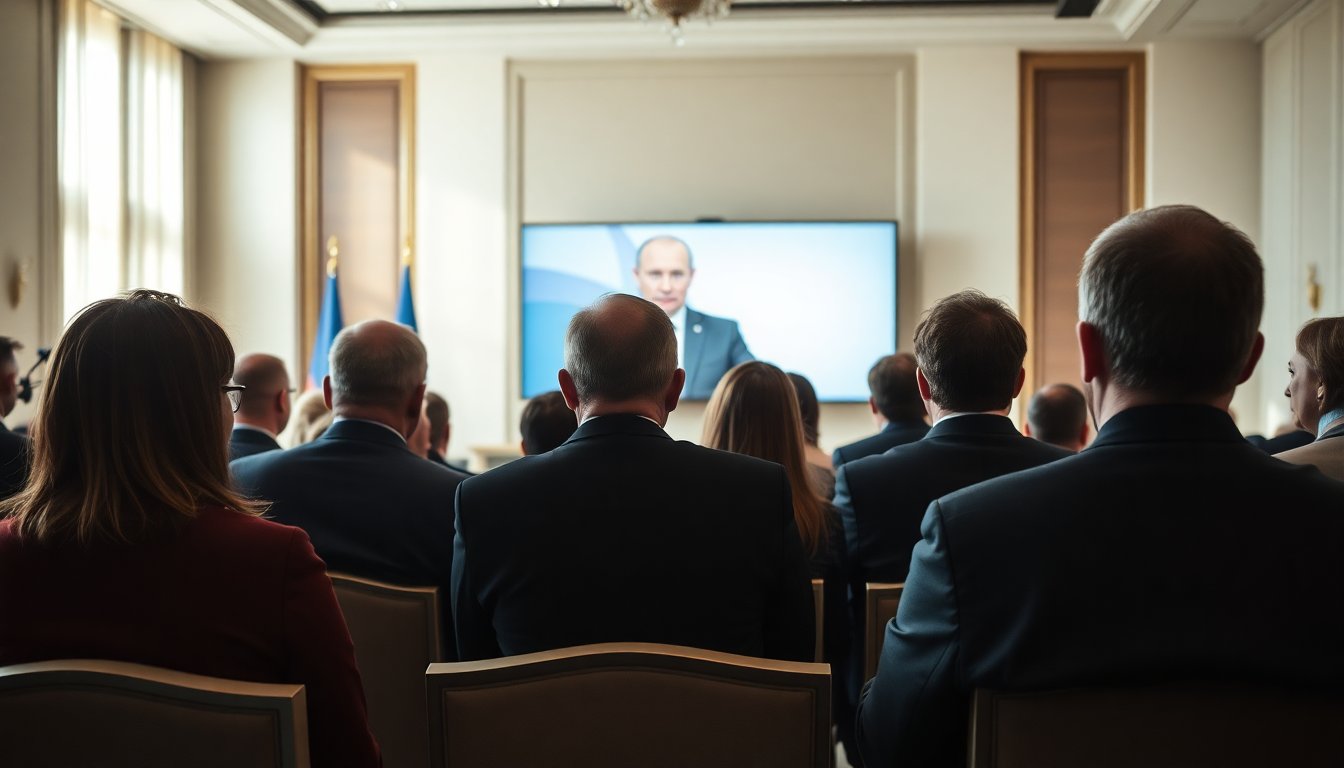
On a recent Friday, Russian President Vladimir Putin participated in his annual Direct Line event, addressing questions from a select group of journalists and citizens for nearly four and a half hours. This televised event provided Putin with an opportunity to discuss a range of topics, including the ongoing war in Ukraine, Russia’s foreign relations, and the nation’s economy. However, a closer examination of his remarks reveals numerous discrepancies and misleading assertions.
One of the primary claims made by Putin was regarding the federal budget, which he stated has a deficit of 2.6% of GDP, projecting it to reduce to 1.6% in the following year. He emphasized that the government had successfully balanced the budget, highlighting its stability. Yet, these assertions are misleading; amid substantial wartime expenditures exceeding $137 billion in 2025, the government’s strategy to achieve a balanced budget involves significant tax increases.
Financial realities behind Putin’s claims
Beginning in 2026, Russia plans to raise its value-added tax (VAT) from 20% to 22%. This tax increase is explicitly intended to fund the country’s military efforts, particularly concerning the war against Ukraine. While Putin referred to this increase as a temporary measure, it raises questions about the actual stability of the Russian economy.
Promises of peace and their implications
Another notable claim from Putin was his assertion that Russia has not outright rejected any peace proposals. He insisted that the responsibility lies with Western leaders and the Ukrainian government to engage in constructive dialogue. However, the reality portrays a different picture. While Moscow has not fully dismissed the notion of a peace agreement, it has shown little willingness to compromise or accept a ceasefire that acknowledges its control over occupied territories.
During the Direct Line, Putin reiterated his demands for peace, which include the complete transfer of regions such as Donetsk, Luhansk, Kherson, and Zaporizhzhia to Russia. Given the current climate of warfare, these conditions appear unlikely to be accepted by Ukraine, especially as military pressure continues to escalate.
NATO expansion claims and historical context
In discussing NATO, Putin lamented what he described as a breach of promises regarding its eastward expansion. He claimed that Western leaders had deceived Russia, leading to increased military presence near its borders. However, this assertion is rooted in a selective interpretation of historical events. No formal agreements were made to prevent NATO’s expansion, and while discussions took place during the reunification of Germany, no concrete commitments were established.
The foreign agents law and its implications
Addressing the foreign agents law, Putin asserted that it simply requires individuals engaged in political activities to disclose their funding sources. He characterized the law as benign, yet the reality is far more severe. Violating the stipulations of this law can lead to criminal penalties, including prison sentences. Recently, the Russian judiciary handed down a 22-month sentence to opposition figure Ilya Yashin for breaching this law, contradicting Putin’s claims of a non-threatening legal framework.
Respect and the ongoing conflict
During the same event, Putin suggested that respect from the West could prevent military operations, a statement that diverges from previous justifications for the invasion of Ukraine. This new rationale indicates a potential shift in narrative as the conflict continues to evolve.
Furthermore, Putin distanced Russia from responsibility for the casualties in Ukraine, arguing that the war’s origins stem from an unconstitutional coup in Ukraine. This perspective attempts to absolve Russia of its actions, yet it fails to acknowledge the broader context of the conflict and the implications of military aggression.
As the situation develops, the dynamics between Russia, Ukraine, and the West remain fraught with tension. Putin’s statements during the Direct Line reflect a blend of realities, half-truths, and outright fabrications that complicate the understanding of both the war and Russia’s domestic situation. Only time will reveal how these narratives will unfold in the ever-shifting landscape of international relations.


