
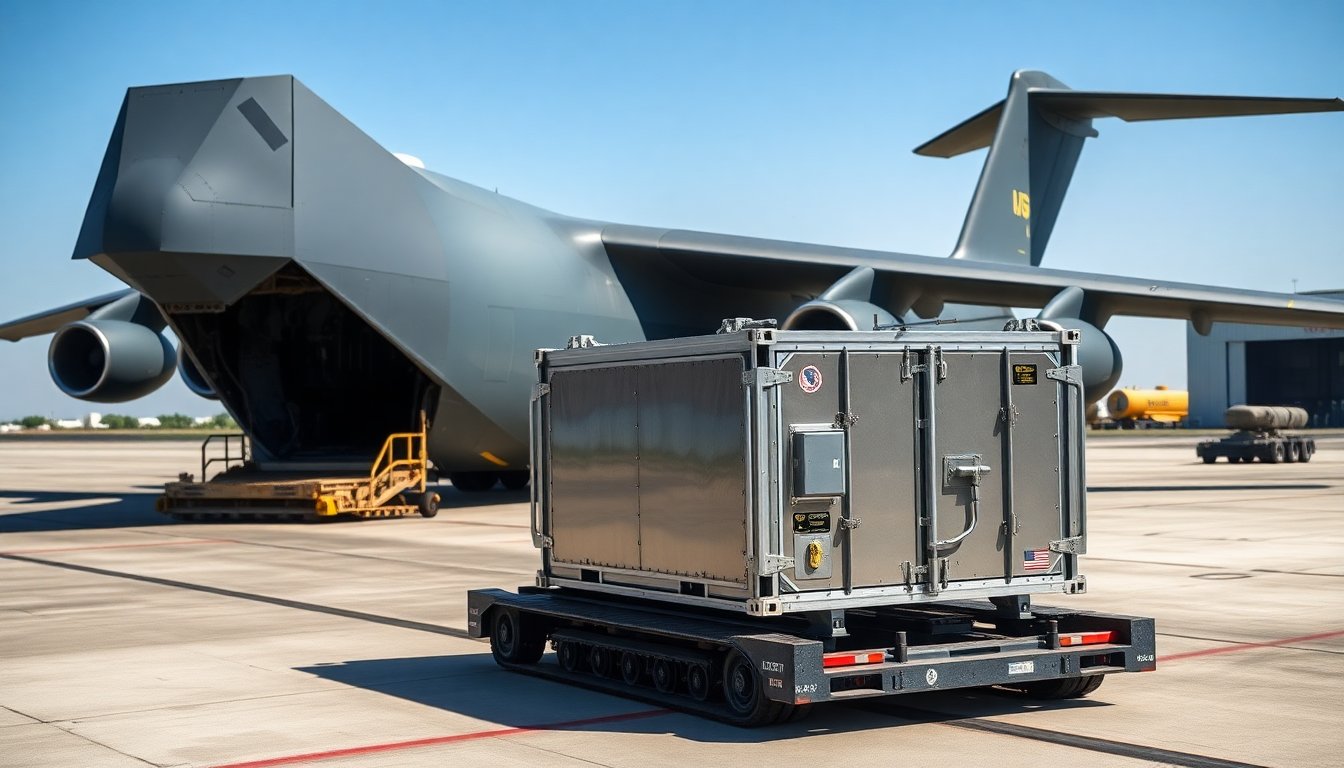
Department of War airlifts next-generation nuclear reactor from California to Utah
Who and what
The Department of War carried out an airlift that moved a next-generation nuclear reactor from Southern California to Utah. Photos circulating on X showed the device aboard a C-17 at March Air Reserve Base. From there it was flown to Hill Air Force Base and prepared for ground transport to the Utah San Rafael Energy Lab in Orangeville, where it will undergo testing.
Where and when
The shipment began in Southern California, staged through March Air Reserve Base, and routed to Hill Air Force Base before final delivery to Orangeville. Officials have not publicly released specific dates or a full timeline for the operation.
Why this matters
Officials framed the move as part of a broader effort to evaluate advanced reactors for military use — particularly to boost energy resilience at installations and in remote operations. The airlift signals an urgency to test small modular and other advanced designs near defense infrastructure so engineers and planners can gather real-world performance data.
What to expect from testing
The reactor is headed for a structured evaluation at the Utah San Rafael Energy Lab. Engineers will put it through a program designed to measure reliability, maintenance demands and the unit’s ability to supply continuous power to forward operating bases, austere sites, and other locations with limited or disrupted grid access. Results are intended to inform procurement decisions and potential fielding, with an emphasis on operational metrics rather than theoretical claims.
Policy context
Senior officials link this initiative to executive directives aimed at speeding development and testing of advanced reactors. The administration is pressing federal agencies to streamline R&D, accelerate laboratory testing, and launch pilot programs to support new construction. Public statements cast nuclear energy as a strategic asset for powering emerging technologies and sustaining critical systems during outages.
That push comes with trade-offs. Agencies face pressure to deliver measurable outcomes quickly rather than pursuing lengthy consensus-building. Observers worry that compressed schedules could strain oversight, environmental review and independent validation unless clear benchmarks and transparent reporting are built into pilot programs.
Voices from leadership
Department and cabinet leaders framed the effort in national-security terms. Interior Secretary Doug Burgum argued the U.S. once led in nuclear innovation and suggested renewed emphasis could reverse recent stagnation he blames on excessive regulation. War Secretary Pete Hegseth described modern reactors as tools for keeping critical systems — including artificial intelligence platforms and command infrastructure — operational during disruptions.
Commercial partnerships and speed
Officials emphasized private-sector collaboration as central to accelerating development. Contracts are expected to include milestones for prototype delivery and independent safety validation, and the government plans to shift more risk-sharing onto commercial partners. Still, industry and regulators will need to reconcile compressed timelines with established safety standards; demonstrable performance and transparent oversight will determine whether this approach succeeds.
Energy resilience for military sites
For defense planners, small modular reactors promise continuous baseload power that could reduce reliance on civilian grids, especially for bases in remote or contested areas. If validated, such reactors could help maintain operations during severe weather, cyberattacks or other outages. They would be evaluated alongside microgrids, fuel cells and batteries as part of a layered resilience strategy, with attention to deployability and protection against sabotage or cyber intrusion.
Who and what
The Department of War carried out an airlift that moved a next-generation nuclear reactor from Southern California to Utah. Photos circulating on X showed the device aboard a C-17 at March Air Reserve Base. From there it was flown to Hill Air Force Base and prepared for ground transport to the Utah San Rafael Energy Lab in Orangeville, where it will undergo testing.0
Who and what
The Department of War carried out an airlift that moved a next-generation nuclear reactor from Southern California to Utah. Photos circulating on X showed the device aboard a C-17 at March Air Reserve Base. From there it was flown to Hill Air Force Base and prepared for ground transport to the Utah San Rafael Energy Lab in Orangeville, where it will undergo testing.1
Who and what
The Department of War carried out an airlift that moved a next-generation nuclear reactor from Southern California to Utah. Photos circulating on X showed the device aboard a C-17 at March Air Reserve Base. From there it was flown to Hill Air Force Base and prepared for ground transport to the Utah San Rafael Energy Lab in Orangeville, where it will undergo testing.2
Who and what
The Department of War carried out an airlift that moved a next-generation nuclear reactor from Southern California to Utah. Photos circulating on X showed the device aboard a C-17 at March Air Reserve Base. From there it was flown to Hill Air Force Base and prepared for ground transport to the Utah San Rafael Energy Lab in Orangeville, where it will undergo testing.3
Who and what
The Department of War carried out an airlift that moved a next-generation nuclear reactor from Southern California to Utah. Photos circulating on X showed the device aboard a C-17 at March Air Reserve Base. From there it was flown to Hill Air Force Base and prepared for ground transport to the Utah San Rafael Energy Lab in Orangeville, where it will undergo testing.4