
Table of Contents
The recent reporting on the troop movements—highlighted in coverage on 28/03/2026—describes significant forward positioning of US Marine forces and naval platforms in the Middle East. These deployments include two shipborne Marine Expeditionary Units and additional amphibious and naval assets, plus consideration of an 82nd Airborne brigade as a rapid reinforcement. Observers say the pattern signals a shift from deterrence by patrols to visible preparations that could be used for targeted operations or to influence diplomatic calculations.
At the same time, political messaging from Washington and public denials from Tehran have created a mix of signals. President Donald Trump has publicly described contacts and talks with Iranian leaders while also issuing stern threats tied to the closure of the Strait of Hormuz. Tehran has denied formal negotiations. Analysts emphasize that deploying these units serves both an operational purpose and a communications role: to demonstrate capability and resolve without necessarily deciding a kinetic path.
What units are arriving and what they bring
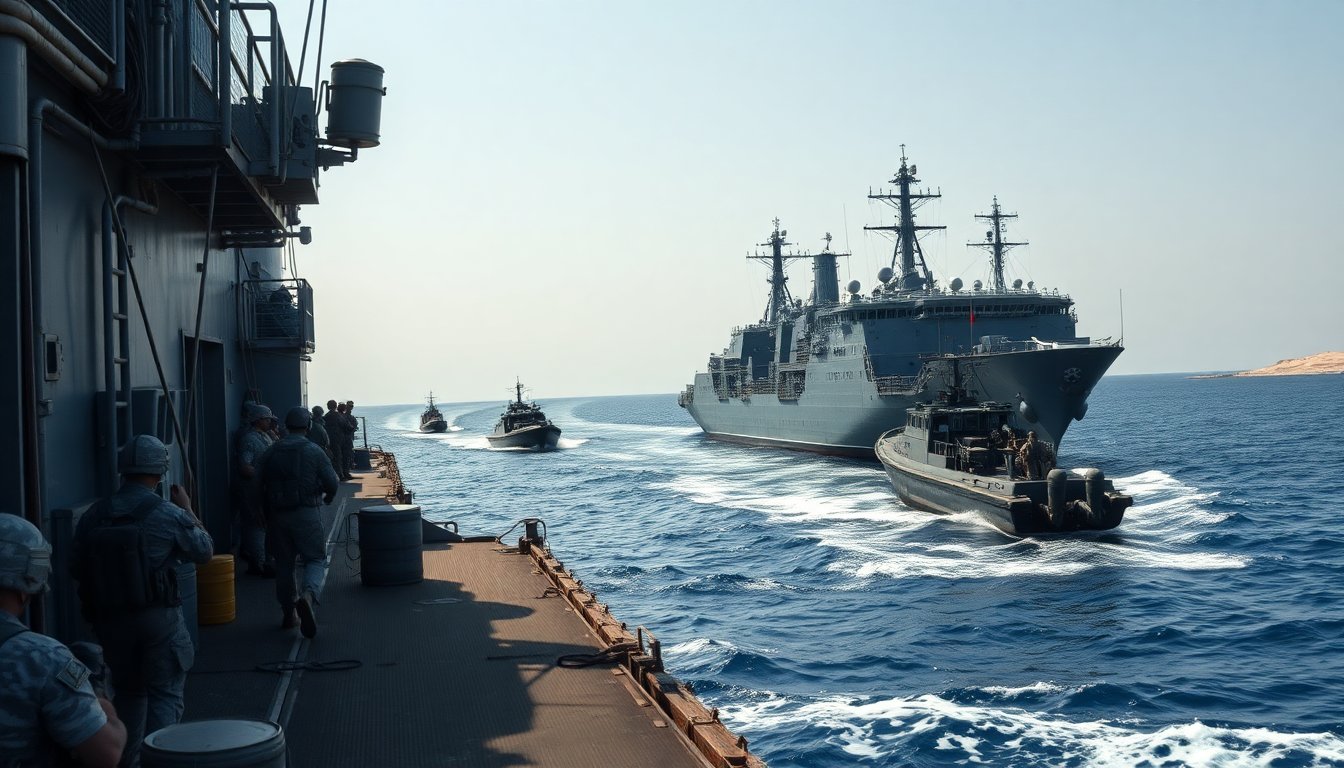
Marine Expeditionary Units are the centerpiece of the deployment. The 31st MEU, embarked on the USS Tripoli with the amphibious dock USS New Orleans, is expected to place roughly 2,200 Marines into the theater. The 11th MEU, often called the “Pride of the Pacific,” is underway aboard the USS Boxer with about 2,500 Marines transferring from California. These MEUs are organized as integrated, sea-based crisis-response forces consisting of infantry, armored and artillery elements, helicopters and fixed-wing support, logistics, and command elements ready for rapid action.
Capabilities and role
MEUs operate as amphibious assault formations designed for short-duration, high-intensity missions that begin from ships at sea. They carry their own air assets and sustainment, allowing them to project power ashore quickly. Military planners appreciate MEUs for their flexibility: they can conduct evacuations, seize critical littoral positions, or support other operations ashore. At the same time, MEUs are not configured for prolonged occupation; their doctrine emphasizes nimble interventions and handoff to larger formations if needed.
Why commanders might use these forces
At the heart of the deployment is a strategic objective that has been repeatedly referenced in public statements: forcing a reopening of the Strait of Hormuz, the chokepoint through which a large share of global oil shipments transit. One concept under consideration by U.S. planners, reported by multiple outlets, is capturing or securing small but strategically placed islands or facilities—an approach meant to create leverage over maritime access. Such operations aim to restore navigation quickly and to pressure Iranian decision-makers without immediately escalating into broader ground campaigns.
Risks and tactical challenges
Experts warn that operations near Iran’s coast—such as plans sketched to take Kharg Island, a crucial oil-transit site—carry heavy risks. Although previous bombardments have degraded many defenses, troops operating just miles offshore would be within range of rockets, missiles, drones and other asymmetric threats. Analysts characterize some seizure plans as potentially “high risk, minimal reward,” because holding exposed terrain near Iran could invite sustained retaliation and complicate coalition support. Additional concerns include the reported availability of naval mines and threats to regional energy infrastructure, which could greatly amplify economic and geopolitical fallout.
Regional fallout and broader implications
Beyond immediate combat considerations, the deployment has already influenced regional dynamics. Some Gulf partners have taken steps to facilitate U.S. operations, such as granting access to bases or pursuing measures against Iranian financial and commercial networks. Meanwhile, incidents like drone disruptions affecting commercial cloud services in Bahrain and reports of missile launches toward Israel underline how quickly the security environment can spill over into other arenas. Planners also weigh the signaling value: positioning MEUs and discussing airborne reinforcements communicates that Washington has multiple response options—yet it is also likely to harden Tehran’s resolve and complicate diplomatic openings.
In short, the arrival of sizable, sea-based assault forces and potential airborne reinforcements provides the U.S. with tangible, rapid-response options while simultaneously raising the prospect of escalation and regional collateral effects. Decision-makers face a narrow window to use these capabilities to shape outcomes without triggering the broader, protracted conflicts that many analysts want to avoid.