
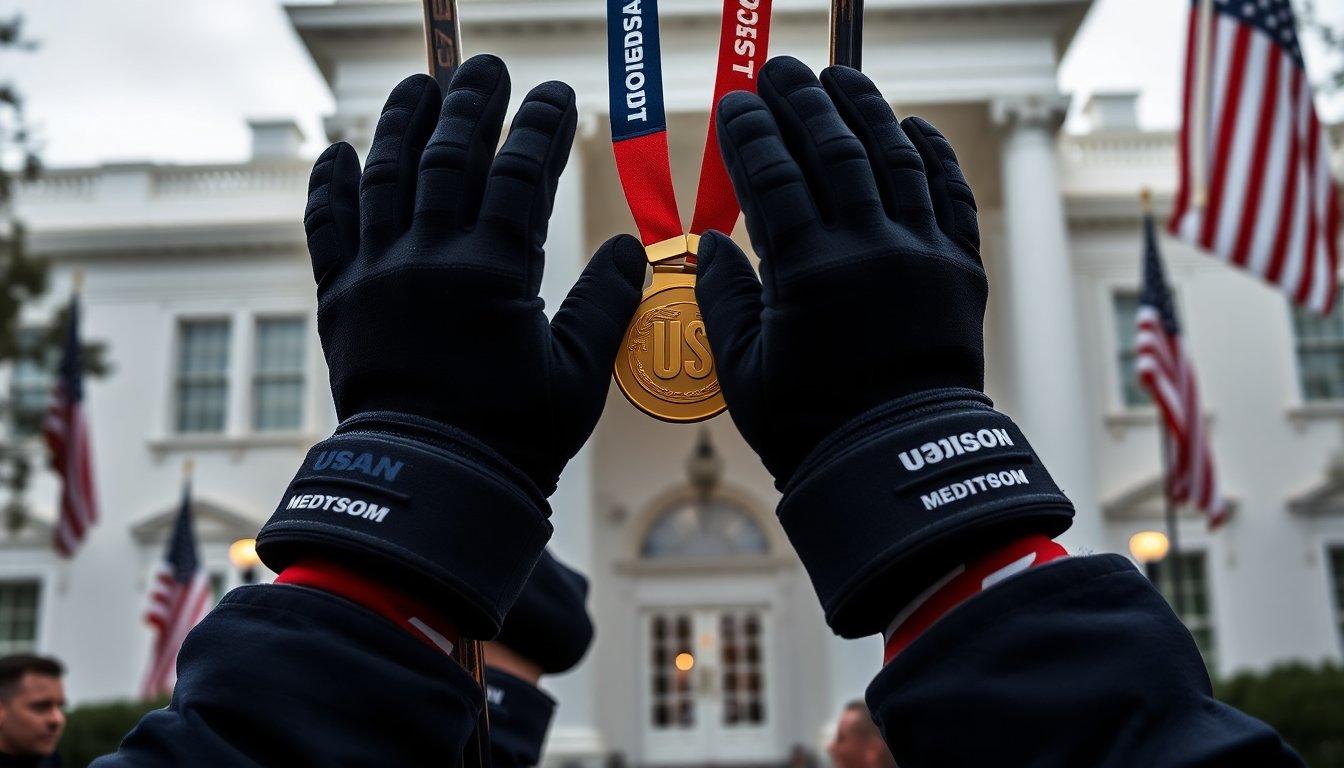
U.S. men’s hockey returned to Washington this week riding the afterglow of a weekend for the ages. After Jack Hughes’s overtime winner gave the Americans a 2-1 victory over Canada at the Milano–Cortina Olympics on February 22, 2026, the gold-medal squad was feted at the White House and recognized from the House gallery during the president’s State of the Union address on February 24.
A brisk, public celebration
The team arrived at the South Portico and threaded through parts of the West Wing with staff, supporters and photographers lining the route. Players posed for photos in the Oval Office, flashed their medals and swapped quick, friendly words with President Donald Trump, who praised the roster and called them “special champions.” Clips and images from the visit spread across social platforms within minutes, turning private moments into shared ones and dominating the day’s coverage.
State of the Union spotlight
Two nights later the delegation drew a lengthy, bipartisan standing ovation during the State of the Union. As the players walked down the press gallery to take their seats, members of Congress rose, cheered and repeatedly chanted “U.S.A.!” The reaction underscored how rare and resonant an American men’s hockey gold still is—a moment that cut across party lines and briefly united the chamber in celebration.
In his address, the president announced several acknowledgments, including that goaltender Connor Hellebuyck—who recorded a 41-save performance in the final—will receive the Presidential Medal of Freedom. Hellebuyck acknowledged the applause with a hand to his heart as the ovation continued.
The game that made history
The gold-medal final itself was a study in tension and big plays. Matt Boldy opened the scoring with a polished sequence that gave the U.S. an early edge. Canada tied the game in the second period, and the contest swung back and forth until Hughes finished it in overtime. Hellebuyck’s work between the pipes—numerous highlight saves, breakaway stops and a memorable behind-the-back stop—kept the Americans in the hunt and made the final’s drama possible. It was the country’s first Olympic men’s hockey gold since the 1980 “Miracle on Ice,” and the result instantly revived that narrative of unlikely national triumph.
Travel, parties and homecomings
The team returned to North America on a charter and made a stop in Miami for public appearances; fans greeted players at the airport, and some members shared celebratory moments from nightlife and private events on social media. For many players this was a first White House visit; for others, like Matthew Tkachuk, it was another stop on a busy string of post-championship celebrations. The mix of official honors and public adulation transformed the victory into a sustained national moment beyond the rink.
Two receptions, one decision
Not every Olympic roster traveled to Washington. The men accepted the prominent invitations to the White House and to the State of the Union; the women’s team declined the State of the Union appearance, citing scheduling issues. The administration said the women would be invited to the White House at a later date. Those differing responses reflected a practical calculus teams now make after major tournaments—balancing recovery, sponsorship obligations and public engagements.
Why these moments matter
Beyond the handshakes and speeches, this sequence of events illustrates how modern sporting triumphs ripple through media and public life. High-visibility appearances generate immediate spikes in public attention and shape who sees what image or highlight next, but they also give athletes a platform: for celebration, for sponsors, and sometimes for politics. For the U.S. men’s team, a single overtime goal translated into a national moment—equal parts athletic accomplishment and public theater.
What’s next
Officials were still finalizing parts of the team’s travel and celebration schedule at the time of reporting. Media outlets, sponsors and fans will be watching closely for any homecomings or public events that follow—each one an opportunity to relive the win and prolong a rare piece of American hockey history.