
“`html
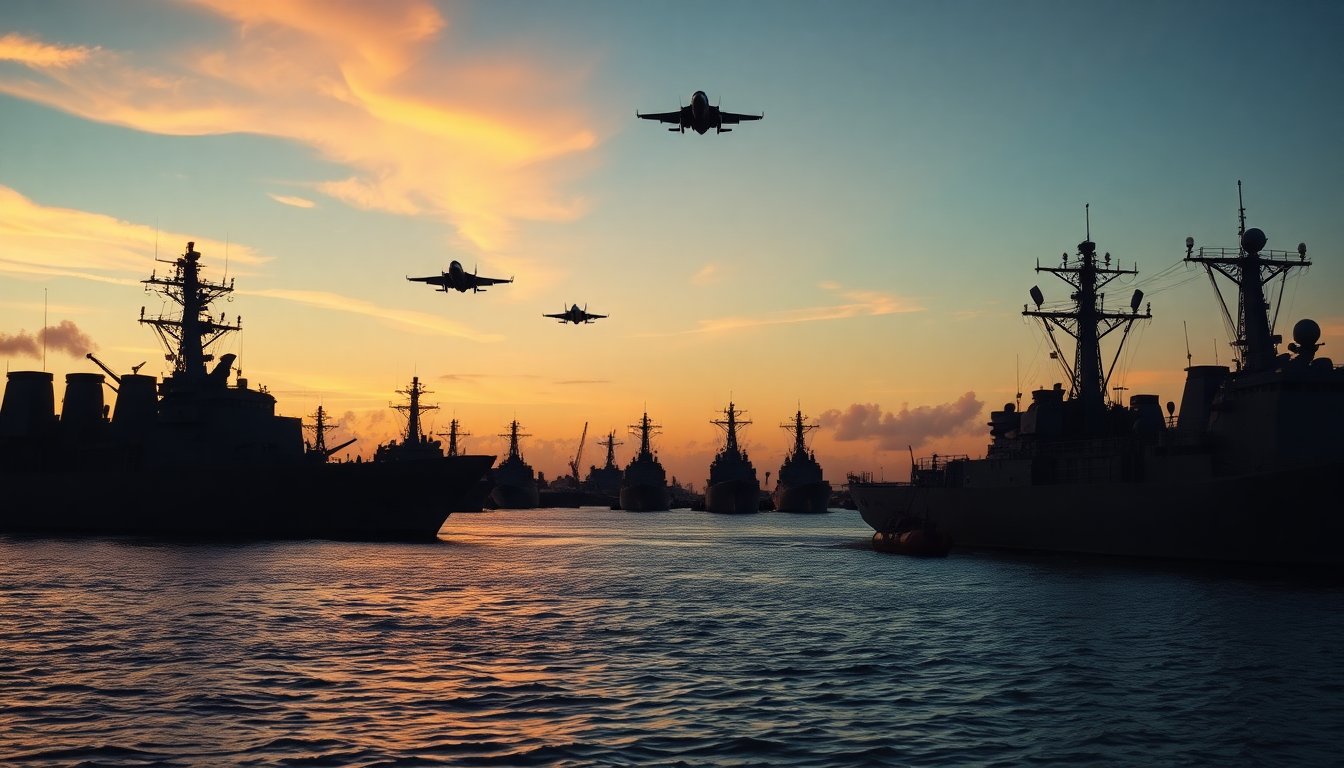
The United States has recently increased its military presence in the Caribbean, prompting speculation about its intentions toward Venezuela. This escalation includes a significant deployment of warships, aircraft, and covert operations. U.S. officials have highlighted the potential for targeted strikes against Venezuelan military assets alleged to be involved in drug trafficking. This buildup serves as a warning to President Nicolás Maduro, suggesting that his time in power may be coming to an end.
The current military maneuvers represent the largest U.S. military effort in decades. Advanced fighter jets and bombers, including B-52s, have been conducting demonstrations off the Venezuelan coastline. Additionally, the deployment of the USS Gerald R Ford, the largest aircraft carrier in the world, significantly enhances the U.S. military’s capabilities in the region.
Strategic military operations and objectives
Over the past months, the U.S. has mobilized various military assets, including drones and surveillance planes, to establish a commanding presence in the Caribbean. This extensive operation has raised concerns among observers, many of whom question whether the U.S. objective of combating drug trafficking masks a broader agenda focused on regime change in Venezuela. Some view the military buildup as a tactic to intimidate the Venezuelan military and encourage dissent against Maduro’s government.
Military tactics and their implications
Recent reports suggest that the U.S. has conducted airstrikes against vessels allegedly linked to drug trafficking, claiming to have eliminated numerous narco-terrorists. However, these actions have drawn criticism from various regional leaders, who argue that the legality and justification of such strikes are debatable. Observers contend that the military presence indicates a strategic intimidation campaign rather than a genuine commitment to combat drug-related crimes.
Dr. Christopher Sabatini, a senior fellow at Chatham House, emphasizes that the primary objective of the U.S. military appears to be signaling to the Venezuelan military that a change in leadership is both possible and necessary. While the focus on regime change is not explicitly stated, it has become increasingly evident through the rhetoric of U.S. officials.
Challenges to regime change
Despite intensified military actions and vocal opposition to Maduro from the U.S. government, achieving successful regime change poses significant challenges. The announcement of a $50 million bounty for information leading to Maduro’s capture has not produced notable results, as many within his inner circle remain loyal, driven by the substantial wealth derived from Venezuela’s oil-rich economy.
Political analysts suggest that the allegiance of the Venezuelan military is crucial for any potential regime change. However, military leaders would likely require guarantees of immunity from prosecution for their past actions to consider turning against Maduro. The widespread corruption within the Venezuelan elite complicates this scenario, as many individuals are deeply entrenched in illicit activities.
Context of U.S.-Venezuela relations
The backdrop of U.S.-Venezuela relations is characterized by historical tensions and mutual accusations. The U.S. has not recognized Maduro’s government following the recent elections, which faced widespread criticism for lacking fairness and transparency. Reports from the U.S. Justice Department have accused Maduro of leading a drug trafficking organization, a claim he fiercely denies. Furthermore, the U.S. government’s narrative often emphasizes the need to combat not only drug trafficking but also broader implications of Venezuelan governance as a criminal regime.
The growing U.S. military presence in the Caribbean raises significant questions about the true intentions behind these deployments. While drug trafficking remains a central theme, the underlying goal of influencing Venezuela’s political landscape cannot be overlooked. The effectiveness of this strategy in prompting change within the Venezuelan military and ultimately leading to a shift in leadership remains uncertain.
“`


