
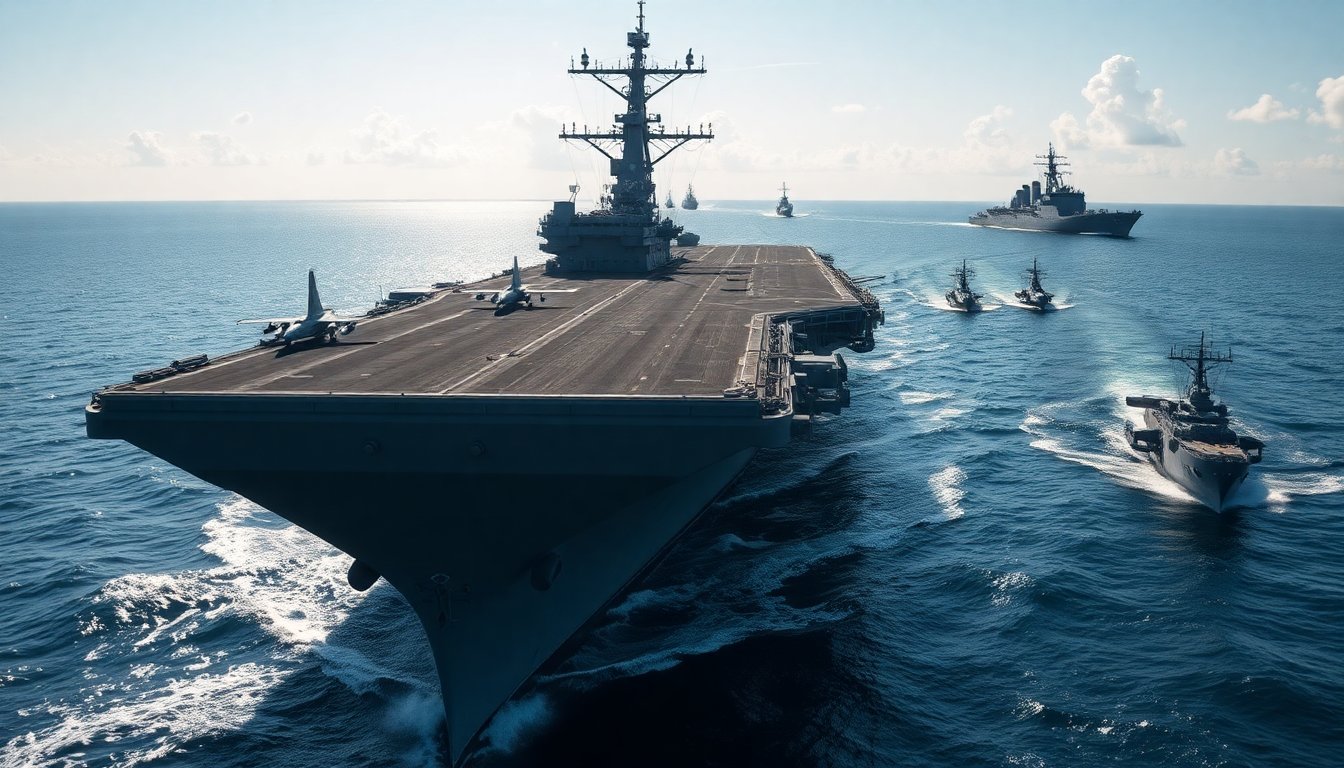
The White House has ordered a second U.S. carrier strike group to the Middle East, sending the USS Gerald R. Ford from the Caribbean to join the USS Abraham Lincoln and its escorts already on station. Officials say the deployment comes as Washington pursues indirect talks with Tehran while simultaneously tightening pressure on Iran — a dual-track approach that blends diplomacy with a show of force.
Why another carrier?
U.S. leaders describe the move as both deterrent and insurance: a highly visible, reversible capability meant to discourage escalation and to ensure military options remain available if negotiations break down. The decision follows a string of incidents at sea — involving commercial and military vessels — that have sharpened regional nerves and prompted warnings from neighboring governments about the risk of a wider confrontation.
What the strike group adds
A carrier strike group is more than a single ship. It brings the carrier itself, escorting destroyers and supply ships, plus a carrier air wing of strike and surveillance aircraft. Those assets let commanders fly sorties, interdict shipping, gather intelligence and operate without relying on host-nation bases. With the Ford joining the Abraham Lincoln, U.S. military sources say fixed-wing sortie rates and munitions stocks in the region will roughly double and theater manpower will increase by more than 5,000 personnel.
How it will operate — and the risks
Planners emphasize the posture is scalable: ships can be repositioned, aircraft reassigned, and logistics adjusted to match the diplomatic climate. Routine operations will include patrols, flight operations, intelligence collection and, where possible, exercises with partner navies. Electronic-intelligence platforms and surveillance flights will monitor key sea lanes and regional movements, while maritime deconfliction procedures aim to reduce accidental clashes. Still, close-in naval operations raise the prospect of miscalculation. A larger presence can deter adversaries — but it can also be perceived as coercive, complicating diplomacy and increasing the chance of unintended incidents.
Logistics and sustainment
Moving the Ford from the Caribbean to the Arabian Sea is a marathon, not a sprint. Sustaining carrier air wings requires steady resupply of fuel, ordnance and maintenance support from replenishment ships and forward logistics nodes. Extended deployments strain both crews and systems: maintenance windows shrink, personnel rotations compress, and long-term readiness can suffer if deployments pile up.
Strategic purpose and regional context
Officials argue the deployment gives commanders more options and reassures allies worried about maritime security. Navy leaders say the ability to shift forces quickly can unsettle adversary planning and lend credibility to diplomatic pressure. At the same time, U.S. partners such as Israel are pushing for tighter limits on Iran’s ballistic missile capabilities and on its backing for proxy groups — concerns that are shaping coordinated diplomatic and security moves among allied capitals.
The administration frames the second carrier as leverage in talks with Tehran: a contingency that keeps military choices on the table if diplomacy falters. Whether that posture calms tensions or risks amplifying them will depend on how carefully naval operations are managed and how both sides calibrate their next moves.