
Table of Contents
Destruction of memorial plaque highlights ongoing battle for free speech
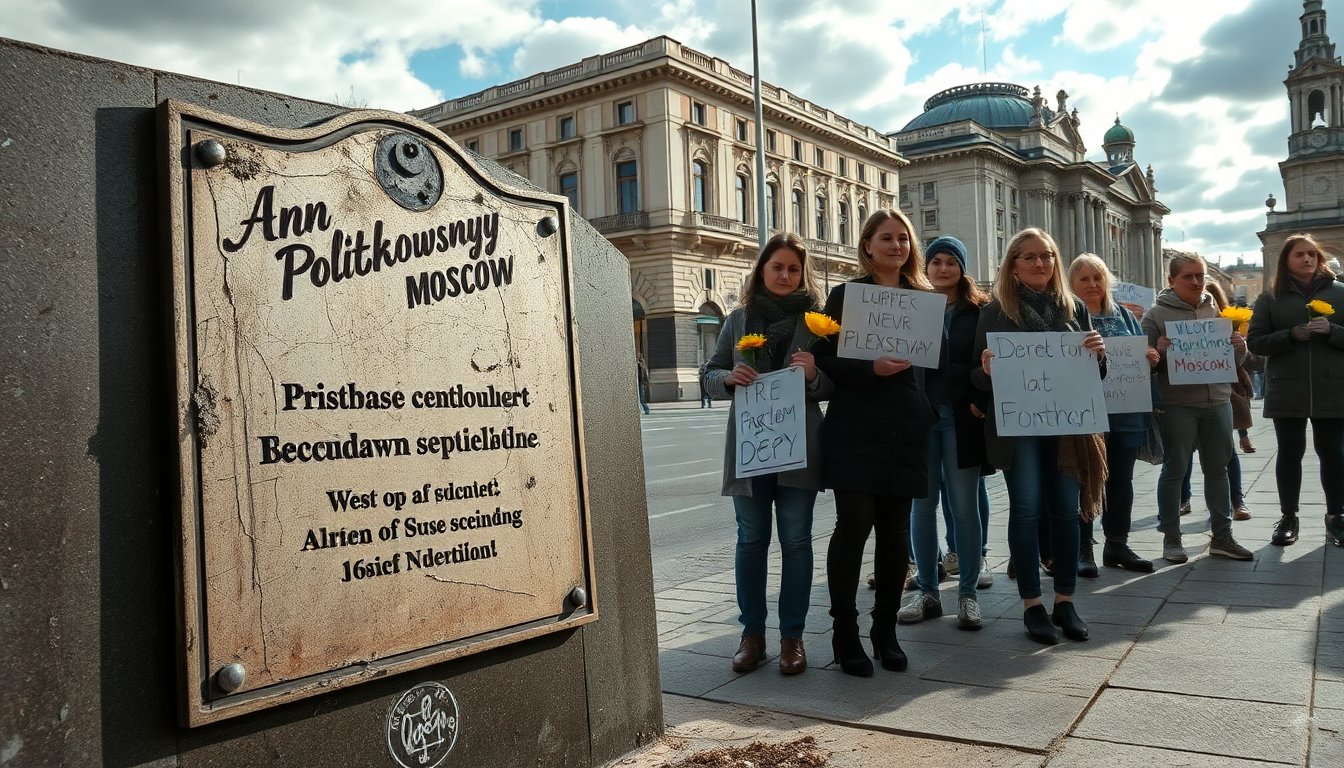
The memorial plaque honoring journalist Anna Politkovskaya has been subjected to a series of destructive acts in Moscow. This trend reflects a troubling increase in aggression against symbols of free speech. Politkovskaya, renowned for her courageous reporting on the atrocities in Chechnya, was assassinated in 2006. Since then, her legacy has faced both homage and hostility. In a particularly alarming incident, this plaque has been torn down five times within a single week. This situation underscores the persistent conflict between those who aim to celebrate her memory and those who attempt to erase it.
Vandalism incidents and community response
The recent act of vandalism occurred shortly before the anniversary of a tragic event involving human rights defenders. This incident underscores a troubling pattern of violence against individuals who challenge the status quo. Alexander Zamyatin, a former municipal deputy, reported that the memorial had been desecrated just days prior to a commemorative date honoring the lives of Stanislav Markelov and Anastasia Baburova. Both were murdered in 2009 by extremist groups, highlighting the ongoing risks faced by those advocating for justice and human rights.
Neo-Nazi involvement
In the aftermath of the vandalism incident, a post surfaced on a closed Telegram channel linked to the Russian neo-Nazi group National Socialism/White Power (NS/WP). The group claimed responsibility for the act, framing it as a tribute to their predecessors in the violent BORN organization. This acknowledgment by a far-right group highlights the alarming convergence of political extremism and the targeting of journalists.
Legal consequences and ongoing vandalism
In response to the recent vandalism, a court in Moscow identified Alexander Filippov as the individual responsible for the initial destruction. He was fined 1,000 rubles, roughly $13, for what was classified as petty hooliganism. Filippov, however, contended that the plaque fell and broke on its own while he was clearing flowers beneath it. This explanation was met with skepticism, as many, including the editorial team at Novaya Gazeta, speculated that the attacks were orchestrated by a group with clear neo-Nazi affiliations rather than being the actions of a solitary individual.
Temporary replacements fall victim
Activists from the Civic Initiative group have demonstrated resilience by attempting to replace the destroyed plaques with temporary versions. However, these replacements have also been targeted. Each time a new plaque is installed, it is removed within hours. Notably, one cardboard version disappeared less than a day after being affixed to the building. While the tenacity of the activists is commendable, this situation raises significant concerns about the safety and effectiveness of memorializing victims of political violence in such a hostile environment.
Commemoration and the fight for justice
The community continues to confront repeated acts of vandalism, while the memory of Anna Politkovskaya fuels ongoing discussions about freedom of speech and the threats journalists face in oppressive regimes. Politkovskaya’s murder remains unresolved, with the true masterminds behind the conspiracy still unaccounted for. Current memorialization efforts highlight that the pursuit of justice and recognition persists.
This year marks the 19th anniversary of Politkovskaya’s death. Although some individuals linked to the case have been released from prison, the search for those who orchestrated the crime continues. The public’s resolve to honor her legacy is evident through the flowers placed at her grave and the memorials held in her name, symbolizing a collective commitment to remember her, even amid adversity.
Looking forward to October, which marks two decades since her assassination, it is essential to reflect on the legacy of a brave journalist and the broader significance of her story in the ongoing struggle for human rights and journalistic integrity. The narrative surrounding her memorial highlights both the vulnerability of freedom and the determination of those who advocate for it.